EUR/USD drops on strong US jobs data; Fed’s Daly leans dovish
- EUR/USD tumbles below 1.1700 as US initial Jobless Claims beat forecasts.
- Fed minutes show internal split, with most members cautious on rate cuts.
- Trump’s Brazil tariffs spark retaliation threats from President Lula.

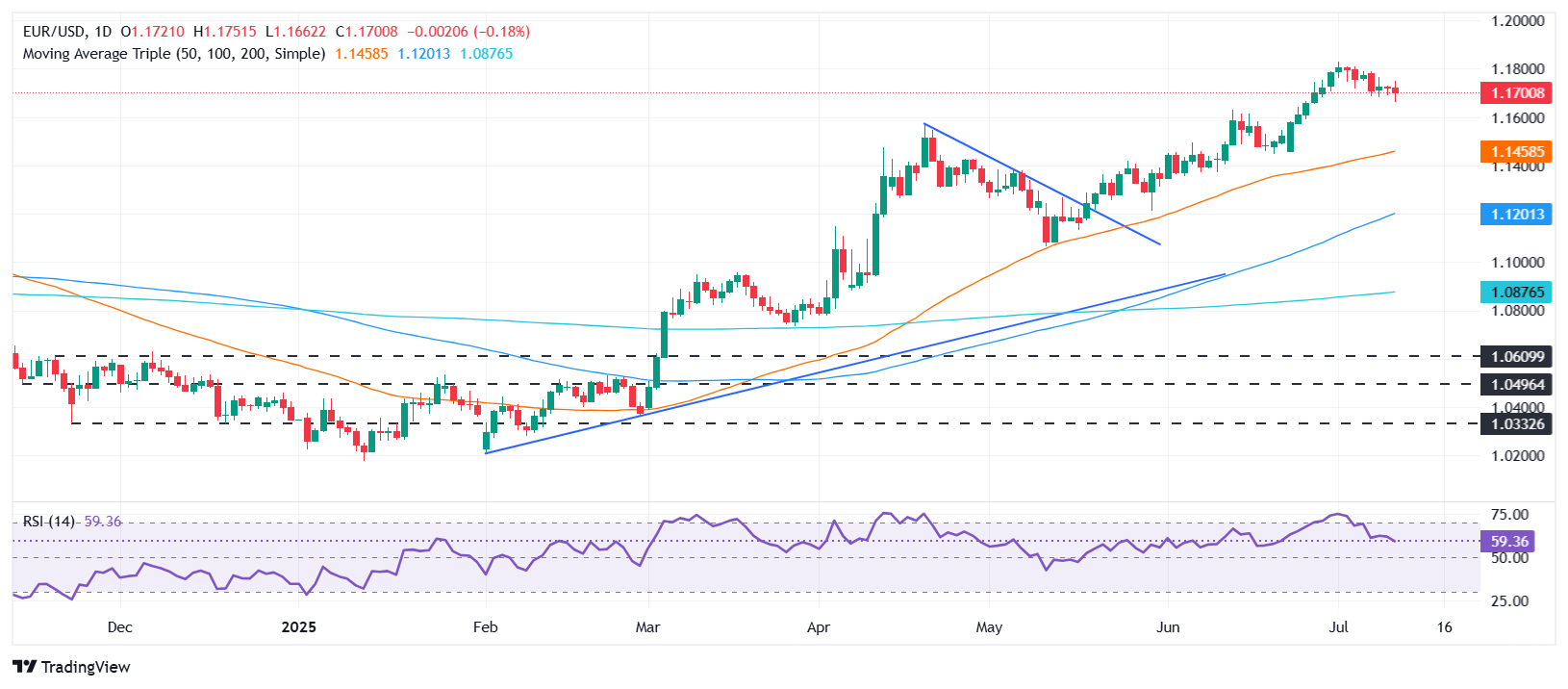
EUR/USD slides during the North American session, down over 0.23%, as market participants digest a jobs report in the United States that reinforces the Federal Reserve's case for holding rates unchanged at the upcoming July meeting. At the time of writing, the pair trades at 1.1695 after peaking at 1.1749.
Wall Street finished Thursday’s session with gains as traders assessed the current job market situation in the US. Initial Jobless Claims for the past week came in below estimates and the previous print, signaling some strength. Nevertheless, Continuing Claims had risen to its highest level since 2022.
On Wednesday, the Fed released its latest minutes, which revealed some divergence among its members. Although two of the Governors are eyeing a rate cut at the July 30 meeting, the majority had penciled just one, warning that tariffs could trigger a jump in inflation.
Recently, St. Louis Fed President Alberto Musalem advocated for waiting to cut rates as they assess incoming data. Contrarily, San Francisco Fed President Mary Daly added her name to a group of doves, saying that she favors two rate cuts, saying that tariffs would impact modestly.
Regarding trade news, US President Donald Trump's decision to impose 50% duties on Brazil sparked a reaction by its President Lula Da Silva, who threatened to retaliate against the US.
Across the pond, Germany revealed that inflation remains well-contained within the 2% target set by the Bundesbank and the European Central Bank (ECB).
Ahead in the week, the US economic docket will feature speeches by Fed officials. In the European Union (EU), ECB officials would cross the wires, along with the release of France inflation data.
Daily digest market movers: EUR/USD cracks below 1.1700 on solid jobless claims report
- US Initial Jobless Claims for the past week showed that 227K Americans filed for unemployment benefits, below estimates and the previous print of 235K and 232K, respectively. Nevertheless, Continuing Claims rose to its highest level in three and a half years, up to 1.97 million in the previous week.
- Lately, Fed Chair Jerome Powell pointed out that in the current low-hiring and low-firing environment, any increase in layoffs could rapidly push up the unemployment rate.
- Fed Governor Christopher Waller reiterated that a July cut is possible, saying that policy is "too tight and we could consider cutting the policy rate in July.”
- St. Louis Fed President Alberto Musalem stated that the US economy remains on solid footing, with the labor market at or near full employment. However, he cautioned that inflation risks are skewed to the upside, citing potential lagged effects from tariffs and warning that a weaker US Dollar could further amplify inflationary pressures.
- Federal Reserve Bank of San Francisco President Mary Daly said she still views two interest rate cuts as likely this year and sees a greater chance that the price effects from tariffs may be more muted than anticipated.
- Trump added that he could have been harsher on trade and announced that he would impose duties on pharmaceuticals, semiconductors, and copper, which he said would result in tariffs of around 50%.
- German Harmonized Inflation for Consumer Prices (HICP) rose by 2% YoY in June, as expected, unchanged compared to May figures.
Euro technical outlook: EUR/USD clings to 1.1700 as the pair consolidates
The EUR/USD hovers on top/below the 1.1700 figure after testing the 20-day Simple Moving Average (SMA) of 1.1663 earlier in the session. Nevertheless, it bounces back towards 1.1700, set to trade within the 1.1660-1.1749 range in the near term.
For a bullish resumption, the EUR/USD must clear the 1.1749 level. Once hurdled, the next resistance is 1.1800 and the year-to-date (YTD) high of 1.1829. On the other hand, the 20-day SMA serves as support at 1.1663. A decisive break clears the path to challenge the 1.1600 figure, followed by the 50-day SMA at 1.1464.
Euro FAQs
The Euro is the currency for the 19 European Union countries that belong to the Eurozone. It is the second most heavily traded currency in the world behind the US Dollar. In 2022, it accounted for 31% of all foreign exchange transactions, with an average daily turnover of over $2.2 trillion a day. EUR/USD is the most heavily traded currency pair in the world, accounting for an estimated 30% off all transactions, followed by EUR/JPY (4%), EUR/GBP (3%) and EUR/AUD (2%).
The European Central Bank (ECB) in Frankfurt, Germany, is the reserve bank for the Eurozone. The ECB sets interest rates and manages monetary policy. The ECB’s primary mandate is to maintain price stability, which means either controlling inflation or stimulating growth. Its primary tool is the raising or lowering of interest rates. Relatively high interest rates – or the expectation of higher rates – will usually benefit the Euro and vice versa. The ECB Governing Council makes monetary policy decisions at meetings held eight times a year. Decisions are made by heads of the Eurozone national banks and six permanent members, including the President of the ECB, Christine Lagarde.
Eurozone inflation data, measured by the Harmonized Index of Consumer Prices (HICP), is an important econometric for the Euro. If inflation rises more than expected, especially if above the ECB’s 2% target, it obliges the ECB to raise interest rates to bring it back under control. Relatively high interest rates compared to its counterparts will usually benefit the Euro, as it makes the region more attractive as a place for global investors to park their money.
Data releases gauge the health of the economy and can impact on the Euro. Indicators such as GDP, Manufacturing and Services PMIs, employment, and consumer sentiment surveys can all influence the direction of the single currency. A strong economy is good for the Euro. Not only does it attract more foreign investment but it may encourage the ECB to put up interest rates, which will directly strengthen the Euro. Otherwise, if economic data is weak, the Euro is likely to fall. Economic data for the four largest economies in the euro area (Germany, France, Italy and Spain) are especially significant, as they account for 75% of the Eurozone’s economy.
Another significant data release for the Euro is the Trade Balance. This indicator measures the difference between what a country earns from its exports and what it spends on imports over a given period. If a country produces highly sought after exports then its currency will gain in value purely from the extra demand created from foreign buyers seeking to purchase these goods. Therefore, a positive net Trade Balance strengthens a currency and vice versa for a negative balance.
Author

Christian Borjon Valencia
FXStreet
Markets analyst, news editor, and trading instructor with over 14 years of experience across FX, commodities, US equity indices, and global macro markets.