EUR/JPY retreats for second day as Yen strengthens, Euro weighed by softer growth revision
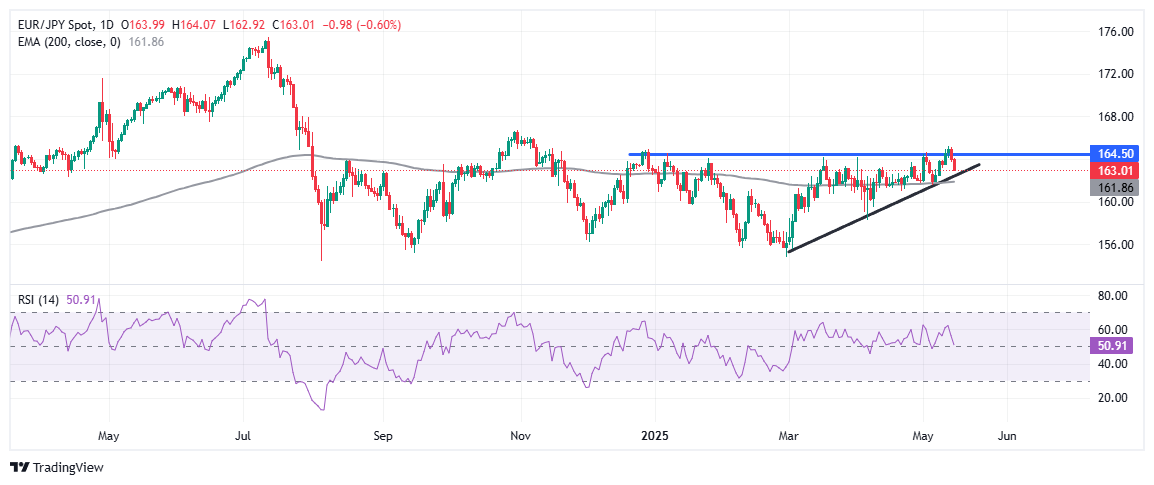
- EUR/JPY slides toward 163.00, testing key support from the ascending trendline and the 200-day EMA.
- The Euro remains under pressure after Q1 GDP was revised lower despite upbeat industrial output.
- Safe-haven flows boost the Yen amid cautious risk sentiment.

EUR/JPY extended its pullback for a second consecutive session on Thursday, falling 0.5% to trade around 163.00, with the Japanese Yen (JPY) gaining traction on safe-haven flows. The Euro (EUR) also came under pressure after Eurozone growth data showed signs of moderation, prompting traders to reassess the region’s near-term outlook.
The latest economic data showed the Eurozone economy grew by 0.3% in Q1, slightly below the preliminary estimate of 0.4%, though it still marked the sixth straight quarter of expansion. Annual growth held steady at 1.2%, while Industrial Production surprised to the upside with a 2.6% MoM jump in March. Despite the industrial beat, the softer Gross Domestic Product (GDP) print keeps pressure on the European Central Bank (ECB) to maintain a dovish stance, particularly as inflation continues to ease.
The Japanese Yen draws support from broader macroeconomic and geopolitical factors. Persistent global trade uncertainties pressured the US Dollar (USD), lifting other major currencies, including the Yen. A broader rally in Asian currencies was also underway, driven by speculation that the US administration is favoring a weaker Dollar to rebalance trade flows. Washington has repeatedly argued that undervalued Asian currencies offer an unfair advantage to regional exporters. Meanwhile, attention is turning to the US-Japan trade negotiations, with Tokyo aiming to secure a deal by June.
From a technical perspective, EUR/JPY is currently testing an ascending trendline from the March lows, converging with the 200-day Exponential Moving Average (EMA) at 161.86. This zone remains a key area of support. The broader structure remains intact as long as this level holds, with buyers likely to step in on dips. A sustained break below the trendline-EMA confluence would signal potential for further downside toward 160.50.
The Relative Strength Index (RSI) has eased to 50.9, hovering in neutral territory and suggesting a pause in bullish momentum rather than a full trend reversal. On the upside, 164.50 continues to cap gains, and a breakout above this level is required to resume the bullish bias.EUR/JPY remains at a critical juncture, with the 162.00–161.85 zone acting as a key technical pivot. A bounce could trigger fresh bullish momentum, but a break lower would shift the near-term bias in favor of the Yen.
Author

Vishal Chaturvedi
FXStreet
I am a macro-focused research analyst with over four years of experience covering forex and commodities market. I enjoy breaking down complex economic trends and turning them into clear, actionable insights that help traders stay ahead of the curve.