EUR/JPY Price Forecast: Remains capped below the 100-day EMA near 159.50
- EUR/JPY weakens to near 159.40 in Friday’s early European session.
- The negative view of the cross remains intact, but further consolidation cannot be ruled out.
- The first downside target to watch is 159.12; the immediate resistance level emerges at 160.70.

The EUR/JPY cross loses traction to around 159.40 during the early European session on Friday. The uncertainty and risk-off sentiment in the markets boost the safe-haven flows, benefiting the Japanese Yen (JPY). Investors await the release of the Eurozone Gross Domestic Product (GDP) for the fourth quarter, which is due later on Friday.
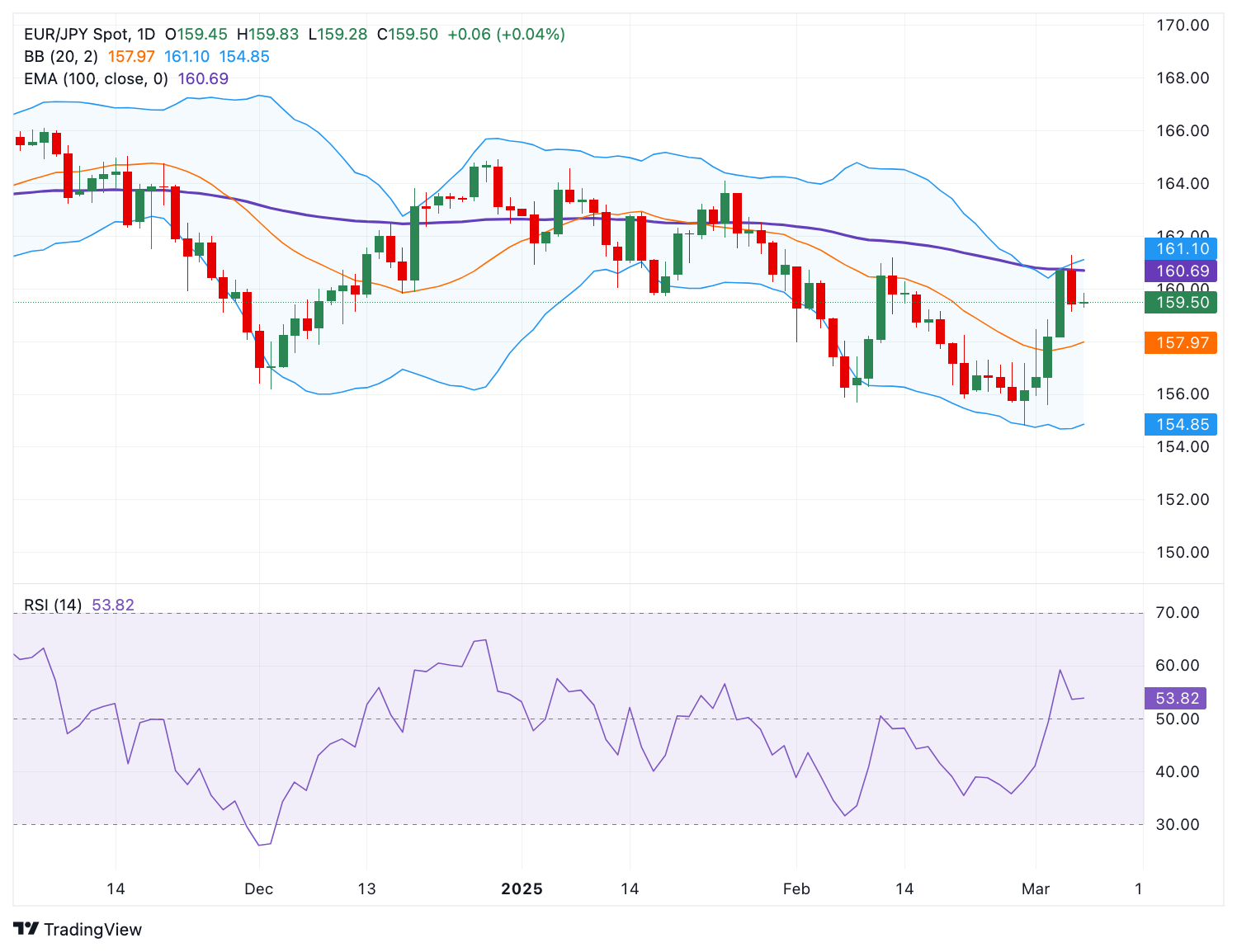
Technically, EUR/JPY keeps the bearish vibe on the daily chart as the index remains capped below the key 100-day Exponential Moving Average (EMA). Nonetheless, further consolidation cannot be ruled out as the 14-day Relative Strength Index (RSI) hovers around the 50-midline near 54.0, suggesting neutral momentum in the near term.
The initial support level for the cross emerges at 159.12, the low of March 6. Any follow-through selling below this level could expose 156.18, the low of December 3, 2024. The crucial contention level to watch is the 154.85-154.80 zone, representing the lower limit of the Bollinger Band and the low of February 28.
On the bright side, the first upside barrier is located at 160.70, the 100-day EMA. Extended gains could pave the way to the 161.00-161.10 region, representing the psychological level and the upper boundary of the Bollinger Band. The next hurdle is seen at 162.80, the high of January 14.
EUR/JPY daily chart
Japanese Yen FAQs
The Japanese Yen (JPY) is one of the world’s most traded currencies. Its value is broadly determined by the performance of the Japanese economy, but more specifically by the Bank of Japan’s policy, the differential between Japanese and US bond yields, or risk sentiment among traders, among other factors.
One of the Bank of Japan’s mandates is currency control, so its moves are key for the Yen. The BoJ has directly intervened in currency markets sometimes, generally to lower the value of the Yen, although it refrains from doing it often due to political concerns of its main trading partners. The BoJ ultra-loose monetary policy between 2013 and 2024 caused the Yen to depreciate against its main currency peers due to an increasing policy divergence between the Bank of Japan and other main central banks. More recently, the gradually unwinding of this ultra-loose policy has given some support to the Yen.
Over the last decade, the BoJ’s stance of sticking to ultra-loose monetary policy has led to a widening policy divergence with other central banks, particularly with the US Federal Reserve. This supported a widening of the differential between the 10-year US and Japanese bonds, which favored the US Dollar against the Japanese Yen. The BoJ decision in 2024 to gradually abandon the ultra-loose policy, coupled with interest-rate cuts in other major central banks, is narrowing this differential.
The Japanese Yen is often seen as a safe-haven investment. This means that in times of market stress, investors are more likely to put their money in the Japanese currency due to its supposed reliability and stability. Turbulent times are likely to strengthen the Yen’s value against other currencies seen as more risky to invest in.
Author

Lallalit Srijandorn
FXStreet
Lallalit Srijandorn is a Parisian at heart. She has lived in France since 2019 and now becomes a digital entrepreneur based in Paris and Bangkok.

















