|

EUR/JPY Price Analysis: Climbs above 164.00 with bulls eyeing YTD high

  • EUR/JPY breaks above Tenkan-Sen, eyes 165.00 potential.
  • Holding above 164.00 may lead to testing yearly highs.
  • Bears aim below 164.00 for reversal; Tenkan-Sen, Kijun-Sen as supports.

The Euro posted solid gains against the Japanese Yen (JPY) on Wednesday, amid an improvement in risk appetite and the dovish stance adopted by the Bank of Japan (BoJ) despite rising interest rates. At the time of writing, the EUR/JPY trades at 164.25, up 0.67%.

EUR/JPY Price Analysis: Technical outlook

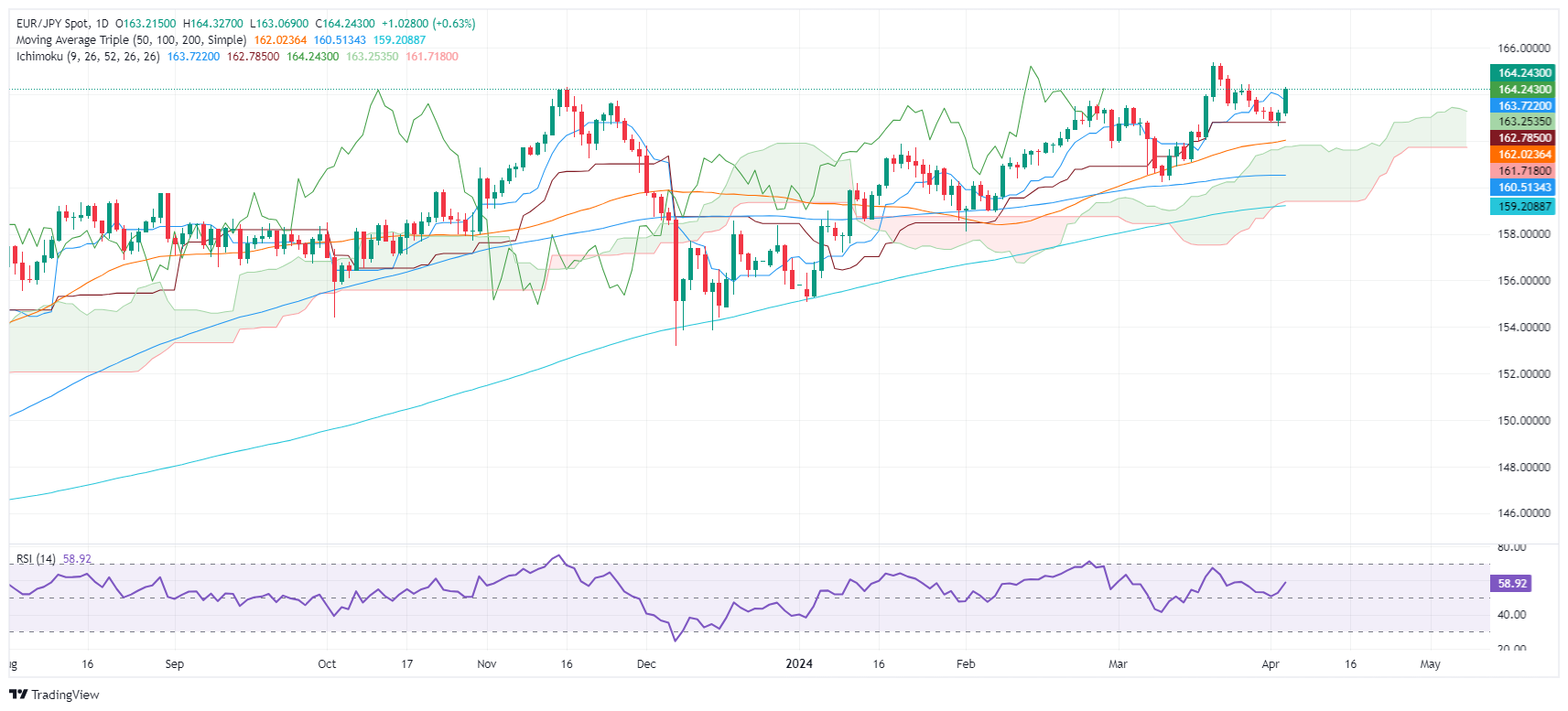
Euro bulls re-entered the market, lifting the EUR/JPY pair above the Tenkan-Sen a 163.71, which opened the door to reclaim the 164.00 mark. That suggests that buyers are gathering steam, which would open the door to challenge the 165.00 mark. A breach of the latter will expose the year-to-date (YTD) high of 165.34.

On the flip side, sellers must drag prices below 164.00 to challenge the new Tenkan-Sen level at 163.71, the next support level. Once surpassed, traders could test the Senkou Span Aat 163.25, followed by the Kijun-Sen level at 162.78.

EUR/JPY Price Action – Daily Chart
EUR/JPY

Overview
Today last price164.27
Today Daily Change1.05
Today Daily Change %0.64
Today daily open163.22
 
Trends
Daily SMA20162.86
Daily SMA50161.95
Daily SMA100160.51
Daily SMA200159.18
 
Levels
Previous Daily High163.34
Previous Daily Low162.61
Previous Weekly High164.42
Previous Weekly Low162.94
Previous Monthly High165.36
Previous Monthly Low160.22
Daily Fibonacci 38.2%163.06
Daily Fibonacci 61.8%162.89
Daily Pivot Point S1162.77
Daily Pivot Point S2162.33
Daily Pivot Point S3162.05
Daily Pivot Point R1163.5
Daily Pivot Point R2163.78
Daily Pivot Point R3164.22

Author

Christian Borjon Valencia

Markets analyst, news editor, and trading instructor with over 14 years of experience across FX, commodities, US equity indices, and global macro markets.


More from Christian Borjon Valencia
Share:

Editor's Picks

AUD/USD flirts with 0.7000, lowest since early August amid bullish USD

AUD/USD hits a fresh low since early August during the Asian session on Friday and looks vulnerable near 0.7000 after breaking below the 200-day SMA overnight. Against the backdrop of the hawkish Fed, a two-day rally in oil prices revives inflation fears and continues to push US bond yields to multi-year highs. Adding to this, geopolitical risks lift the US Dollar to a two-month high, overshadowing RBA rate hike bets and weighing on the pair.

USD/JPY pulls back from three-week high after failing near 159.00

USD/JPY edges lower during the Asian session on Friday, stalling its recent strong move to a three-week high of 159.00 as Japanese Yen bears turn cautious amid intervention fears. Meanwhile, the US Dollar retains a strong bullish undertone as the Fed's hawkish outlook and oil-driven inflation fears continue to push US bond yields to multi-year peaks. Furthermore, the BoJ's dovish rate hike last week might cap JPY and support spot prices.

Gold eyes worst week in a month amid hawkish Fed outlook

Gold is extending Thursday’s late rebound from the weekly low of $4,244 into Asia on Friday, but remains below $4,300. The bullion is headed for its worst week in four weeks amid a hawkish US Federal Reserve outlook and deepening global bond rout.

Crypto exchange Bitget hacked for over $350 million
Cryptocurrency exchange Bitget has been hacked for over $351 million after attackers compromised a few of its hot wallets. The hack was first flagged across several onchain tools, which initially noted over $180 million in assets moving from a few of the exchange's wallets to unidentified addresses.
Treasury announces second oversized bond buyback as it tries to put a lid on yields

The Treasury Department will buy back another $6 billion in long-term Treasuries as it continues efforts to tamp down rising yields. Treasury Secretary Scott Bessent announced this second expanded buyback on Wednesday.

BoJ Recap: Not as hawkish as expected

The Bank of Japan (BoJ) raised its short-term interest-rate target to 1.25% from 1.00% in a 7-2 vote, marking another step in the normalisation of monetary policy and widely matching what everyone has been expecting for weeks.













