EUR/GBP Price Forecast: The pair finds resistance above 0.8700
- Euro bulls are rejected above 0.8700, and the Pound regains some ground on Wednesday.
- Upbeat UK S&P Global Services PMI data has provided some support to the GBP.
- EUR/GBP price action remains strapped within a broadening wedge pattern.

The Euro rally against the British Pound has been unable to confirm above the 0.8700 level, and the pair retreated during the European session on Wednesday, turning negative on the daily charts and reaching a low of 0.8685 at the time of writing.
The upward revision of August’s UK Services PMI has provided some support to the Sterling, offsetting market concern about the UK’s fiscal deficit. In the Eurozone, on the other hand, data has been mixed with services activity revised lower while factory prices beat expectations.
Technical Analysis: EUR/GBP remains trapped within an expanding wedge
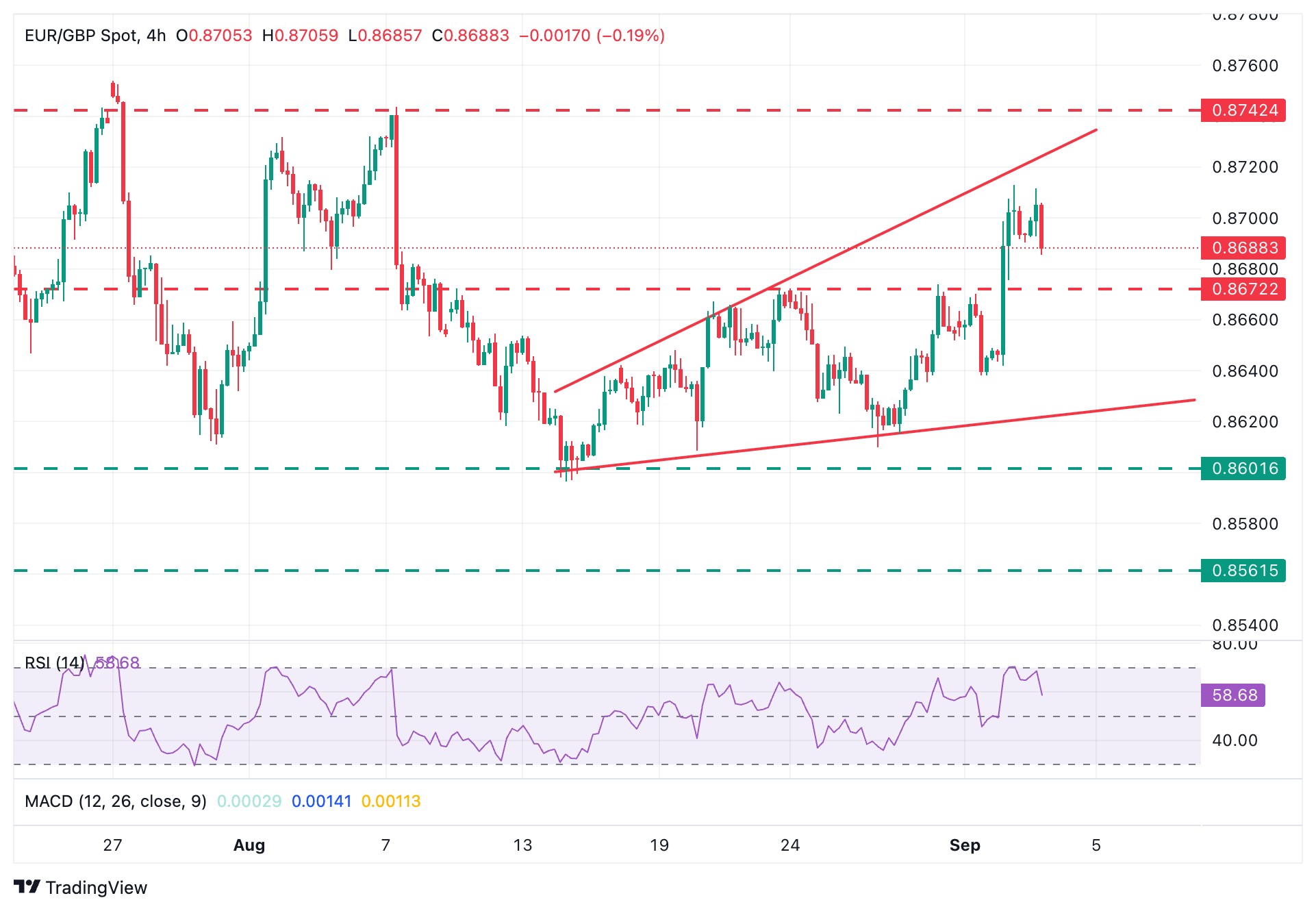
The EUR/GBP technical picture is showing faltering bullish momentum, with the pair trading inside a broadening pattern —a figure that often highlights an emotional market, often preceding significant moves.
Euro bulls have been capped at Tuesday’s high, near 0.8710, a few pips short of the wedge top, now at 0.8725. Further up, the August 7 high and July 23 highs at 0.8745 and 0.8755, respectively, would come into focus.
Immediate support is at the August 22 and 29 highs in the 0.8670 area, ahead of the September 1 low, at 0.8635 and the wedge bottom, now around 0.8320.
Economic Indicator
S&P Global Services PMI
The Services Purchasing Managers Index (PMI), released on a monthly basis by S&P Global, is a leading indicator gauging business activity in the UK’s services sector. Survey responses reflect the change, if any, in the current month compared to the previous month and can anticipate changing trends in official data series such as Gross Domestic Product (GDP), employment and inflation. The index varies between 0 and 100, with levels of 50.0 signaling no change over the previous month. A reading above 50 indicates that the services economy is generally expanding, a bullish sign for the Pound Sterling (GBP). Meanwhile, a reading below 50 signals that activity among service providers is generally declining, which is seen as bearish for GBP.
Read more.Last release: Wed Sep 03, 2025 08:30
Frequency: Monthly
Actual: 54.2
Consensus: 53.6
Previous: 53.6
Source: S&P Global
Economic Indicator
S&P Global Composite PMI
The Composite Purchasing Managers Index (PMI), released on a monthly basis by S&P Global, is a leading indicator gauging private-business activity in UK for both the manufacturing and services sectors. The data is derived from surveys to senior executives. Each response is weighted according to the size of the company and its contribution to total manufacturing or services output accounted for by the sub-sector to which that company belongs. Survey responses reflect the change, if any, in the current month compared to the previous month and can anticipate changing trends in official data series such as Gross Domestic Product (GDP), industrial production, employment and inflation.The index varies between 0 and 100, with levels of 50.0 signaling no change over the previous month. A reading above 50 indicates that the UK private economy is generally expanding, a bullish sign for the Pound Sterling (GBP). Meanwhile, a reading below 50 signals that activity is generally declining, which is seen as bearish for GBP.
Read more.Last release: Wed Sep 03, 2025 08:30
Frequency: Monthly
Actual: 53.5
Consensus: 53
Previous: 53
Source: S&P Global
Author

Guillermo Alcala
FXStreet
Graduated in Communication Sciences at the Universidad del Pais Vasco and Universiteit van Amsterdam, Guillermo has been working as financial news editor and copywriter in diverse Forex-related firms, like FXStreet and Kantox.