|

EUR/GBP Price Analysis: Pair holds neutral bias at the start of the week

  • EUR/GBP trades near the 0.85 area after slipping during Monday’s session.
  • Momentum indicators remain mixed, with shorter-term signals leaning bearish.
  • Key support rests near 0.8498, while resistance zones cluster around 0.8525.

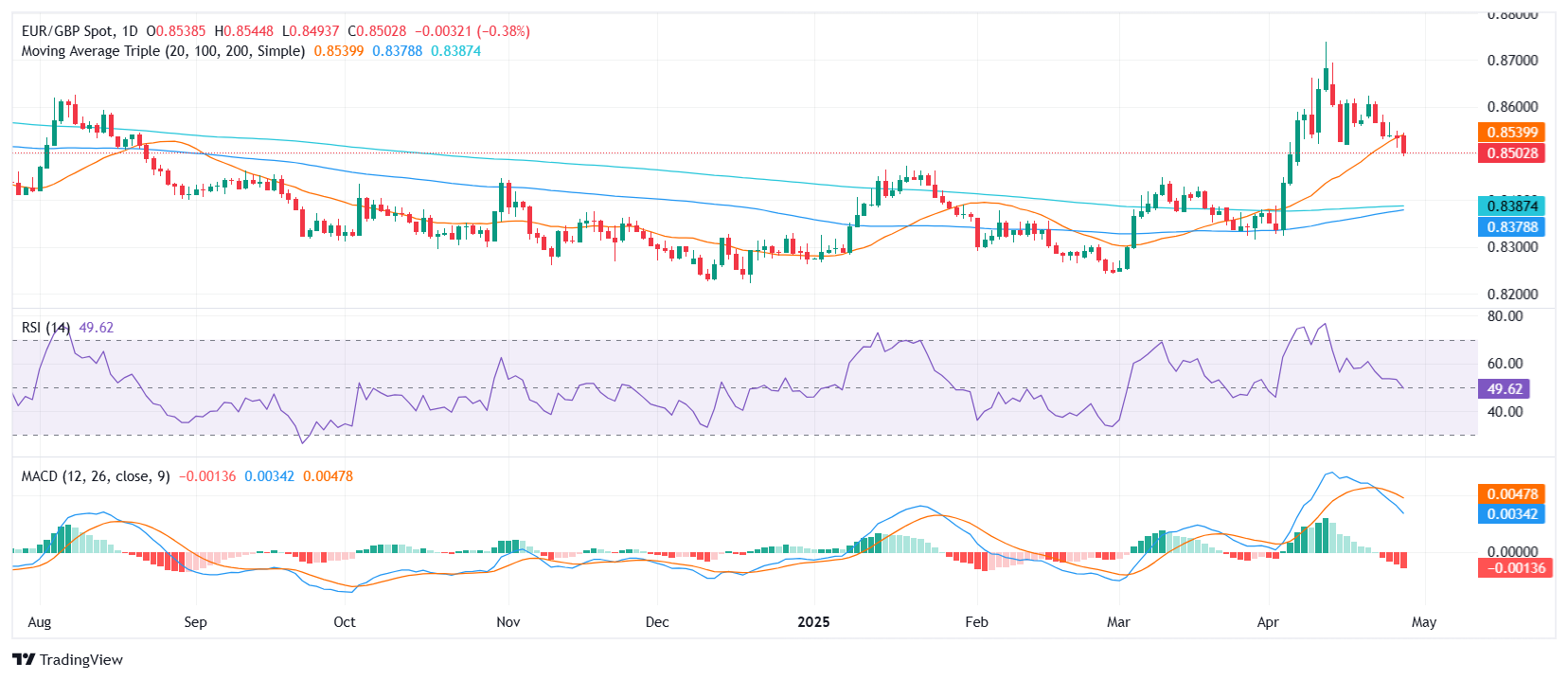
After Monday’s European session, the EUR/GBP pair was seen trading near the 0.85 zone, having moved lower earlier in the day. The pair slipped moderately and remains neutral overall, staying contained within today’s trading range. On the technical front, the Relative Strength Index (RSI) holds close to the 50 mark, showing neutrality, while the Moving Average Convergence Divergence (MACD) presents a sell signal. Other momentum indicators like the Williams Percent Range and the Ultimate Oscillator also display neutral stances. Meanwhile, a divergence between shorter and longer-term moving averages suggests some underlying uncertainty.

On the technical side, shorter-term pressure is evident, with the 20-day Simple Moving Average (SMA) near 0.8540 flashing a bearish signal as the pair trades beneath it. However, longer-term support persists, as both the 100-day SMA around 0.8379 and the 200-day SMA near 0.8389 continue to suggest a bullish trend over a broader horizon. The Ichimoku Base Line, flat around 0.8527, reinforces the neutral bias for now.

Support for EUR/GBP is located around the 0.8498 mark, followed by deeper cushions near 0.8482 and 0.8459. On the upside, resistance can be seen near 0.8515, with additional barriers at 0.8525 and 0.8527. Given the combination of a sell signal from the MACD and neutral readings from the Williams Percent Range and Ultimate Oscillator, the pair could remain in consolidation unless either buyers or sellers take stronger control in the next sessions.

Daily Chart
Author

Patricio Martín

Patricio is an economist from Argentina passionate about global finance and understanding the daily movements of the markets.


More from Patricio Martín
Share:

Markets move fast. We move first.

Orange Juice Newsletter brings you expert driven insights - not headlines. Every day on your inbox.

By subscribing you agree to our Terms and conditions.

Editor's Picks

EUR/USD rebounds after falling toward 1.1700

EUR/USD gains traction and trades above 1.1730 in the American session, looking to end the week virtually unchanged. The bullish opening in Wall Street makes it difficult for the US Dollar to preserve its recovery momentum and helps the pair rebound heading into the weekend.

GBP/USD steadies below 1.3400 as traders assess BoE policy outlook

Following Thursday's volatile session, GBP/USD moves sideways below 1.3400 on Friday. Investors reassess the Bank of England's policy oıtlook after the MPC decided to cut the interest rate by 25 bps by a slim margin. Meanwhile, the improving risk mood helps the pair hold its ground.

Gold stays below $4,350, looks to post small weekly gains

Gold struggles to gather recovery momentum and stays below $4,350 in the second half of the day on Friday, as the benchmark 10-year US Treasury bond yield edges higher. Nevertheless, the precious metal remains on track to end the week with modest gains as markets gear up for the holiday season.

Crypto Today: Bitcoin, Ethereum, XRP rebound amid bearish market conditions

Bitcoin (BTC) is edging higher, trading above $88,000 at the time of writing on Monday. Altcoins, including Ethereum (ETH) and Ripple (XRP), are following in BTC’s footsteps, experiencing relief rebounds following a volatile week.

How much can one month of soft inflation change the Fed’s mind?

One month of softer inflation data is rarely enough to shift Federal Reserve policy on its own, but in a market highly sensitive to every data point, even a single reading can reshape expectations. November’s inflation report offered a welcome sign of cooling price pressures. 

XRP rebounds amid ETF inflows and declining retail demand demand

XRP rebounds as bulls target a short-term breakout above $2.00 on Friday. XRP ETFs record the highest inflow since December 8, signaling growing institutional appetite.