|

EUR/GBP Price Analysis: Euro weakens near 0.8500 as short-term signals turn negative

  • EUR/GBP trades near the 0.8500 zone after declining through Thursday’s session.
  • Bearish bias prevails, confirmed by downside signals from momentum and short-term trend indicators.
  • Immediate support rests below, while key resistance aligns around recent moving averages.

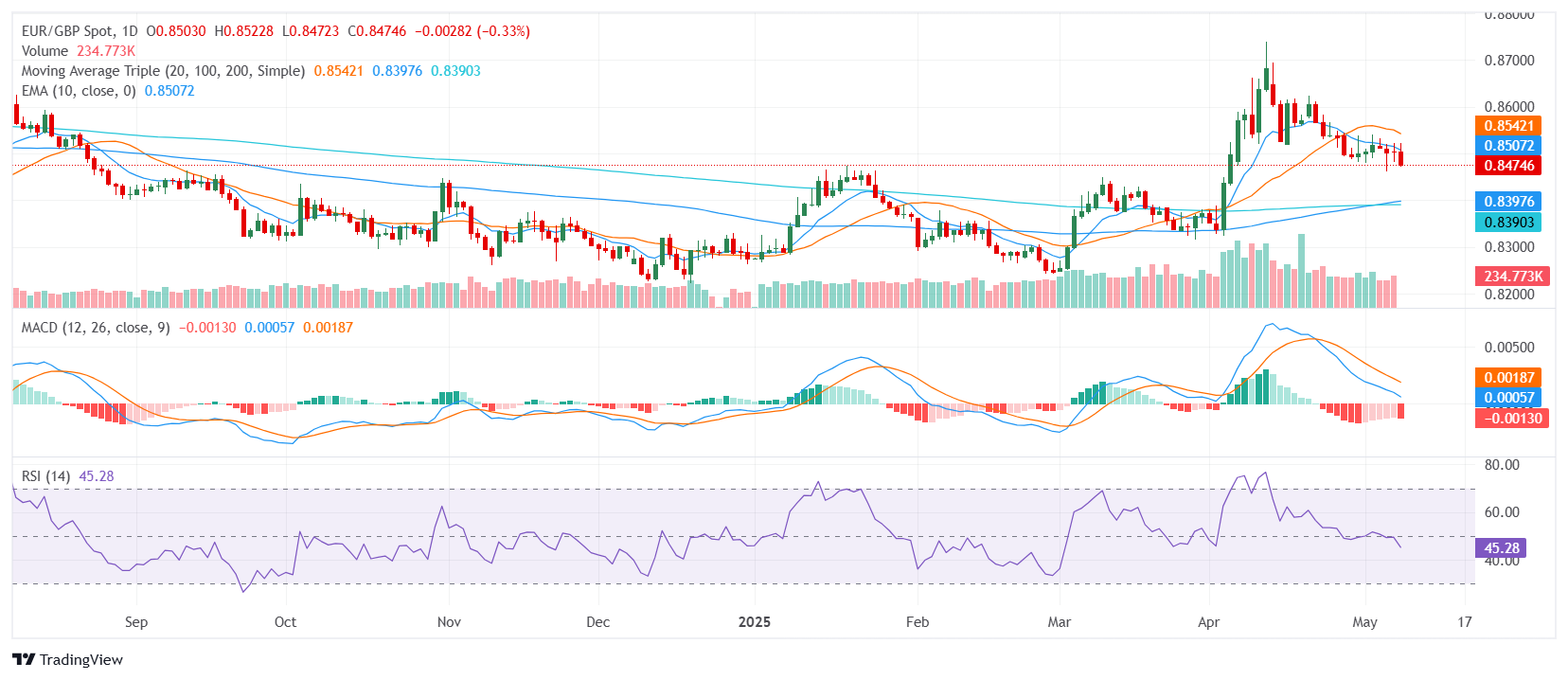
The EUR/GBP pair drifted lower on Thursday, trading near the 0.8500 zone after the European session and settling within the middle of the day’s range. The decline reflects growing bearish sentiment in the short term, with technical signals tilting to the downside. While the longer-term outlook remains supported by major moving averages, current momentum favors sellers heading into the next trading phase.

From a technical perspective, the bearish tone is underscored by several indicators. The Relative Strength Index holds a neutral stance near 46, but the Moving Average Convergence Divergence continues to show a sell signal, reinforcing the current downtrend. The 10-period Momentum is also negative, suggesting selling interest is gradually building. Meanwhile, the Average Directional Index shows weak trend strength, indicating that while pressure is present, it has yet to fully solidify.

The short-term trend structure confirms the bearish view. The 10-day Exponential and Simple Moving Averages are both trending downward above price, while the 20-day Simple Moving Average also reinforces resistance. On the other hand, the longer-term 100-day and 200-day Simple Moving Averages remain bullish, positioned well below and still sloping upward — suggesting broader structural support persists.

Support levels are found at 0.8470, 0.8457, and 0.8429. Resistance stands at 0.8498, 0.8499, and 0.8504. A breakdown below nearby support could expose the pair to a deeper correction, while a close above short-term resistance would be needed to challenge the prevailing bearish bias.

Daily Chart
Author

Patricio Martín

Patricio is an economist from Argentina passionate about global finance and understanding the daily movements of the markets.


More from Patricio Martín
Share:

Editor's Picks

AUD/USD stuck as the RBA talks tough into a slowdown

The Australian Dollar is going nowhere in a hurry, and the contradiction at its core explains why. The Reserve Bank of Australia keeps dangling the prospect of another hike, yet the economy it governs just expanded 0.3% in the first quarter, a clear step down from the prior pace. A central bank threatening to tighten into a visible slowdown is not a recipe for conviction in either direction, and the tape shows it.

USD/JPY: Japanese Yen coiled at the line, leaning on everyone but Japan

The Yen is doing very little, and that stasis is the whole story. USD/JPY sits glued near 160.00 not because Japan has found new strength, but because two outside forces are fighting to a draw over it: a US rate complex that keeps the dollar bid, and a Ministry of Finance that refuses to let the line break.

Gold declines below $4,500 on stalled US-Iran ceasefire talks, US NFP data looms

Gold price edges lower to near $4,470 during the early Asian session on Friday. The precious metal remains volatile amid ongoing geopolitical turmoil. Traders will closely monitor the developments surrounding the US-Iran peace deal and the US May employment report later on Friday. 


Bitcoin falls below $64K as demand turns negative, short-term holders' selling intensifies

Bitcoin has fallen below $64,000 on Thursday amid weakening market demand and mounting selling pressure from short-term holders. The leading cryptocurrency slipped toward the $63,000 level amid a broader risk-off environment, with several key metrics signaling one of the most challenging periods of the current market cycle.

Nonfarm payrolls: Testing the limits of Fed policy patience

The upcoming nonfarm payrolls report for May will provide the final update on the US labor market before Kevin Warsh attends his first policy meeting as the new Fed Chair later this month.

Recession on paper: What really moves the Canadian Loonie now?

Statistics Canada handed the headline writers a gift and the analysts a headache. Real GDP shrank 0.1% on an annualized basis in the first quarter, and with the fourth quarter of 2025 revised down to a 1.0% contraction, that is two negative quarters in a row, the textbook definition of a technical recession and Canada's first since the pandemic.