|

EUR/GBP mildly declines despite steady UK retail sales data

  • EUR/GBP marginally fell to 0.8530, tallying a two-day losing streak.
  • The cross declined despite the release of steady UK retail sales data during the European session.
  • The data favors that the BoE will continue cutting rates.

Friday's trading painted a slightly less vibrant picture for the EUR/GBP pair which slid to 0.8530 as investors are digesting mixed Retail Sales figures from the UK.

In July, UK retail sales showed signs of recovery, with total retail sales volume increasing by 0.5% month-on-month, slightly below expectations, but improving from a revised decline of 0.9% in June (previously reported as -1.2%). On a year-on-year basis, retail sales grew by 1.4%, matching expectations and up from a revised -0.3% in June (previously reported as -0.2%).

This increase in sales aligns with the improvement seen in the British Retail Consortium's same-store sales for July, signaling a strong start to the third quarter. Despite robust Q2 GDP figures, the June data indicated a slowdown as the quarter ended. Overall, the economic activity seems to be weak which might prompt the Bank of England to continue cutting.

EUR/GBP technical analysis

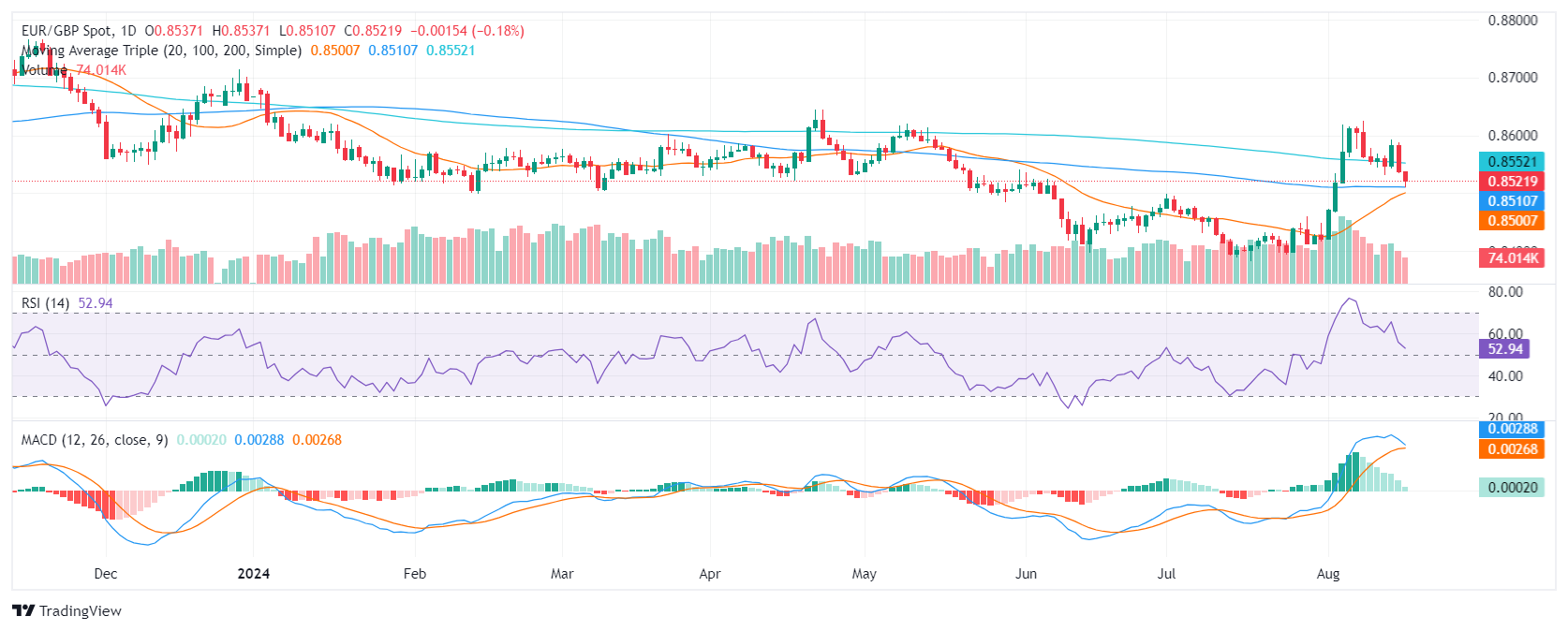
In the span of the last sessions, the EUR/GBP is primarily caught between the 200-day and 100-day Simple Moving Averages (SMAs) at 0.8550 and 0.8510 support and resistance levels respectively, and volume figures signify a gradually diminishing selling pressure. The fact that the bulls gave up the 200-day SMA on Thursday paints the outlook with bearishness.

At a technical level, the Relative Strength Index (RSI) of the pair is lingering around the mid-50s, indicating an equilibrium in market sentiment with neither the bulls nor the bears taking control but with a noticeable falling trend. The Moving Average Convergence Divergence (MACD) indicator is showing decreasing green bars, suggesting a possible downward momentum in future trading sessions.

EUR/GBP daily chart
Author

Patricio Martín

Patricio is an economist from Argentina passionate about global finance and understanding the daily movements of the markets.


More from Patricio Martín
Share:

Editor's Picks

GBP/USD gains traction above 1.3400 as markets bet on BoE rate hikes

The GBP/USD pair gathers strength to around 1.3430 during the Asian trading hours on Friday. The British Pound edges higher against the US Dollar on the UK government leadership transition and growing expectations of further Bank of England interest rate hikes.

EUR/USD nudges higher above 1.1400 as traders ramp up their bets on ECB hikes

The EUR/USD pair posts modest gains around 1.1430 during the early Asian session on Friday, bolstered by a softer US Dollar. The European Central Bank is grappling with elevated core inflation, forcing traders to price in more aggressive tightening despite mixed guidance from ECB officials. 


Gold hovers  below $4,150 amid subdued USD price action

Gold struggles to capitalize on the previous day's positive move, holding below $4,150 in the Asian session on Friday as traders await further developments surrounding the US-Iran saga. Less hawkish FOMC Minutes keep the US Dollar on the defensive and help cap any downside in the non-yielding yellow metal.


Stocks rise as chipmakers rally and Iran oil shock fears fade
Stocks found their footing because two different pressure valves opened at the same time. Oil eased as traders faded the worst-case Iran script, while chipmakers caught a separate gust of oxygen from inside the AI ecosystem itself. That distinction matters. Crude helped calm the macro room, but it was not the spark under semis.
Five sessions, one round trip: Why the whipsaw is exactly what Warsh ordered

Markets opened July with a December hike as the base case and spent five trading sessions unlearning and relearning it. A 57K payrolls print bled the tightening bets out of the strip; a re-shut Strait of Hormuz is pushing them back in. Wednesday's minutes from the June Federal Open Market Committee meeting landed mid-round-trip, describing a world that had already stopped existing.

Bye, forward guidance: How to trade when central banks choose silence

Central banks have spent years telling markets what might come next. Now, traders face the possibility that they say a lot less. From the Federal Reserve to the European Central Bank and the Bank of England, policymakers are pushing back against forward guidance.