EUR/GBP holds steady as EU-US trade deal and BoE comments drive sentiment
- EUR/GBP steadies above 0.8530 as traders monitor central bank policy and economic growth prospects.
- The Euro's strength hinges on the prospects of a trade deal between the European Union and the United States.
- The Bank of England remains cautious ahead of the August 1 rate decision.

The Euro (EUR) is holding steady against the British Pound (GBP) on Thursday as markets continue to monitor comments from central banks and economic resiliency.
At the time of writing, EUR/GBP is trading near 0.8533 as trade talks between the European Union (EU) and the United States (US) take focus.
Negotiations in Brussels are being closely watched by markets, especially with German Chancellor Friedrich Merz and European Commission President Ursula von der Leyen pushing for a breakthrough.
With markets digesting comments from Bank of England (BoE) Governor Andrew Bailey, the Euro is currently hinging on the prospects of a favourable trade deal with the US.
Bank of England Governor Bailey provides dovish comments for the upcoming policy decision
At a conference hosted by the British Chambers of Commerce, Bank of England Governor Andrew Bailey commented on current economic conditions in the United Kingdom.
One of his comments included that, "In recent months, the evidence that slack is opening up has strengthened, especially in the labour market."
These remarks reflect a dovish tone, adding to expectations that the BoE may continue to cut rates in the upcoming months.
However, earlier data showed a modest improvement in UK business activity, with the flash S&P Global Composite PMI rising to 50.7 in June, up from 50.3 in May. Released on Monday, the reading topped forecasts and highlighted the strongest services sector growth in three months, outpacing activity in both Germany and France
The European Union pushes for a trade deal with the United States
Meanwhile, for Europe’s largest economy, Germany, the focus remains on the prospects of a trade deal with the United States, which has placed immense pressure on the German economy.
On Thursday, the Growth from Knowledge released the latest Germany GfK Consumer Confidence Survey for July. The report, considered a leading economic indicator, showed that confidence in Germany is waning. Expectations were for the July reading to print at -19.3, which is already reflective of a diminishing confidence. Instead, the actual figures showed confidence for July falling to -20.3.
A major headwind for Germany and the European Union (EU) has been the tariffs imposed on global nations by the United States.
The high tariffs imposed by the US on “Liberation Day”, have placed immense pressure on countries that are reliant on exports of industrial goods. Currently, global trading partners are facing a 10% baseline tariff on all imports into the US, with a higher tariff on EU imports currently scheduled to take effect on July 9.
The EU is striving to reach an agreement with the US that is mutually beneficial. The ability to do so, or at least reduce the high tariffs currently imposed on steel, aliminium and autoparts, may provide some relief to the European economy.
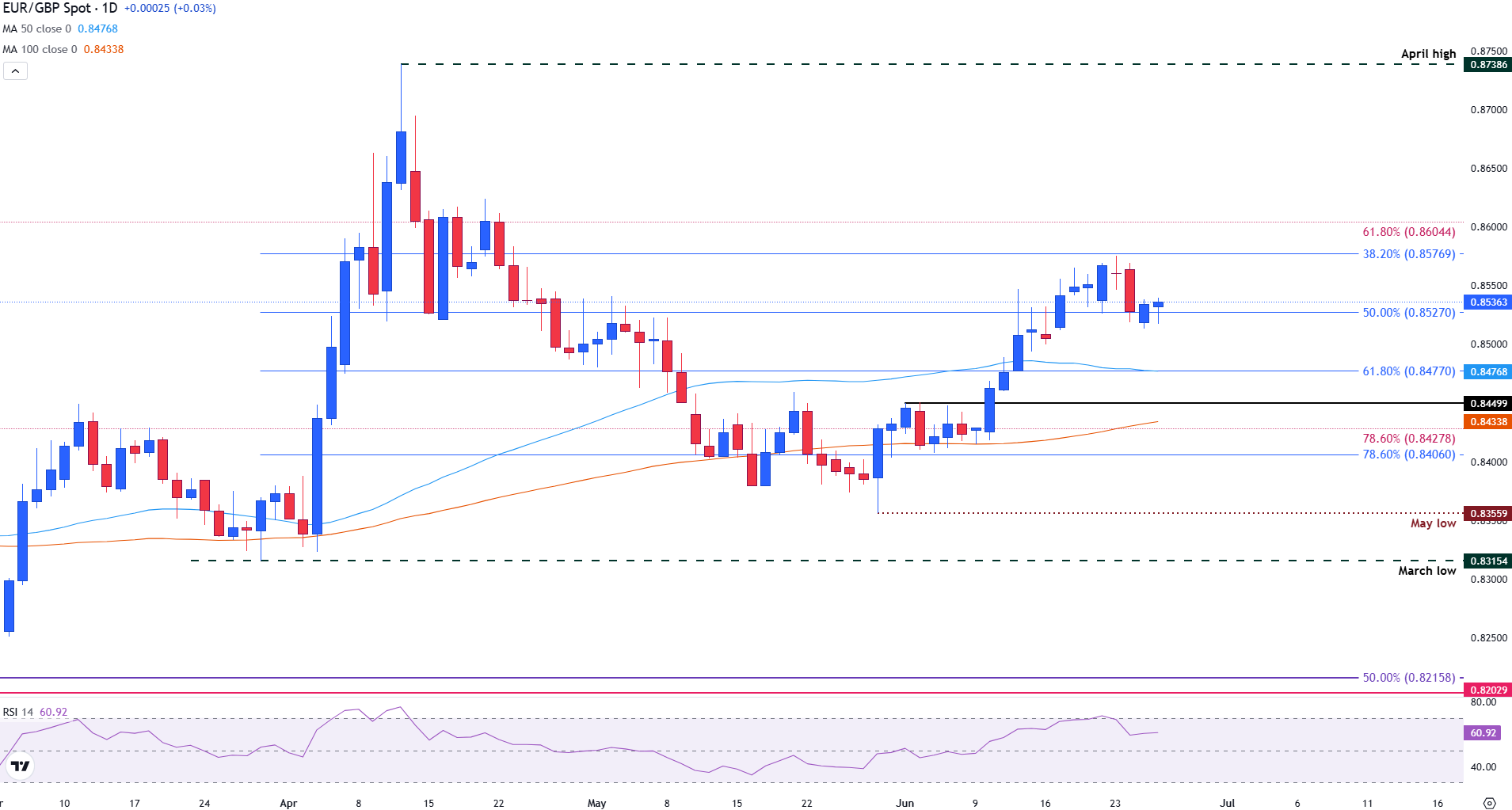
EUR/GBP pauses for direction above 0.8530
The EUR/GBP daily chart shows price consolidating near the 50.0% Fibonacci retracement level of the March–April rally, currently at 0.8527.
This level marks a key midpoint of the recent bullish leg and is providing near-term directional context. The pair remains supported above the 50-day Simple Moving Average (SMA) at 0.8477, with the 100-day SMA at 0.8433 also in view.
Upside targets remain at the 61.8% retracement level (0.86044) and the April high at 0.8738, while downside risks could accelerate if the pair falls below 0.8518, exposing 0.8477 and 0.8433.
Momentum remains slightly bullish, with the Relative Strength Index (RSI) at 60, just shy of overbought territory.
EUR/GBP daily chart
Tariffs FAQs
Tariffs are customs duties levied on certain merchandise imports or a category of products. Tariffs are designed to help local producers and manufacturers be more competitive in the market by providing a price advantage over similar goods that can be imported. Tariffs are widely used as tools of protectionism, along with trade barriers and import quotas.
Although tariffs and taxes both generate government revenue to fund public goods and services, they have several distinctions. Tariffs are prepaid at the port of entry, while taxes are paid at the time of purchase. Taxes are imposed on individual taxpayers and businesses, while tariffs are paid by importers.
There are two schools of thought among economists regarding the usage of tariffs. While some argue that tariffs are necessary to protect domestic industries and address trade imbalances, others see them as a harmful tool that could potentially drive prices higher over the long term and lead to a damaging trade war by encouraging tit-for-tat tariffs.
During the run-up to the presidential election in November 2024, Donald Trump made it clear that he intends to use tariffs to support the US economy and American producers. In 2024, Mexico, China and Canada accounted for 42% of total US imports. In this period, Mexico stood out as the top exporter with $466.6 billion, according to the US Census Bureau. Hence, Trump wants to focus on these three nations when imposing tariffs. He also plans to use the revenue generated through tariffs to lower personal income taxes.
(This story was corrected on June 26 at 14:50 GMT to say in the first bullet point EUR/GPB, not EUR/USD)
Author

Tammy Da Costa, CFTe®
FXStreet
Tammy is an economist and market analyst with a deep passion for financial markets, particularly commodities and geopolitics.