EUR/GBP declines on diverging Eurozone and UK monetary policy outlook
- EUR/GBP weakens to almost two-and-a-half year lows on Tuesday on diverging monetary policy expectations.
- Interest rates are expected to fall more quickly in Europe than in the UK, weakening the Euro versus the Pound.
- Wednesday promises to be a big day for the pair with Eurozone GDP data for Q3 and the UK Chancellor presenting the Budget.

EUR/GBP exchanges hands just above 0.8300 on Tuesday, down a quarter of a percent on the day and close to the two-and-a-half year lows of 0.8295 set on October 18. A break below these lows would be a considerable bearish development.
EUR/GBP is falling as the Euro (EUR) depreciates against the Pound Sterling (GBP) due to diverging central bank monetary policy expectations. The European Central Bank (ECB) is foreseen as cutting interest rates lower than the Bank of England (BoE) in the remaining months of 2024 and this is pressuring the Single Currency – and EUR/GBP – lower. This is because currencies with relatively lower interest rates tend to depreciate because of capital outflows.
EUR/GBP Daily Chart
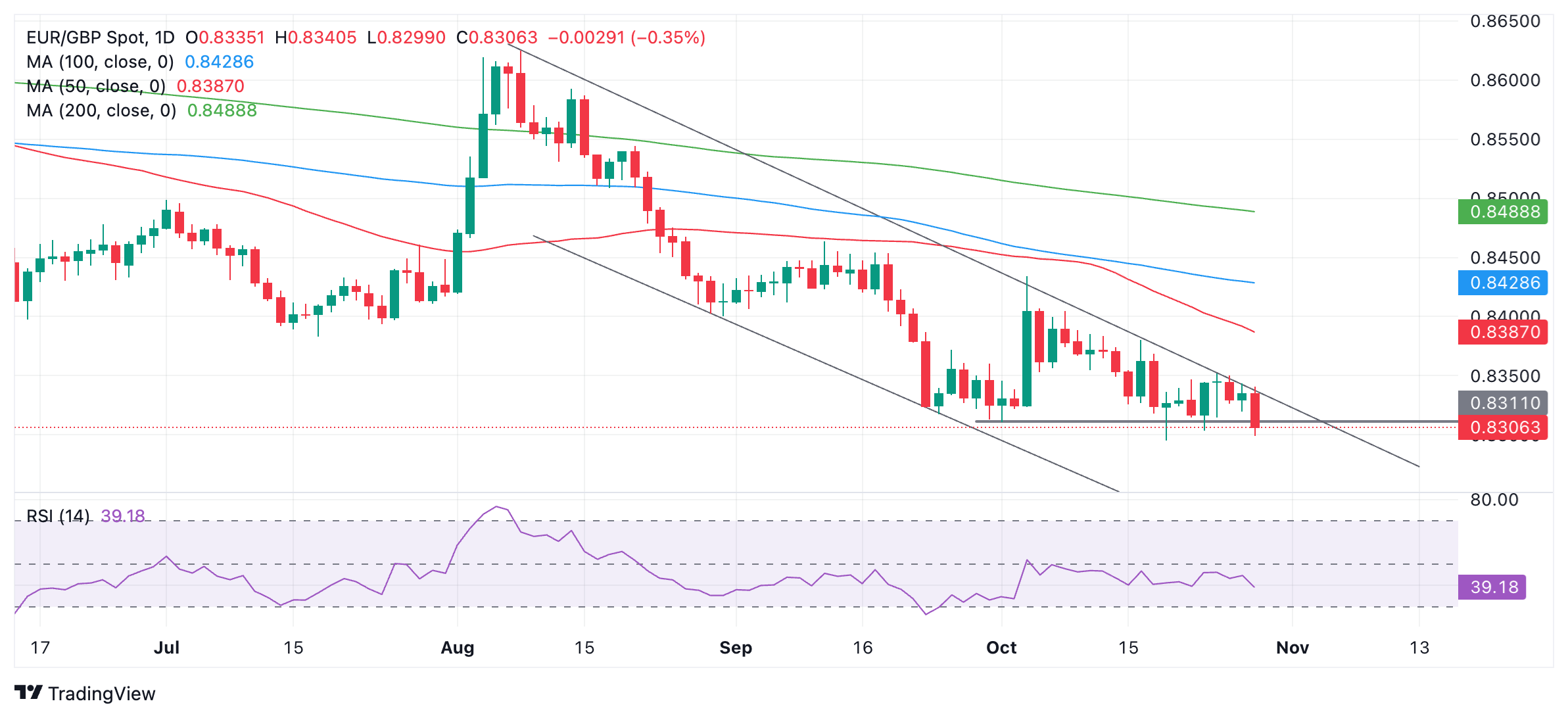
The market’s pricing of Interest Rate Swaps provides a method for predicting what central banks will do in the future, and these are showing “nearly 50% odds of the ECB” cutting interest rates by 50 basis points (bps) (0.50%) at the December meeting, according to Lallalit Srijandorn, Editor at FXStreet. This compares to the UK where, a Reuters poll of economists expect the BoE to cut its Bank Rate by only 25 bps (0.25%) on November 7. In addition, of those surveyed, a nearly-two-thirds majority expect the BoE to leave interest rates unchanged in December.
Recent comments from ECB Governing Council members have on the whole emphasized the possibility of the central bank cutting rates more aggressively since inflation has declined more quickly amid softer-than-expected economic growth.
Commentary somewhat softened so far this week, however, providing some relief to the Euro on Monday. The European Central Bank (ECB) Vice President Luis de Guindos said that the ECB has made significant progress in bringing down inflation but can’t declare victory just yet. Whilst he said “domestic inflation remains high” – implying interest rates should remain elevated – he also highlighted the risks to growth, which by implication could be remedied by lowering interest rates and easing the availability of credit.
Prior to De Guindos, European Central Bank (ECB) policymaker Pierre Wunsch said on Monday that “it is premature to discuss December policy decision.” Further adding that he felt “no urgency in further accelerating easing of monetary policy,” and that the undershoot in September inflation data could be explained as due to lower energy prices from cheaper Oil.
Wednesday could be a pivotal day for EUR/GBP due to the release of preliminary Eurozone Gross Domestic Product (GDP) data for Q3 which will help clarify the growth situation in the region, and the delivery of the UK Budget statement in the UK.
Given the new Labor government’s highlighting of the 22 billion (GBP) black hole in the nation’s accounts left by the previous Conservative government, the UK Budget is likely to incorporate a mixture of higher taxes and moderate government spending. According to Capital Economics, even with higher taxes expected, UK consumers are not reacting by tightening their belts and growth is expected to continue at a “healthy clip”. This suggests Sterling will remain underpinned.
“Overall, there’s little evidence that the prospect of tax rises has caused households to become more cautious with their borrowing. While household borrowing and spending may be a bit softer after the scale of tax rises is revealed in tomorrow’s Budget, our central forecast is that the economy expanded in September and will grow by a decent 0.4% q/q or so in Q4,” says Paul Dales, Chief UK Economist at Capital Economics.
Eurozone GDP data, meanwhile, is expected to show a 0.8% rise in Q3 YoY, from 0.6% in Q2, and a 0.2% increase QoQ, the same as it did in the previous quarter. An undershoot would weaken the Euro and see more losses for EUR/GBP, whilst an overshoot would strengthen the case for a more cautious approach to cutting interest rates reflected in Monday’s commentary and see the Euro, and EUR/GBP recover.
Author

Joaquin Monfort
FXStreet
Joaquin Monfort is a financial writer and analyst with over 10 years experience writing about financial markets and alt data. He holds a degree in Anthropology from London University and a Diploma in Technical analysis.















