|

EUR/GBP declines following UK GDP data

  • EUR/GBP fell to 0.8540, testing a key support level.
  • The pair declined despite mixed UK GDP reported during the European sessions.
  • The softish economic outlook favors additional cuts from the BoE.

Thursday saw the EUR/GBP pair fall to 0.8540, after mixed Gross Domestic Product (GDP) data from the UK. This comes after Wednesday's movements when the strength of the Pound was suppressed by disappointing UK inflation data.

The UK reported its Q2 Gross Domestic Product (GDP) data, showing a quarterly growth rate of 0.6%, down from 0.7% in Q1. The annual growth rate was 0.9%, an increase from 0.3% in Q1, as expected. Private consumption grew by a weaker-than-anticipated 0.2% quarter-on-quarter, but this was partially balanced by stronger government spending, which increased by 1.4% quarter-on-quarter.

Business investment and net exports negatively impacted growth. Monthly data for June, released simultaneously, indicated a slowdown as the quarter ended: GDP remained unchanged month-on-month, industrial production rose by 0.8%, services decreased by 0.1%, and construction increased by 0.5%. Overall, current data suggests the Bank of England will likely continue cutting rates to support the economy.

EUR/GBP technical analysis

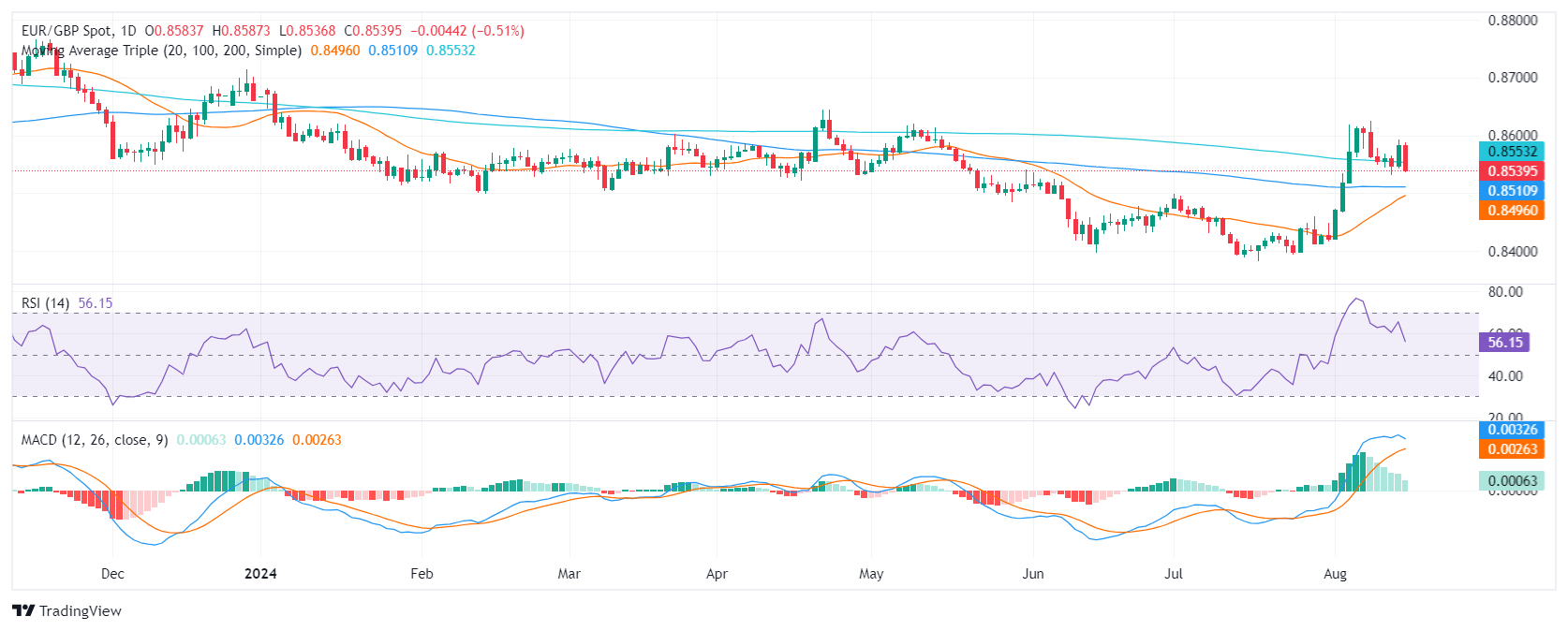
The EUR/GBP shows a mixed trend in recent sessions, with the Relative Strength Index (RSI) moving from mid to high 50s. This suggests a generally bullish or neutral sentiment among traders but with the index now pointing down, it may hint that the sellers are coming. This is backed by the Moving Average Convergence Divergence (MACD) which is showing decreasing red bars, signaling a possible shift towards a bearish sentiment. The volume over the past week has been stable, pointing towards decent liquidity in the pair.

Traders should monitor the 0.8540-0.8590 range as a breakout might fuel sharp movements.

EUR/GBP daily chart
Author

Patricio Martín

Patricio is an economist from Argentina passionate about global finance and understanding the daily movements of the markets.


More from Patricio Martín
Share:

Markets move fast. We move first.

Orange Juice Newsletter brings you expert driven insights - not headlines. Every day on your inbox.

By subscribing you agree to our Terms and conditions.

Editor's Picks

EUR/USD bounces toward 1.1750 as US Dollar loses strength

EUR/USD returned to the 1.1750 price zone in the American session on Friday, despite falling Wall Street, which indicates risk aversion. Trading conditions remain thin following the New Year holiday and ahead of the weekend, with the focus shifting to US employment and European data scheduled for next week.

GBP/USD nears 1.3500, holds within familiar levels

After testing 1.3400 on the last day of 2025, GBP/USD managed to stage a rebound. Nevertheless, the pair finds it difficult to gather momentum and trades with modest intraday gains at around 1.3490 as market participants remain in holiday mood.

Gold trims intraday gains, approaches $4,300

Gold retreated sharply from the $4,400  area and trades flat for the day in the $4,320 price zone. Choppy trading conditions exacerbated the intraday decline, although XAU/USD bearish case is out of the picture, considering growing expectations for a dovish Fed and persistent geopolitical tensions.

Cardano gains early New Year momentum, bulls target falling wedge breakout

Cardano kicks off the New Year on a positive note and is extending gains, trading above $0.36 at the time of writing on Friday. Improving on-chain and derivatives data point to growing bullish interest, while the technical outlook keeps an upside breakout in focus.

Economic outlook 2026-2027 in advanced countries: Solidity test

After a year marked by global economic resilience and ending on a note of optimism, 2026 looks promising and could be a year of solid economic performance. In our baseline scenario, we expect most of the supportive factors at work in 2025 to continue to play a role in 2026.

Crypto market outlook for 2026

Year 2025 was volatile, as crypto often is.  Among positive catalysts were favourable regulatory changes in the U.S., rise of Digital Asset Treasuries (DAT), adoption of AI and tokenization of Real-World-Assets (RWA).















