EUR/GBP consolidates above 0.8650 as German GDP contracts and UK sentiment improves
- EUR/GBP trades flat, consolidating above 0.8650 after paring earlier losses.
- German Q2 GDP shrank by 0.3%, deeper than the initial 0.1% decline estimate.
- Eurozone Consumer Confidence (Aug Prel.) dropped to -15.5, missing expectations of -14.7.
- UK GfK Consumer Confidence rose to -17 in August, improving from -20 and beating forecasts.


The EUR/GBP cross is trading with subdued price action on Friday, consolidating above the 0.8650 level after paring earlier losses during the American session. At the time of writing, the cross is changing hands near 0.8653, showing resilience despite the Euro’s (EUR) slight weakness following a deeper-than-expected contraction in Germany’s second-quarter Gross Domestic Product (GDP), which shrank by 0.3% against the initial estimate of -0.1%.
The single currency also faced headwinds after Thursday’s preliminary reading of Eurozone Consumer Confidence showed a decline to -15.5 in August, down from -14.7 in July and below expectations of -14.9, underscoring fragile household sentiment across the bloc.
On the UK side, the latest GfK Consumer Confidence survey surprised to the upside at -17 in August, improving from -19 previously and beating market forecasts of -20. The data suggests some recovery in sentiment, likely helped by easing financial pressures following the Bank of England’s recent policy shift, though concerns over inflation and jobs remain a drag.
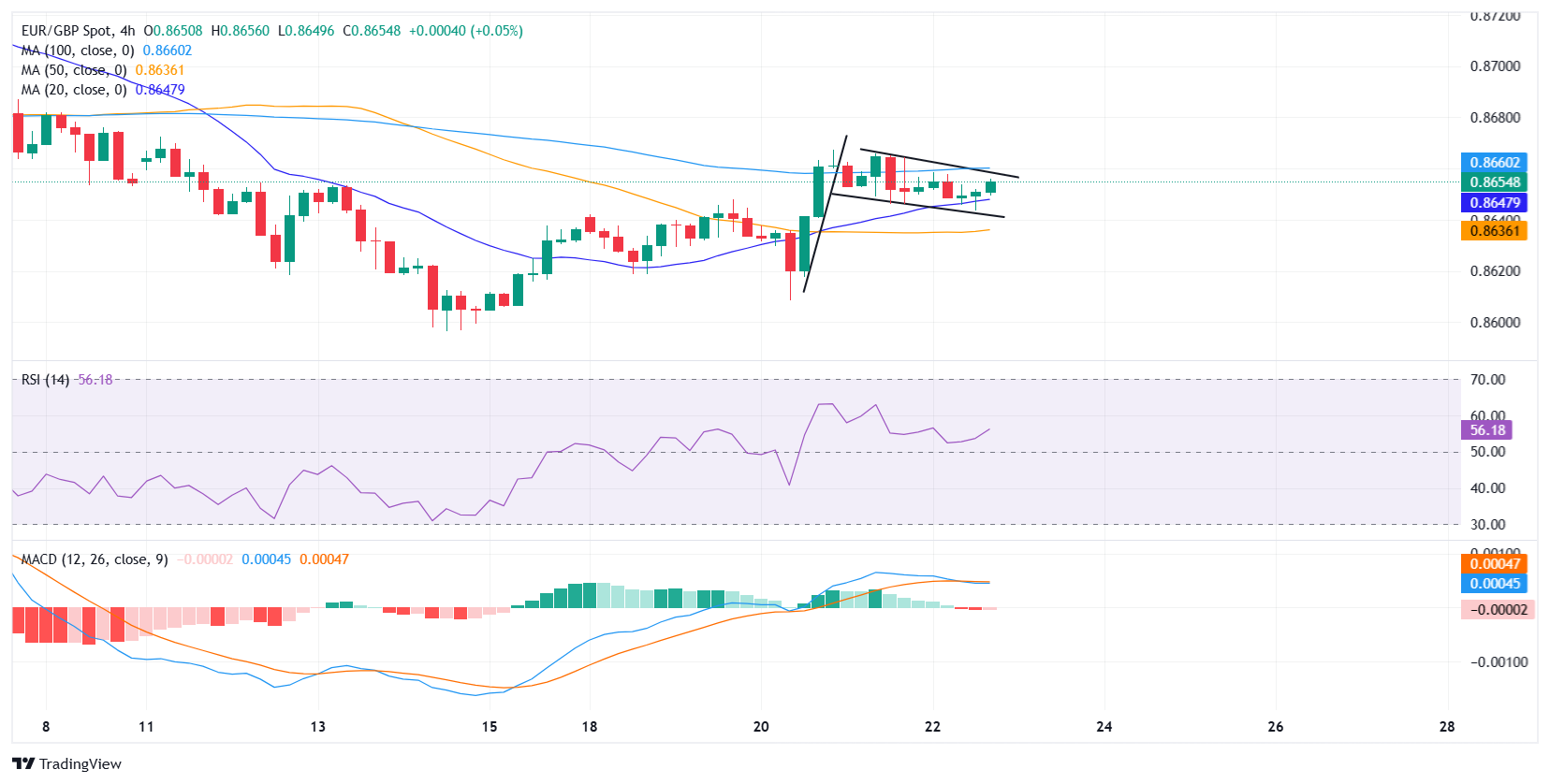
Technically, the EUR/GBP cross is displaying a bullish flag-and-pole formation on the 4-hour chart, with the sharp rebound from the 0.8600 base forming the pole and the current consolidation channel shaping the flag. Price action remains comfortably above the 0.8650 handle, with the 20-period Simple Moving Average (SMA) providing immediate intraday support while the 50-SMA near 0.8636 lines up with the lower boundary of the flag to create a solid support cluster. On the upside, the 100-SMA at 0.8660 has turned into a near-term pivot, capping topside attempts but also signaling that a clean break above it could reinforce the bullish case.
A decisive 4-hour close above the flag resistance at 0.8665, just beyond the 100-SMA, would validate the continuation pattern and pave the way for a test of the 0.8680 psychological level, with scope to extend toward 0.8700 and 0.8750 on follow-through buying. On the downside, failure to hold the 20-SMA would expose the 50-SMA and risk a deeper pullback toward the 0.8600 psychological mark.
Momentum indicators support the constructive bias, with the Relative Strength Index (RSI) holding near 56, staying comfortably above neutral without entering overbought territory, while the MACD hovers around the zero line with a shallow positive tilt, consistent with consolidation within an uptrend. Overall, as long as EUR/GBP defends the 0.8650-0.8635 support zone, the short-term technical outlook leans in favor of an eventual bullish breakout.
(This story was corrected on August 22 at 13:57 GMT to say that the Eurozone's Consumer Confidence print in July was -14.7, not -14.9, and that the UK's GfK Consumer Confidence in July was -19, not -20)
Author
Vishal Chaturvedi
FXStreet
I am a macro-focused research analyst with over four years of experience covering forex and commodities market. I enjoy breaking down complex economic trends and turning them into clear, actionable insights that help traders stay ahead of the curve.