Dow Jones rallies as Microsoft, Meta earnings outshine gloomy US outlook
- Microsoft and Meta beat Q1 estimates, fueling AI-linked stock surge and tech-led Dow rally.
- ISM Manufacturing PMI contracts; jobless claims hit highest since February, raising slowdown concerns.
- Markets price in 94 bps of Fed cuts for 2025; 2-year yield signals policy shift ahead.

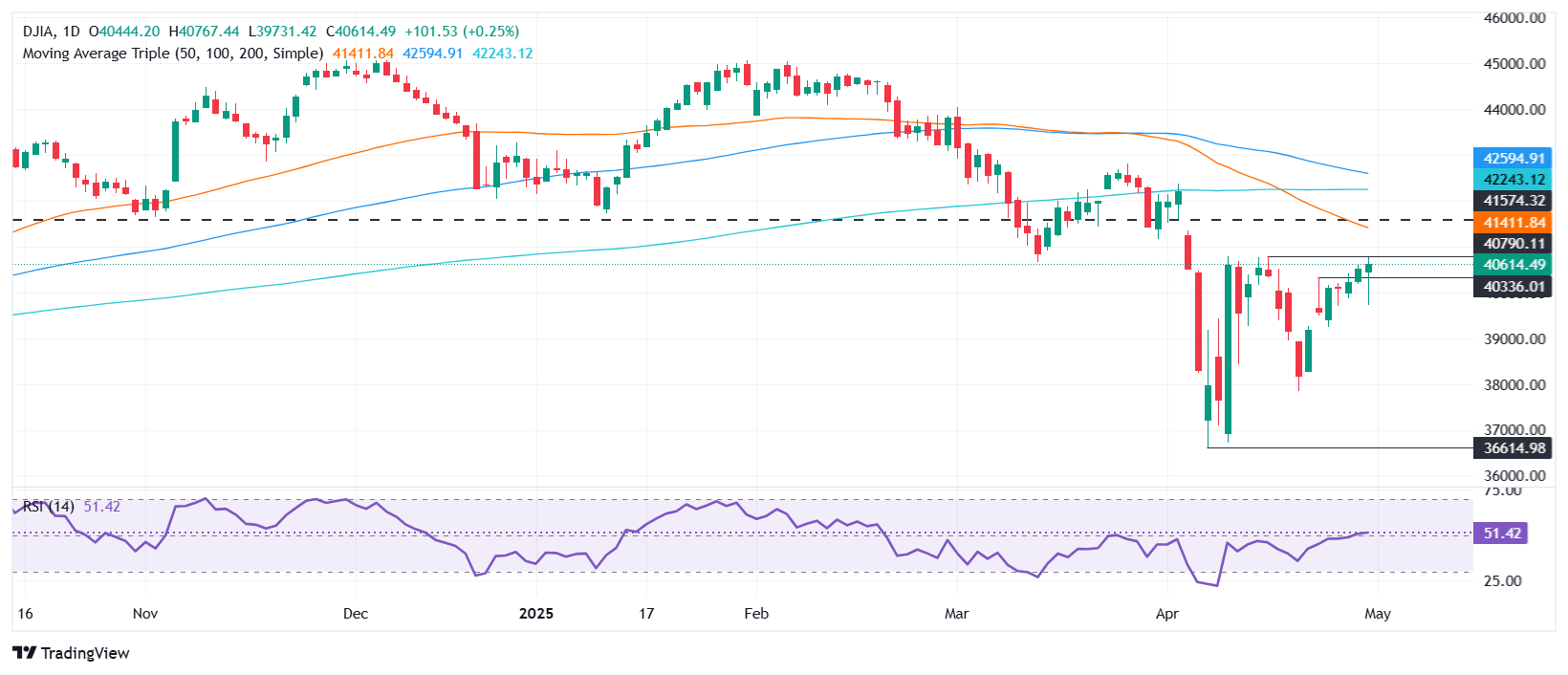
The Dow Jones Industrial Average (DJIA) rallied over 100 points, or 0.24%, on Thursday after big tech companies posted strong earnings reports, ignoring surveys that underscored the ongoing economic slowdown in the United States. At the time of writing, the DJIA is holding firm at nearly 40,600 after hitting a daily high of 41,096.
DJIA climbs as big tech lifts sentiment, offsetting recession fears and weak jobless claims
Meta Platforms (META) and Microsoft (MSFT) posted strong earnings reports for the first calendar quarter of 2025. Meta reported earnings per share (EPS) of $6.43, above estimates of $5.28, with revenue surpassing estimates of $41.4 billion to $42.31 billion. On Microsoft’s side, EPS stood at $3.46, up from $3.22 projected, while market revenue jumped from $68.42 billion to $70.07 billion.
A day after the earnings release, Microsoft shares are up 8%, while Meta stock advanced nearly 4%. The results pulled up stocks of companies related to artificial intelligence (AI) like Nvidia (NVDA).
The Dow's advances have been somewhat capped by data from the Institute for Supply Management, which revealed that April’s Manufacturing PMI contracted the most in the last five months, down from 49 in March, which came to 48.7, above mediocre forecasts of 48.
Labor market data also came in weak as Initial Jobless Claims for the previous week increased to its highest since February. The number of Americans filing for unemployment benefits in the week ending April 26 was 241K, above the 224K expected and up from 223K a week ago.
Thursday’s data has increased concerns about a possible recession in the US, following data from the Commerce Department that portrayed the US economy contracting by 0.3%. This and the labor market's weakness paint a gloomy outlook for the release of Nonfarm Payroll (NFP) figures on Friday.
Fed expected to cut rates
Data from the Chicago Board of Trade (CBOT) shows the swaps market expects 94 basis points of easing toward the end of the year, as revealed by the December 2025 fed funds rate futures contract.
US Treasury Secretary Scott Bessent suggested that the yield of the US 2-year Treasuries signals that the Fed should cut rates.
Dow Jones price forecast
The Dow Jones remains downwardly biased even though bulls found some relief after clearing the 20-day Simple Moving Average (SMA) of 39,705. The DJIA reached a weekly peak at 41,096, shy of testing the 50-day SMA at 41,331. Failure to do so exacerbated a pullback that is poised to drag the index toward 40,500.
A breach of the latter could expose the 40,000 level followed by a challenge of the April 23 low of 39,486, ahead of the April 22 high of 39,271 that would close the gap witnessed between April 22 and 23.
Conversely, bulls reclaimed 41,000 and look for a test of ceiling levels above. The first resistance is the 50-day SMA, followed by the 200-day SMA at 42,277 and the 100-day SMA at 42,503.
Dow Jones FAQs
The Dow Jones Industrial Average, one of the oldest stock market indices in the world, is compiled of the 30 most traded stocks in the US. The index is price-weighted rather than weighted by capitalization. It is calculated by summing the prices of the constituent stocks and dividing them by a factor, currently 0.152. The index was founded by Charles Dow, who also founded the Wall Street Journal. In later years it has been criticized for not being broadly representative enough because it only tracks 30 conglomerates, unlike broader indices such as the S&P 500.
Many different factors drive the Dow Jones Industrial Average (DJIA). The aggregate performance of the component companies revealed in quarterly company earnings reports is the main one. US and global macroeconomic data also contributes as it impacts on investor sentiment. The level of interest rates, set by the Federal Reserve (Fed), also influences the DJIA as it affects the cost of credit, on which many corporations are heavily reliant. Therefore, inflation can be a major driver as well as other metrics which impact the Fed decisions.
Dow Theory is a method for identifying the primary trend of the stock market developed by Charles Dow. A key step is to compare the direction of the Dow Jones Industrial Average (DJIA) and the Dow Jones Transportation Average (DJTA) and only follow trends where both are moving in the same direction. Volume is a confirmatory criteria. The theory uses elements of peak and trough analysis. Dow’s theory posits three trend phases: accumulation, when smart money starts buying or selling; public participation, when the wider public joins in; and distribution, when the smart money exits.
There are a number of ways to trade the DJIA. One is to use ETFs which allow investors to trade the DJIA as a single security, rather than having to buy shares in all 30 constituent companies. A leading example is the SPDR Dow Jones Industrial Average ETF (DIA). DJIA futures contracts enable traders to speculate on the future value of the index and Options provide the right, but not the obligation, to buy or sell the index at a predetermined price in the future. Mutual funds enable investors to buy a share of a diversified portfolio of DJIA stocks thus providing exposure to the overall index.
Author

Christian Borjon Valencia
FXStreet
Markets analyst, news editor, and trading instructor with over 14 years of experience across FX, commodities, US equity indices, and global macro markets.