Dow Jones Industrial Average whipsaws but holds steady on Friday
- The Dow Jones waffled near 42,000 as equities trim gains on Friday.
- Despite a lack of noteworthy data, equities are reeling under the pressure of expiries.
- President Trump hinted at “flexibility” in upcoming tariffs as the pivot begins anew.

The Dow Jones Industrial Average (DJIA) saw an uptick in volatility on Friday, but settled close to where it started near 42,000 as investors grapple with deciding where to go next. Despite a relatively thin showing on the economic data docket, market sentiment remains tightly-drawn as traders wrestle with fresh inconsistencies from US President Donald Trump.
Adding further pressure to equities, Friday was a “quadruple witching hour” for markets, with a jumbo proportion of options slated for expiry. According to estimates by Goldman Sachs (CS) and reported by CNBC Sean Conlon, over $4.7 trillion worth of stock, index, and futures options will expire on Friday.
After weeks of flip-flopping on recent tariff packages, but still vowing “reciprocal” tariffs on April 2nd, US President Donald Trump has again opened the door to “flexibility” to his previously-declared set in stone tariffs package due in early April. In a social media post on Friday morning, President Trump reiterated that the US will be imposing reciprocal tariffs on any country that has tariffs on US exports, but teased that there could be some “flexibility” in tariffs, opening the door to countries being able to negotiate down or away US import taxes. This is the sixth straight time in less than ten weeks that Donald Trump’s own tariff proposals have been changed by Donald Trump himself, and investors have grown weary under the weight of Trump’s on-again off-again trade war with everybody at the same time.
The Federal Reserve (Fed) towed the line this week, brushing off recent jumps in inflation metrics and generally waving off warning signs that have begun to crop up in economic data. Fed Chair Jerome Powell and the Federal Open Market Committee (FOMC) still see US interest rates declining by another 50 bps through the rest of 2025. According to the CME’s FedWatch Tool, rate traders are pricing in a nearly 80% chance that the Fed’s next quarter-point cut will be coming at the US central bank’s rate call on June 18.
Stocks news
Despite a charged Friday, US equity indexes remain close to the day’s opening bids. Most of the US stock sectors are testing slightly into the red, offsetting gains in key names like Boeing (BA), which is extending a recent recovery and climbing over 4% to regain $180 per share.
Dow Jones price forecast
The Dow Jones continues to churn just south of key price levels, marking in several failed attempts to crack back through the 200-day Exponential Moving Average (EMA) near the 42,000 major price handle. Price action is still tilted in favor of buyers, but a lack of topside momentum is keeping bids hobbled by a new technical ceiling.
Dow Jones daily chart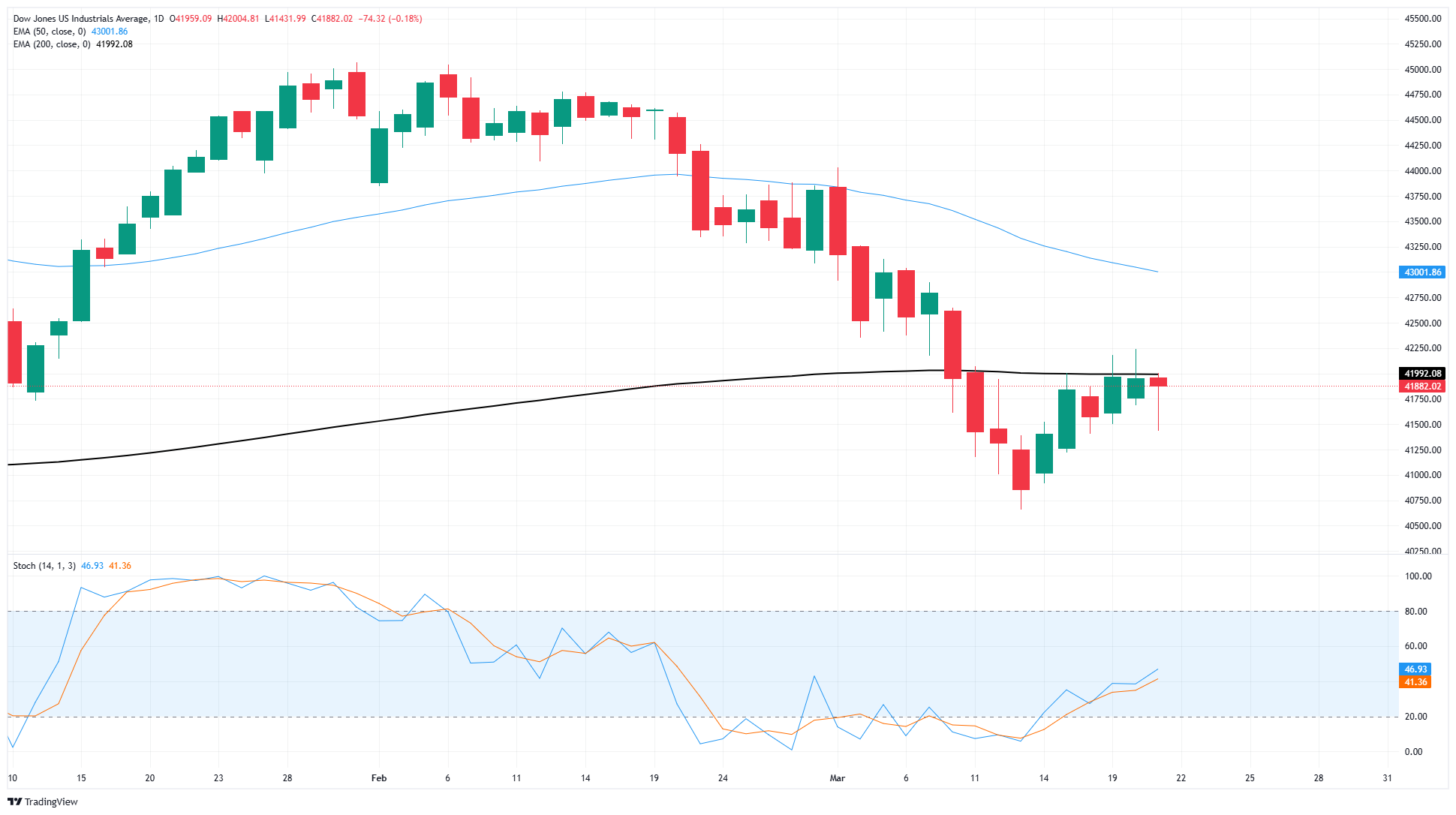
Tariffs FAQs
Tariffs are customs duties levied on certain merchandise imports or a category of products. Tariffs are designed to help local producers and manufacturers be more competitive in the market by providing a price advantage over similar goods that can be imported. Tariffs are widely used as tools of protectionism, along with trade barriers and import quotas.
Although tariffs and taxes both generate government revenue to fund public goods and services, they have several distinctions. Tariffs are prepaid at the port of entry, while taxes are paid at the time of purchase. Taxes are imposed on individual taxpayers and businesses, while tariffs are paid by importers.
There are two schools of thought among economists regarding the usage of tariffs. While some argue that tariffs are necessary to protect domestic industries and address trade imbalances, others see them as a harmful tool that could potentially drive prices higher over the long term and lead to a damaging trade war by encouraging tit-for-tat tariffs.
During the run-up to the presidential election in November 2024, Donald Trump made it clear that he intends to use tariffs to support the US economy and American producers. In 2024, Mexico, China and Canada accounted for 42% of total US imports. In this period, Mexico stood out as the top exporter with $466.6 billion, according to the US Census Bureau. Hence, Trump wants to focus on these three nations when imposing tariffs. He also plans to use the revenue generated through tariffs to lower personal income taxes.
Author

Joshua Gibson
FXStreet
Joshua joins the FXStreet team as an Economics and Finance double major from Vancouver Island University with twelve years' experience as an independent trader focusing on technical analysis.