Dow Jones Industrial Average softens after weak ISM PMI print
- The Dow Jones saw early declines on Tuesday after ISM Services PMI figures came in below expectations.
- 44,000 remains a key inflection point for the major equity index.
- US President Donald Trump has fresh tariff threats ahead of his latest trade deal deadline.

The Dow Jones Industrial Average (DJIA) took a hit early Tuesday, declining after United States (US) ISM Purchasing Manager Index (PMI) figures for July came in below expectations, adding further downside pressure to already-battered investor sentiment. US President Donald Trump issued fresh tariff threats on Tuesday, reiterating that he will increase tariffs on the European Union (EU) to 35% across the board if the EU government doesn’t fulfill its “obligations”, likely referring to a loose, preliminary handshake deal between Europe and the US to invest billions of dollars in American business infrastructure at some point in the future.
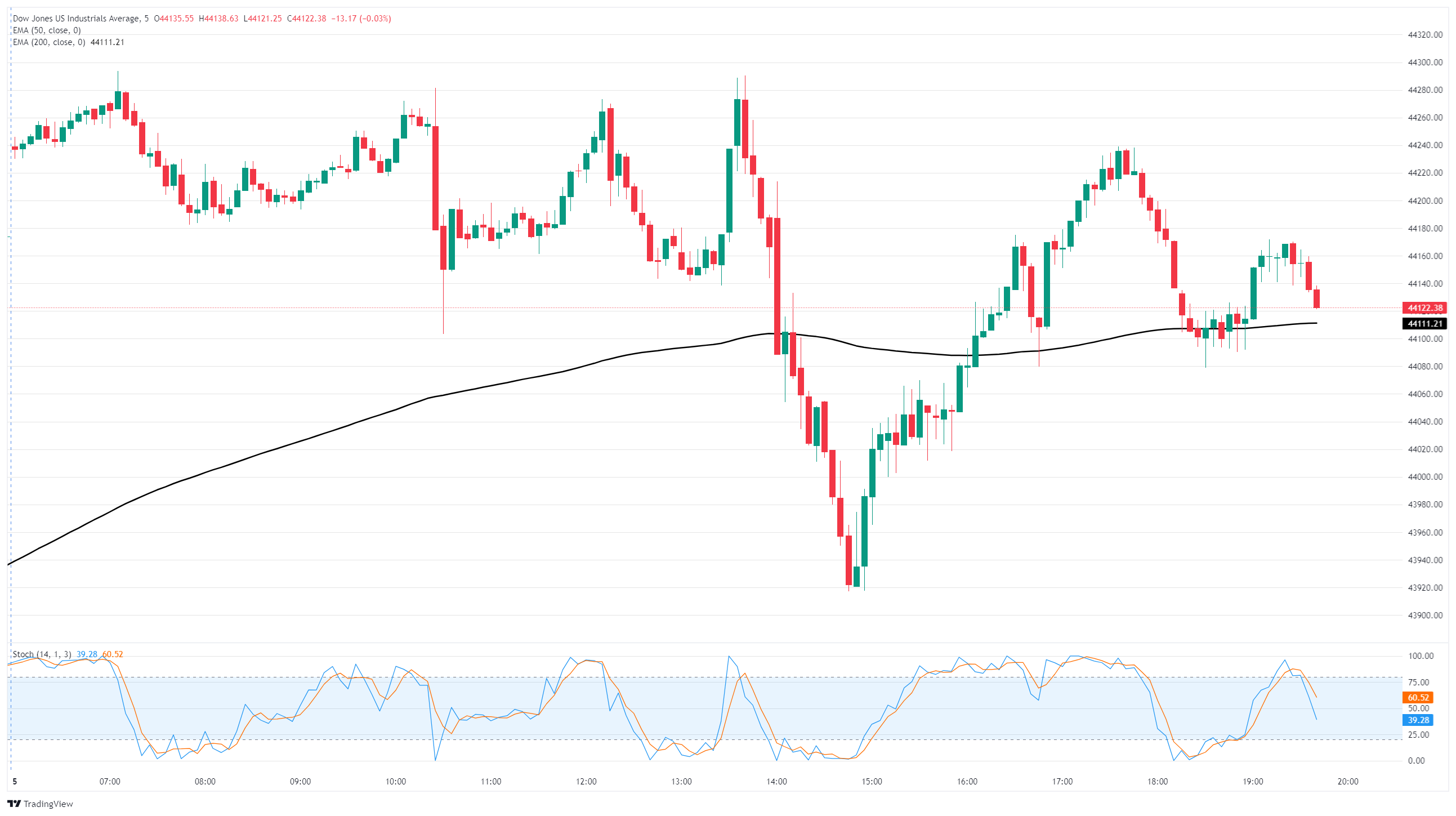
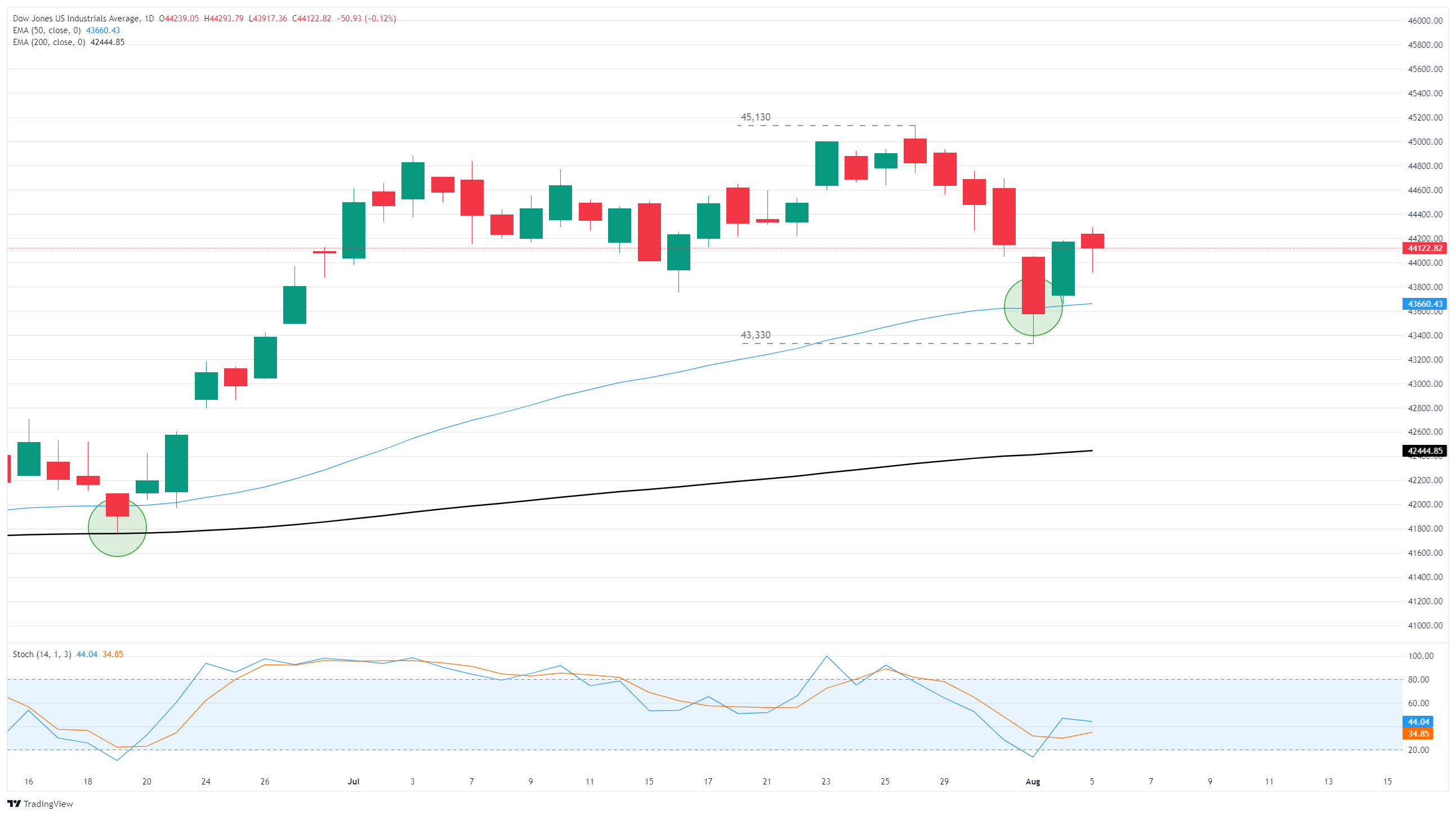
The Dow Jones fell to an intraday low of 43,917 before recovering its footing and pushing back into the day’s opening level near 44,200. The Dow has recovered from a recent decline that dragged the major equity index down nearly 4% top-to-bottom from record highs at 45,130, catching a technical bounce from the 50-day Exponential Moving Average (EMA) near 43,660. Despite snapping a six-day decline on Monday, the Dow still shows further signs of price action weakness as bulls struggle to muscle bids back over 44,250.
US PMI figures warn of trade and employment weakness
US ISM Services PMI survey results sank to 50.1 in July, flubbing an expected increase to 51.5 from 50.8. Digging deeper into the data, most components of the ISM PMI report were in expansion territory, with the business activity, supplier deliveries, and prices index all showing improvement from the previous month. However, hiring expectations fell into contraction territory, with most businesses placing the blame on seasonal and weather factors. There were also sharp contractions in both new exports and imports activity expectations as tariff impacts continue to creep into US activity data.

Trump on trade: a tumultuous, ever-changing affair
US President Donald Trump reiterated that he would be kicking future EU tariff levels up to 35% if the EU doesn’t fulfill its trade and investment obligations to the US. Specific details, as always, remain limited, and Trump’s timeline on deadlines remains particularly fluid. The makings of a trade agreement between the US and the EU are in the works, but, as with most trade agreements secured by the Trump administration, specific details remain essentially non-existent, and none have been written into effective law by any government at this stage.
After promising steep secondary tariffs earlier this week on India for trading in Russian Crude Oil products, Donald Trump has shifted his focus on Tuesday back to Russia. Rumors that Russia is weighing offering a temporary air-truce offer in order to appease President Trump are in the water supply. However, according to reporting by the Financial Times, the Trump team could be poised to introduce fresh economic sanctions against Russia if Russian President Vladimir Putin doesn’t achieve a complete ceasefire with Ukraine by Friday.
Dow Jones 5-minute chart
Dow Jones daily chart
Economic Indicator
ISM Services PMI
The Institute for Supply Management (ISM) Services Purchasing Managers Index (PMI), released on a monthly basis, is a leading indicator gauging business activity in the US services sector, which makes up most of the economy. The indicator is obtained from a survey of supply executives across the US based on information they have collected within their respective organizations. Survey responses reflect the change, if any, in the current month compared to the previous month. A reading above 50 indicates that the services economy is generally expanding, a bullish sign for the US Dollar (USD). A reading below 50 signals that services sector activity is generally declining, which is seen as bearish for USD.
Read more.Last release: Tue Aug 05, 2025 14:00
Frequency: Monthly
Actual: 50.1
Consensus: 51.5
Previous: 50.8
Source: Institute for Supply Management
The Institute for Supply Management’s (ISM) Services Purchasing Managers Index (PMI) reveals the current conditions in the US service sector, which has historically been a large GDP contributor. A print above 50 shows expansion in the service sector’s economic activity. Stronger-than-expected readings usually help the USD gather strength against its rivals. In addition to the headline PMI, the Employment Index and the Prices Paid Index numbers are also watched closely by investors as they provide useful insights regarding the state of the labour market and inflation.
Author

Joshua Gibson
FXStreet
Joshua joins the FXStreet team as an Economics and Finance double major from Vancouver Island University with twelve years' experience as an independent trader focusing on technical analysis.