Diamondback Energy eyes the level that started its downfall

Diamondback Energy (FANG), a leading Permian Basin operator, is approaching a moment of technical reckoning. The stock is climbing back toward $170.15—a level that holds painful memories for anyone who rode the breakdown. This wasn't just any support failure. Price tested $170 twice, and when it finally gave way, the collapse was swift and unforgiving. FANG didn't just drift lower; it plummeted nearly 35% to $112 before finding a floor.
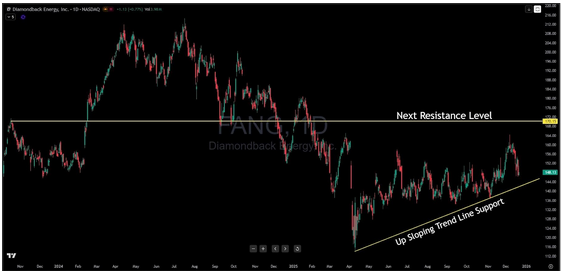
The low at $112 marked capitulation. Sellers exhausted themselves, and buyers began stepping in cautiously at first, then with increasing conviction. What emerged from that bottom was the ascending trendline we're watching today: a steady procession of higher lows that's carried FANG back to $148. This isn't a vertical moonshot recovery; it's a methodical grind higher that suggests real buying interest rather than a fleeting bounce.
But now comes the test. That $170.15 level is right where support turned into resistance. This is textbook technical behavior: a broken support level often becomes the new ceiling. Why? Because traders who bought near $170 during the initial breakdown are still underwater, and many will look to exit near breakeven if price returns. Add in the psychological weight of that double failure, and you've got a formidable barrier.
The bullish case hinges on reclaiming $170.15 decisively. If FANG can push through and hold above this level for a few sessions, it would flip the script entirely—transforming resistance back into support and potentially opening the door to the $185-$195 zone. That would represent a full recovery of more than half the decline from the 2024 highs.
The bearish alternative: Rejection at $170.15 followed by a breakdown of the ascending trendline would be deeply concerning. A close beneath $140 would invalidate the uptrend structure and likely send price testing the $130-$125 support zone, with $112 back in play if that doesn't hold.
For traders, patience pays here. Bulls might wait for a confirmed breakout above $172-$175 before committing, while those expecting resistance to hold could watch for rejection signals near $170 with stops above $175. The trendline around $142-$145 offers a safer entry for those wanting to buy the dip with a tight stop.
Diamondback Energy is rewriting its story one session at a time. Whether $170.15 becomes a launchpad or a ceiling will tell us everything about the strength of this recovery.
Author

Benjamin Pool
Verified Investing
A seasoned financial expert with a passion for empowering individuals to mastering smart money management.