Could Intel be kicked out of the Dow Jones index?
- An analyst at the Carson Group thinks Intel is likely to be dropped from the Dow Jones.
- INTC shares are down 6% on Tuesday and 59% for the year.
- Intel is whispered to be considering a sale of its FPGA unit to Marvell.
- Intel stock makes up just 0.35% of the DJIA.
Intel (INTC) shares slid lower on the first day of trading this week after CEO Pat Gelsinger was said to be considering selling the former Altera unit that makes field programmable gate array (FPGA) chips.
INTC dipped some 6% on Tuesday morning, while chatter emerged about whether the Dow Jones Industrial Average (DJIA) might drop Intel from its index altogether. The Dow Jones index is sinking 1.1% midday on Tuesday after US manufacturing data showed contraction in August. This comes after the DJIA reached another all-time high last week. The NASDAQ is off a whopping 2.5% as well on Tuesday.
Intel stock news
News emerged on Monday that Intel is studying the possibility of sellings its FPGA unit, originally called Altera, that it acquired for $16.7 billion back in 2015. Offloading the high-margin unit would help the company improve its balance sheet immediately as it attempts to halt large losses stemming from its move into third-party chip fabrication.
The rumor is that up-and-coming semiconductor firm Marvell Technology (MRVL) is the suspected buyer, and Raymond James analysts think the unit could fetch between $18 billion and $22 billion.
FPGA chips tend to be high gross margin products, says Raymond James, but revenue has been on a downward trajectory of late for the unit, and the analysts predict revenue will be $1.9 billion in 2025, about $1 billion behind 2023.
“[A]n outright sale looks viable and should significantly strengthen Intel's balance sheet," writes analyst Srini Pajjuri.
Despite considering slowing its entrance into the German semi market, Intel is partnering with a Japanese research institution to build a research laboratory for the study of EUV technology in chip design. Companies will pay a fee to access the experimental equipment at the center, which is expected to be up and running within five years.
Removed from Dow Jones index?
An analyst at the Carson Group is predicting that Intel will soon be kicked out of the Dow Jones index right as its 25th anniversary of inclusion is approaching.
"Intel being removed was likely a long time coming," said Ryan Detrick, chief market strategist at the Carson Group.
INTC stock is down 59% year to date and has essentially been in a downtrend since hitting an all-time high in August 2000, although shares had recovered near that level in both 2020 and 2021. Intel entered the Dow Jones in November of 1999.
INTC now makes up about 0.35% of the Dow Jones, and Detrick said its uncertain outlook primes it for displacement. Similarly, Amazon (AMZN) replaced Walgreen Boots Alliance (WBA) in the index back in February when that drugstore chain fell on hard times.
Intel stock forecast
Intel stock is of course trading well below all the relevant moving averages on the weekly chart. The 26-week, 52-week and 104-week Simple Moving Averages (SMAs) are all resting between $30.90 and $36.45, while INTC loses another 6.7% midday on Tuesday to trade at $20.57.
Big losses, ending its dividend and cutting its workforce by 15% haven't been enough to satisfy Wall Street. Near term support sits at $19.00, but at this point its hard to even be confident in that price level. This is the worst period for Intel in half a century or maybe ever.
Things may start to look up if INTC stock reclaims the $24.90 prior support level from February 2023. However, falling out the bottom of the DJIA is a recipe for disaster.
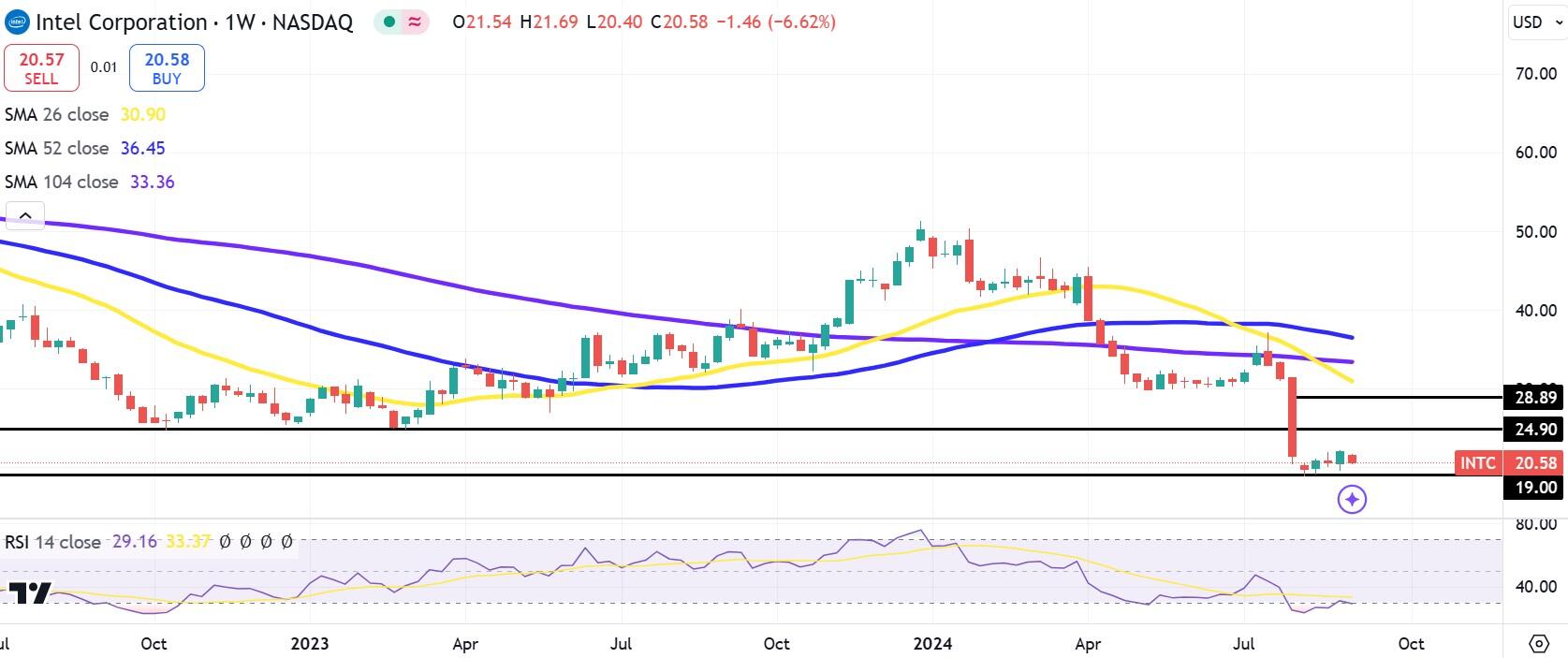
INTC weekly stock chart
Author

Clay Webster
FXStreet
Clay Webster grew up in the US outside Buffalo, New York and Lancaster, Pennsylvania. He began investing after college following the 2008 financial crisis.