|

China Consumer Price Index and China Producer Price Index fail to move the needle in AUD/USD

The China Consumer Price Index and the China Producer Price Index that are released by the National Bureau of Statistics of China have been released as follows:

  • China CPI YoY Dec: 1.8% (est 1.8%, prev 1.6%).
  • For the MoM: 0.0%
  • China Producer Price Index YoY Dec: -0.7% (est -0.1%, prev -1.3%).
  • For MoM: -0.5%.

AUD/USD update

The outcomes have failed to move the needle in AUD/USD which sits at 0.6918 in quiet pre-US CPI event markets. 

On Wednesday, however, AUD/USD rallied on the knee-jerk to the Aussie data dump as follows: 

The move was faded above 0.6900 and bears moved in at the high of 0.6925 in choppy conditions as the markets get set for the US Consumer Price Index. 
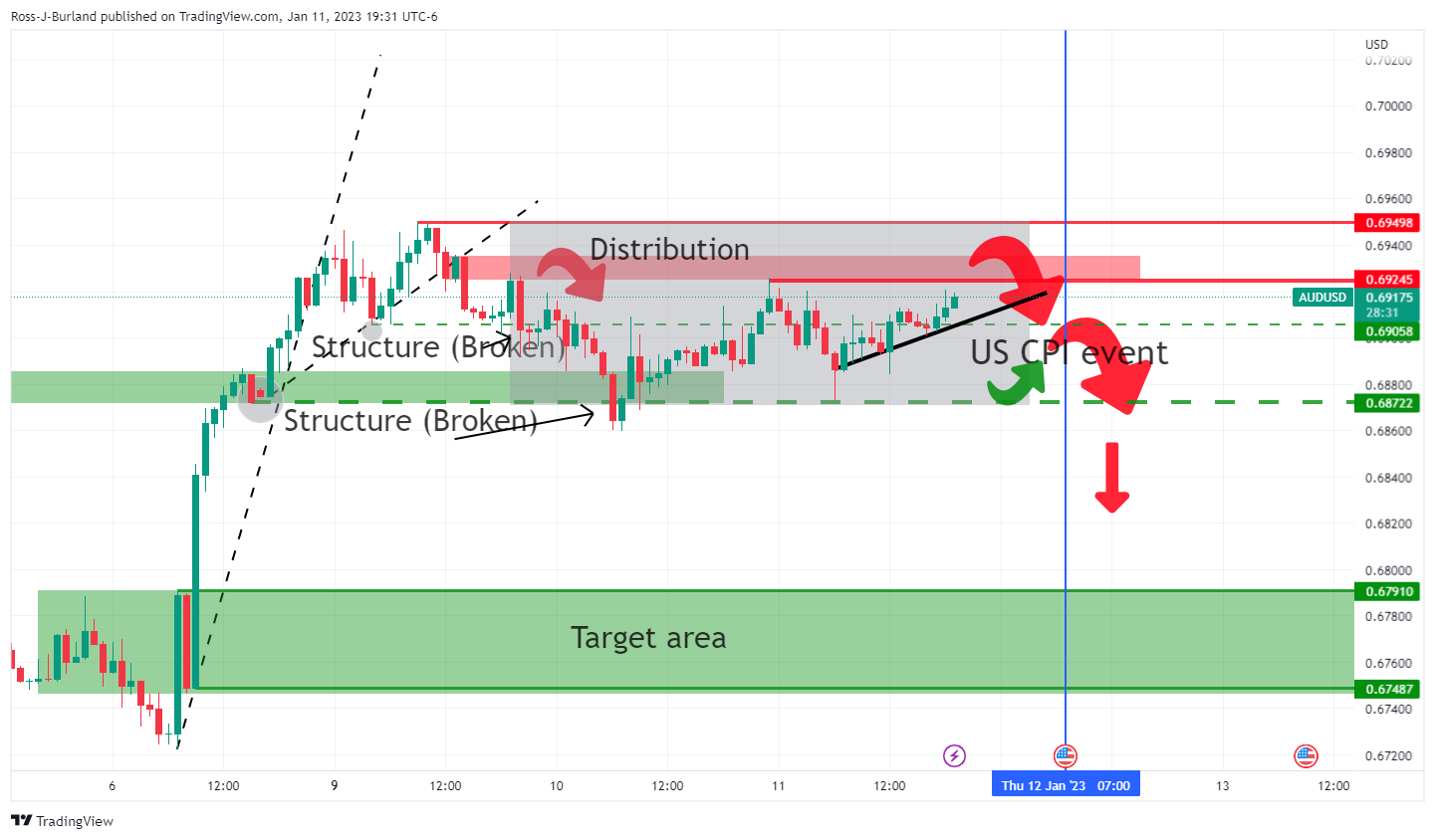
The analysis above assumes that distribution could be playing out into US CPI critical event.

While below 0.6950, the bias is to the downside for the near term. A break of 0.6870 will open the risk of a move into the 0.6800 figure and the targetted area between 0.6791 and 0.6748. 

About China CPI

The Consumer Price Index is released by the National Bureau of Statistics of China. It is a measure of retail price variations within a representative basket of goods and services. The result is a comprehensive summary of the results extracted from the urban consumer price index and rural consumer price index. The purchasing power of the CNY is dragged down by inflation. The CPI is a key indicator to measure inflation and changes in purchasing trends. A substantial consumer price index increase would indicate that inflation has become a destabilizing factor in the economy, potentially prompting The People’s Bank of China to tighten monetary policy and fiscal policy risk. Generally speaking, a high reading is seen as positive (or bullish) for the CNY, while a low reading is seen as negative (or Bearish) for the CNY.

Author

Ross J Burland

Ross J Burland, born in England, UK, is a sportsman at heart. He played Rugby and Judo for his county, Kent and the South East of England Rugby team.


More from Ross J Burland
Share:

Editor's Picks

AUD/USD remains below 0.7000 amid light trading

AUD/USD fills a modest bearish gap on Monday, but remains below 0.7000 in the Asian session amid holiday-thinned liquidity. The US Dollar attempts a bounce even as US bond yields pull back from multi-year highs, limiting the pair. Moreover, diminishing odds of another RBA rate hike in November cap the Aussie.

USD/JPY hovers above 158.00 amid Japan/ US holiday

USD/JPY extends its range-bound price action into a new week, trading above 158.00 as bulls remain on high alert amid speculation that authorities will step in to prop up the Japanese Yen. Meanwhile, softer US bond yields keep US Dollar bulls on the back foot and cap the pair's upside. However, geopolitical uncertainties could limit losses for the safe-haven buck amid thin liquidity due to a holiday in Japan and the US.

Gold remains vulnerable below $4,200 on Fed hike bets

Gold is under mild selling pressure on Monday, trading at around $4,170. The US Dollar advances modestly in thin trading, supported by bets that the Federal Reserve will hike rates at least one more time before year-end.

Bitcoin struggles as ETF outflows, geopolitical uncertainty weigh

Bitcoin hovers around $83,600 on Monday after a 3.1% correction last week. US-listed spot ETFs recorded an outflow of $681.10 million last week, snapping the three-week inflow streak. Geopolitical uncertainty and mixed signals keep investors cautious.

The week ahead: A critical week as earnings and CPI test market

The Oil price is relatively stable this morning, and US and European stock markets are poised to open higher, as risk sentiment shrugs off an escalation in the Middle East and concerns about rising bond yields.

Has Bitcoin really escaped the macro forces it was built to fight?
Over 17 years ago, Satoshi Nakamoto designed Bitcoin (BTC) on the back of a global financial crisis as an alternative to the global monetary system outside the control of central banks, governments and traditional intermediaries. This raises a key question: has Bitcoin really become independent of the macroeconomic forces it was built to challenge?














