Canadian Dollar extends gains following risk-on market surge on US NFP data miss
- The Canadian Dollar is bounding higher, extending weekly gains.
- Canada Unemployment Rate missed forecasts, hampering CAD upside.
- CAD gains 17.5K jobs, entirely part-time employment; wage growth also lower.

The Canadian Dollar (CAD) is seeing further upside against the US Dollar (USD) after a US Nonfarm Payrolls (NFP) report that came in below expectations, printing at its lowest reading since February of 2021.
The US data print is a welcome miss for investors who have been hoping for cooling economic data from the US to convince the Federal Reserve (Fed) that there is no need for further rate hikes and to help push the US central bank along toward eventual rate cuts.
Daily Digest Market Movers: Canadian Dollar propped up by US data miss, even as CAD data sours
- The CAD gains after US NFP prints at 150K, its lowest reading in almost three years.
- US wages also missed the mark, MoM Average Hourly Earnings only rose 0.2% (forecast 0.3%, previous revised from 0.2% to 0.3%).
- Canada Net Change in Employment came in below expectations at 17.5K, 22.5K expected, 63.8K previous.
- Canada job additions reveal low-quality data, jobs additions entirely in part-time category as full-time jobs evaporate.
- Majority of job additions are in services sector, goods sector only added 7.5K jobs.
- Canada Unemployment Rate for October comes in at 5.7%, its highest since February 2022 and accelerating above 5.6% forecast, extends from September’s 5.5% print.
- US Unemployment Rate also ticks higher to 3.9% after markets expected a steady hold at 3.8%.
- US ISM Services Purchasing Manager Index (PMI) also misses, declining to 51.8 for October.
- US Nonfarm Payrolls increase by 150,000 in October vs. 180,000 forecast
Technical Analysis: Canadian Dollar seeking its highest prices in almost two weeks as US Dollar recedes
The Canadian Dollar (CAD) is finding gains as the US Dollar (USD) recedes against the broader market.
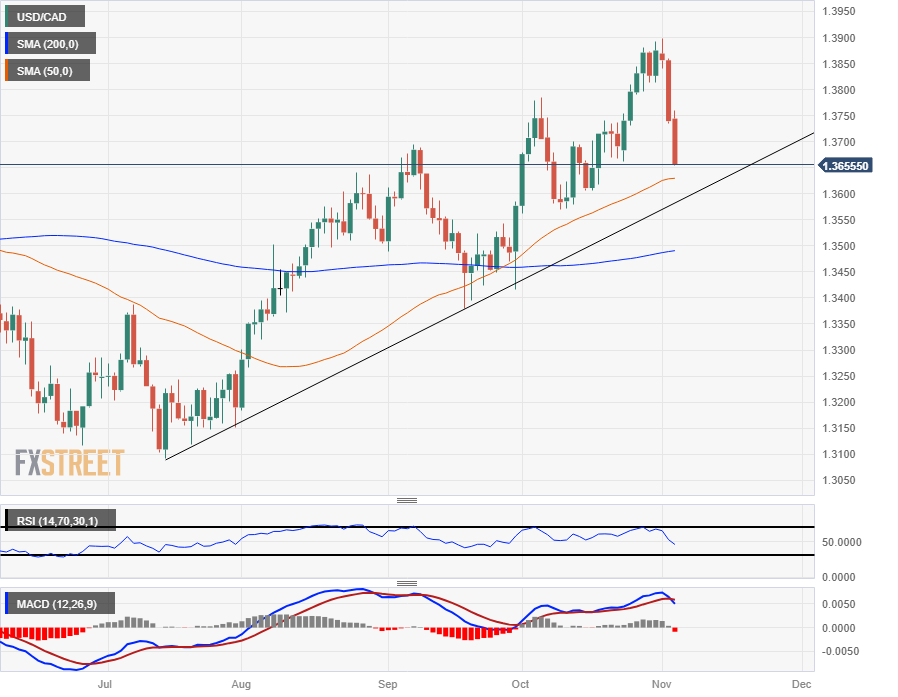
The USD/CAD pair fell to an intraday low of 1.3654 following the NFP print, breaking into a new 2-week low.
The USD/CAD is set for a decline back into the 50-day Simple Moving Average (SMA) near 1.3625, with long-term declines seeing a price floor near 1.3500 at the 200-day SMA.
On the top side, a bullish break will need to find enough momentum to crack the 1.3900 handle before the USD/CAD can take another run at 12-month highs beyond late 2022’s peak of 1.3978.
USD/CAD Daily Chart
Nonfarm Payrolls FAQs
What are Nonfarm Payrolls?
Nonfarm Payrolls (NFP) are part of the US Bureau of Labor Statistics monthly jobs report. The Nonfarm Payrolls component specifically measures the change in the number of people employed in the US during the previous month, excluding the farming industry.
How does Nonfarm Payrolls influence the Federal Reserve monetary policy decisions?
The Nonfarm Payrolls figure can influence the decisions of the Federal Reserve by providing a measure of how successfully the Fed is meeting its mandate of fostering full employment and 2% inflation.
A relatively high NFP figure means more people are in employment, earning more money and therefore probably spending more. A relatively low Nonfarm Payrolls’ result, on the either hand, could mean people are struggling to find work.
The Fed will typically raise interest rates to combat high inflation triggered by low unemployment, and lower them to stimulate a stagnant labor market.
How does Nonfarm Payrolls affect the US Dollar?
Nonfarm Payrolls generally have a positive correlation with the US Dollar. This means when payrolls’ figures come out higher-than-expected the USD tends to rally and vice versa when they are lower.
NFPs influence the US Dollar by virtue of their impact on inflation, monetary policy expectations and interest rates. A higher NFP usually means the Federal Reserve will be more tight in its monetary policy, supporting the USD.
How does Nonfarm Payrolls affect Gold?
Nonfarm Payrolls are generally negatively-correlated with the price of Gold. This means a higher-than-expected payrolls’ figure will have a depressing effect on the Gold price and vice versa.
Higher NFP generally has a positive effect on the value of the USD, and like most major commodities Gold is priced in US Dollars. If the USD gains in value, therefore, it requires less Dollars to buy an ounce of Gold.
Also, higher interest rates (typically helped higher NFPs) also lessen the attractiveness of Gold as an investment compared to staying in cash, where the money will at least earn interest.
Sometimes Nonfarm Payrolls trigger an opposite reaction than what the market expects. Why is that?
Nonfarm Payrolls is only one component within a bigger jobs report and it can be overshadowed by the other components.
At times, when NFP come out higher-than-forecast, but the Average Weekly Earnings is lower than expected, the market has ignored the potentially inflationary effect of the headline result and interpreted the fall in earnings as deflationary.
The Participation Rate and the Average Weekly Hours components can also influence the market reaction, but only in seldom events like the “Great Resignation” or the Global Financial Crisis.
Author

Joshua Gibson
FXStreet
Joshua joins the FXStreet team as an Economics and Finance double major from Vancouver Island University with twelve years' experience as an independent trader focusing on technical analysis.