Canadian Dollar pares some losses in lopsided Wednesday trading
- The Canadian Dollar recovered some ground on Wednesday.
- Canada remains absent from the economic calendar, strictly low-tier data on offer.
- The CAD shed some weight against the Greenback post-US CPI.

The Canadian Dollar (CAD) pared back some recent losses across the currency board on Wednesday, but a lopsided performance for the CAD still sees some red spots after the Greenback caught a bounce on a US Consumer Price Index (CPI) inflation print that met model forecasts but not investor expectations.
Canada continues its trend of delivering only low-tier economic data releases this week, leaving the CAD at the mercy of overall market flows. A recent recovery streak for the Canadian Dollar looks set to end, with CAD traders left to wait until next week’s Bank of Canada (BoC) CPI inflation print.
Daily digest market movers: US CPI dominates headlines as price pressures cool
- Canadian Dollar traded down against the Greenback, but stuck within one-tenth of one percent.
- US CPI inflation figures cooled in-line with median market forecasts.
- However, investors had set themselves up for further declines after this week’s tumble in US PPI inflation figures.
- US CPI inflation broadly printed as markets expected, with core CPI inflation ticking down to 3.2% YoY from the previous 3.3%.
- Both headline and core CPI ticked up to 0.2% MoM, also as-expected.
- Annualized CPI also shifted lower to 2.9% in July, below the forecasted hold at 3.0%.
Canadian Dollar price forecast: CAD win streak poised to falter near 1.3700
The Canadian Dollar (CAD) found thin gains around the major currency board on Wednesday, but remains hobbled by the US Dollar. CAD losses against the Greenback remain constrained, trading within 0.1% during the midweek market session.
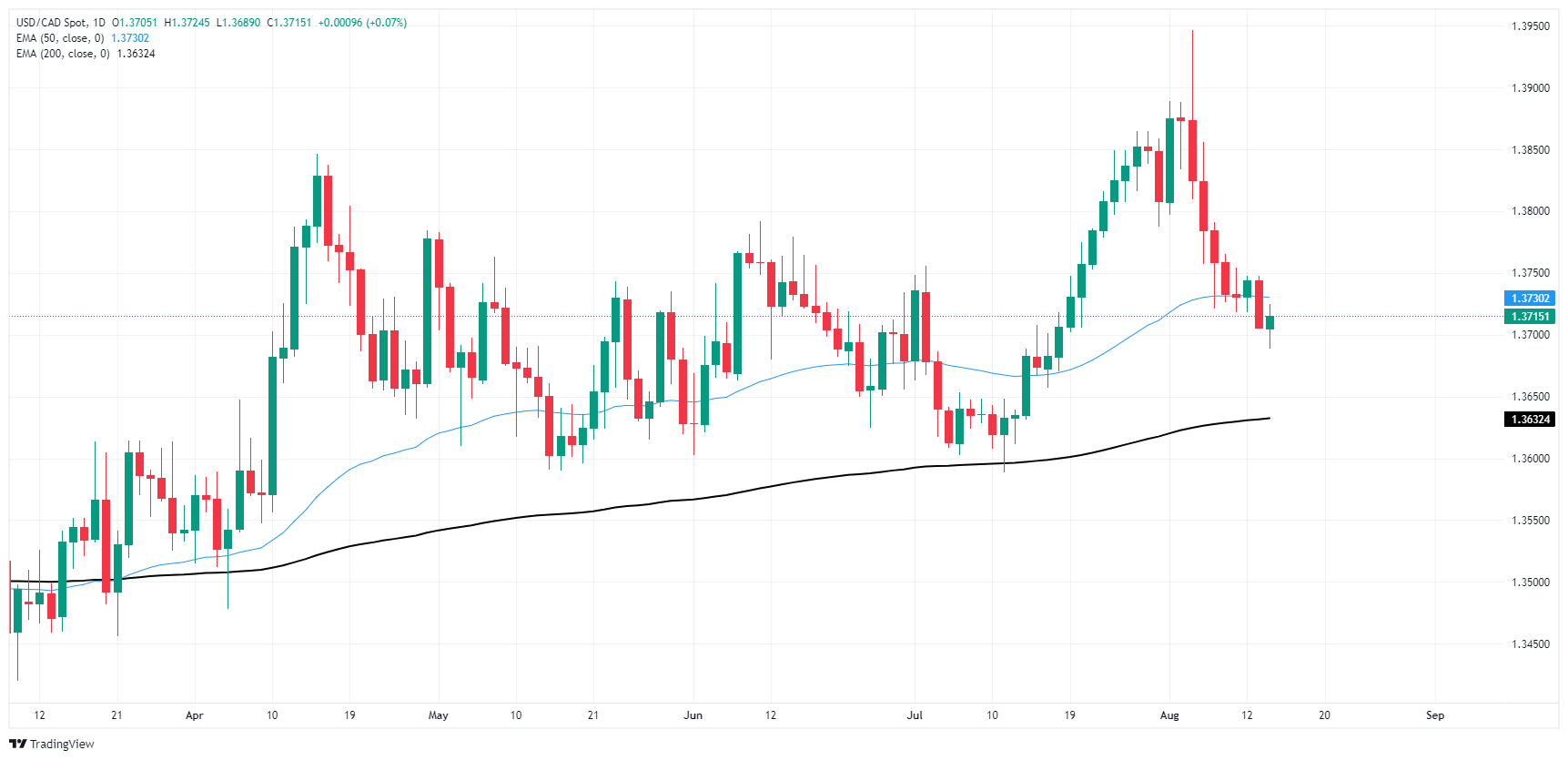
USD/CAD has pumped the brakes on a Canadian Dollar recovery, at least in the near term. The pair is trading south of the 50-day Exponential Moving Average (EMA), but Greenback sellers were unable to extend the CAD’s recovery and drive USD/CAD bids all the way down to the 200-day EMA at 1.3632.
USD/CAD daily chart
Canadian Dollar FAQs
The key factors driving the Canadian Dollar (CAD) are the level of interest rates set by the Bank of Canada (BoC), the price of Oil, Canada’s largest export, the health of its economy, inflation and the Trade Balance, which is the difference between the value of Canada’s exports versus its imports. Other factors include market sentiment – whether investors are taking on more risky assets (risk-on) or seeking safe-havens (risk-off) – with risk-on being CAD-positive. As its largest trading partner, the health of the US economy is also a key factor influencing the Canadian Dollar.
The Bank of Canada (BoC) has a significant influence on the Canadian Dollar by setting the level of interest rates that banks can lend to one another. This influences the level of interest rates for everyone. The main goal of the BoC is to maintain inflation at 1-3% by adjusting interest rates up or down. Relatively higher interest rates tend to be positive for the CAD. The Bank of Canada can also use quantitative easing and tightening to influence credit conditions, with the former CAD-negative and the latter CAD-positive.
The price of Oil is a key factor impacting the value of the Canadian Dollar. Petroleum is Canada’s biggest export, so Oil price tends to have an immediate impact on the CAD value. Generally, if Oil price rises CAD also goes up, as aggregate demand for the currency increases. The opposite is the case if the price of Oil falls. Higher Oil prices also tend to result in a greater likelihood of a positive Trade Balance, which is also supportive of the CAD.
While inflation had always traditionally been thought of as a negative factor for a currency since it lowers the value of money, the opposite has actually been the case in modern times with the relaxation of cross-border capital controls. Higher inflation tends to lead central banks to put up interest rates which attracts more capital inflows from global investors seeking a lucrative place to keep their money. This increases demand for the local currency, which in Canada’s case is the Canadian Dollar.
Macroeconomic data releases gauge the health of the economy and can have an impact on the Canadian Dollar. Indicators such as GDP, Manufacturing and Services PMIs, employment, and consumer sentiment surveys can all influence the direction of the CAD. A strong economy is good for the Canadian Dollar. Not only does it attract more foreign investment but it may encourage the Bank of Canada to put up interest rates, leading to a stronger currency. If economic data is weak, however, the CAD is likely to fall.
Author

Joshua Gibson
FXStreet
Joshua joins the FXStreet team as an Economics and Finance double major from Vancouver Island University with twelve years' experience as an independent trader focusing on technical analysis.