Canadian Dollar flatlines as markets await NFP
- The Canadian Dollar churned on Thursday, holding flat against the Greenback.
- PMI figures from Canada contracted sharply in January, limiting Loonie gains.
- Key US NFP and Canadian employment figures are due on Friday.

The Canadian Dollar (CAD) spun in a tight circle on Thursday, churning chart paper near 1.4300 against the US Dollar (USD) as markets gear up for another Nonfarm Payrolls (NFP) Friday. Markets are treading water near familiar levels as investors shrug off the early week’s trade war fears and resume focusing on hopes for future Federal Reserve (Fed) rate cuts.
Canadian Purchasing Managers Index (PMI) figures for January sharply missed the mark on Thursday. Canadian Net Change in Employment and Average Hourly Wages numbers are due on Friday but will be overshadowed by the much larger US NFP jobs data package.
Daily digest market movers: Canadian Dollar flattens ahead of NFP
- The Canadian Dollar has fought back from 21-year lows this week, but remains trapped in familiar consolidation territory against the Greenback.
- Canada’s Ivey PMI for January contracted sharply on a seasonally adjusted basis, falling to a four-year low of 47.1.
- US tariffs on Mexico and Canada have been kicked down the road by another 30 days, and market tensions are loosening for the time being.
- US tariffs on China are still in place, as are reciprocal tariffs on the US from China, but these tit-for-tat import fees are largely symbolic and markets are expected to circumvent them quickly.
- Canada is expected to add far fewer jobs in January compared to December, down to 25K from 90.9K, and the Canadian Unemployment rate is forecast to tick up to 6.8% from 6.7%.
- Friday’s US NFP is likewise expected to shift lower to 170K net new jobs additions from 256K, but bumper labor prints from earlier in the week could signal an upside surprise.
Canadian Dollar price forecast
With key data due to wrap up the trading week, the Canadian Dollar is stuck back in familiar consolidation territory against the US Dollar. USD/CAD remains hung up on the 1.4300 handle, at the bottom end of a choppy sideways grind that has kept the pair traveling horizontally since mid-December.
The Loonie tumbled early this week to a 21-year low against the Greenback, sending USD/CAD to a two-decade high near 1.4800, but the move was unsustainable and the pair is now back to its middling ways. Price action is drawing into the midrange at the 50-day Exponential Moving Average (EMA), and it will take a material shift in markets to punch in new technical levels.
USD/CAD daily chart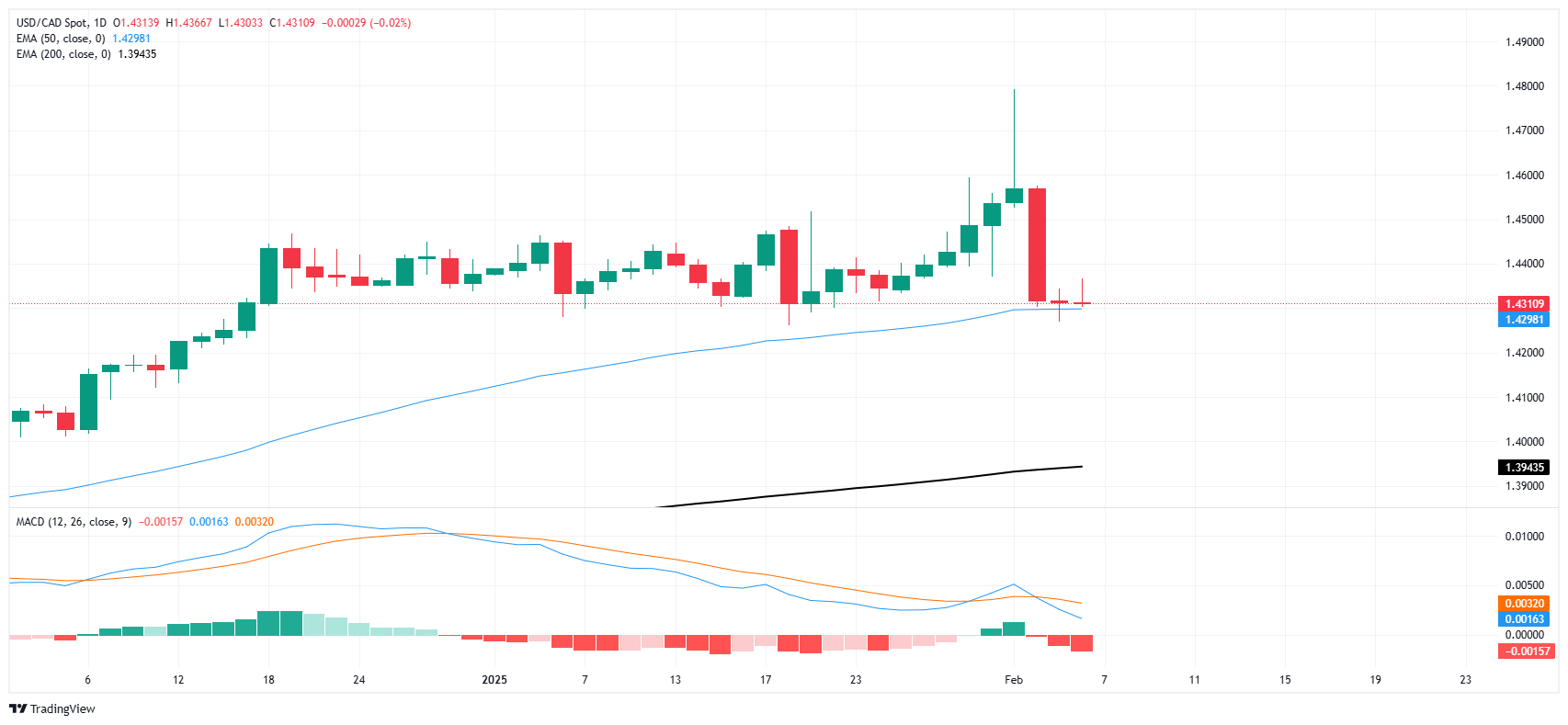
Economic Indicator
Net Change in Employment
The Net Change in Employment released by Statistics Canada is a measure of the change in the number of people in employment in Canada. Generally speaking, a rise in this indicator has positive implications for consumer spending and indicates economic growth. Therefore, a high reading is seen as bullish for the Canadian Dollar (CAD), while a low reading is seen as bearish.
Read more.Next release: Fri Feb 07, 2025 13:30
Frequency: Monthly
Consensus: 25K
Previous: 90.9K
Source: Statistics Canada
Canada’s labor market statistics tend to have a significant impact on the Canadian dollar, with the Employment Change figure carrying most of the weight. There is a significant correlation between the amount of people working and consumption, which impacts inflation and the Bank of Canada’s rate decisions, in turn moving the C$. Actual figures beating consensus tend to be CAD bullish, with currency markets usually reacting steadily and consistently in response to the publication.
Author

Joshua Gibson
FXStreet
Joshua joins the FXStreet team as an Economics and Finance double major from Vancouver Island University with twelve years' experience as an independent trader focusing on technical analysis.