Canadian Dollar churns into a choppy decline against Greenback after US ISM PMI miss
- US data prints miss the mark, ISM PMI and Factory Orders flub forecasts.
- Canada readies for another BoC rate call on Wednesday.
- CAD is softer on the day, only finding gains against USD.

The Canadian Dollar (CAD) climbed against the US Dollar (USD) on Tuesday before falling back once more after the US ISM Services Purchasing Managers Index (PMI) and US Factory Orders both missed forecasts. Market hopes for an accelerated path toward Federal Reserve (Fed) rate cuts are pinning back into the high end as US economic figures tease a steepening economic contraction in the US.
The Bank of Canada (BoC) makes another appearance on Wednesday to deliver what is broadly expected to be another rate hold at 5.0%. ADP Employment Change for the US will dwarf moves from the BoC’s Governor Tiff Macklem, and Fed Chairman Jerome Powell will be making his first of two appearances to testify about the Fed’s Semi-Annual Monetary Policy Report before the US Congress’ House Financial Services Committee.
Daily digest market movers: CAD pares Greenback losses after US data softens
- February’s US ISM Services PMI declined to 52.6 versus the forecast of 53.0, 53.4 previously.
- ISM Services Prices Paid also fell to 58.6 from the previous 64.0.
- US Factory Orders in January slid to -3.6% MoM, missing the -2.9% forecast, and the previous month’s print saw a downside revision to -0.3% from 0.2%.
- Markets shrugged off an uptick in the US S&P Global Composite PMI for February, which ticked up to 52.5 from the forecast hold at 51.4.
- Wednesday’s US ADP Employment Change is forecast to print at 150K versus the previous 107K.
- The BoC is expected to hold rates at 5.0% on Wednesday.
- BoC Preview: Forecasts from seven major banks
Canadian Dollar price today
The table below shows the percentage change of Canadian Dollar (CAD) against listed major currencies today. Canadian Dollar was the weakest against the Japanese Yen.
| USD | EUR | GBP | CAD | AUD | JPY | NZD | CHF | |
| USD | 0.02% | -0.07% | 0.17% | 0.08% | -0.40% | 0.21% | -0.22% | |
| EUR | -0.03% | -0.11% | 0.15% | 0.03% | -0.42% | 0.16% | -0.22% | |
| GBP | 0.08% | 0.10% | 0.24% | 0.13% | -0.32% | 0.28% | -0.13% | |
| CAD | -0.19% | -0.16% | -0.27% | -0.14% | -0.58% | 0.00% | -0.38% | |
| AUD | -0.09% | -0.04% | -0.15% | 0.12% | -0.46% | 0.12% | -0.26% | |
| JPY | 0.39% | 0.41% | 0.29% | 0.57% | 0.42% | 0.61% | 0.19% | |
| NZD | -0.21% | -0.17% | -0.29% | -0.03% | -0.13% | -0.63% | -0.39% | |
| CHF | 0.21% | 0.22% | 0.12% | 0.38% | 0.27% | -0.20% | 0.41% |
The heat map shows percentage changes of major currencies against each other. The base currency is picked from the left column, while the quote currency is picked from the top row. For example, if you pick the Euro from the left column and move along the horizontal line to the Japanese Yen, the percentage change displayed in the box will represent EUR (base)/JPY (quote).
Technical analysis: Canadian Dollar broadly softer on Tuesday, but pares losses against Greenback
The Canadian Dollar (CAD) is broadly flat to lower against the majority of its major currency peers on Tuesday, shedding a quarter of a percent against both the Pound Sterling (GBP) and the Japanese Yen (JPY). The CAD is flat against the New Zealand Dollar (NZD), trading within a tenth of a percent of Tuesday’s opening bids.
The USD/CAD rose early Tuesday, getting rejected once again from the 1.3600 handle and trading back into congestion. The USD eased back to a session low of 1.3555 against the Canadian Dollar before the pair recovered to familiar territory near 1.3580.
USD/CAD continues to knock into the 1.3600 handle as daily candles pull into congestion. The pair continues to find support above the 200-day Simple Moving Average (SMA) at 1.3477.
USD/CAD hourly chart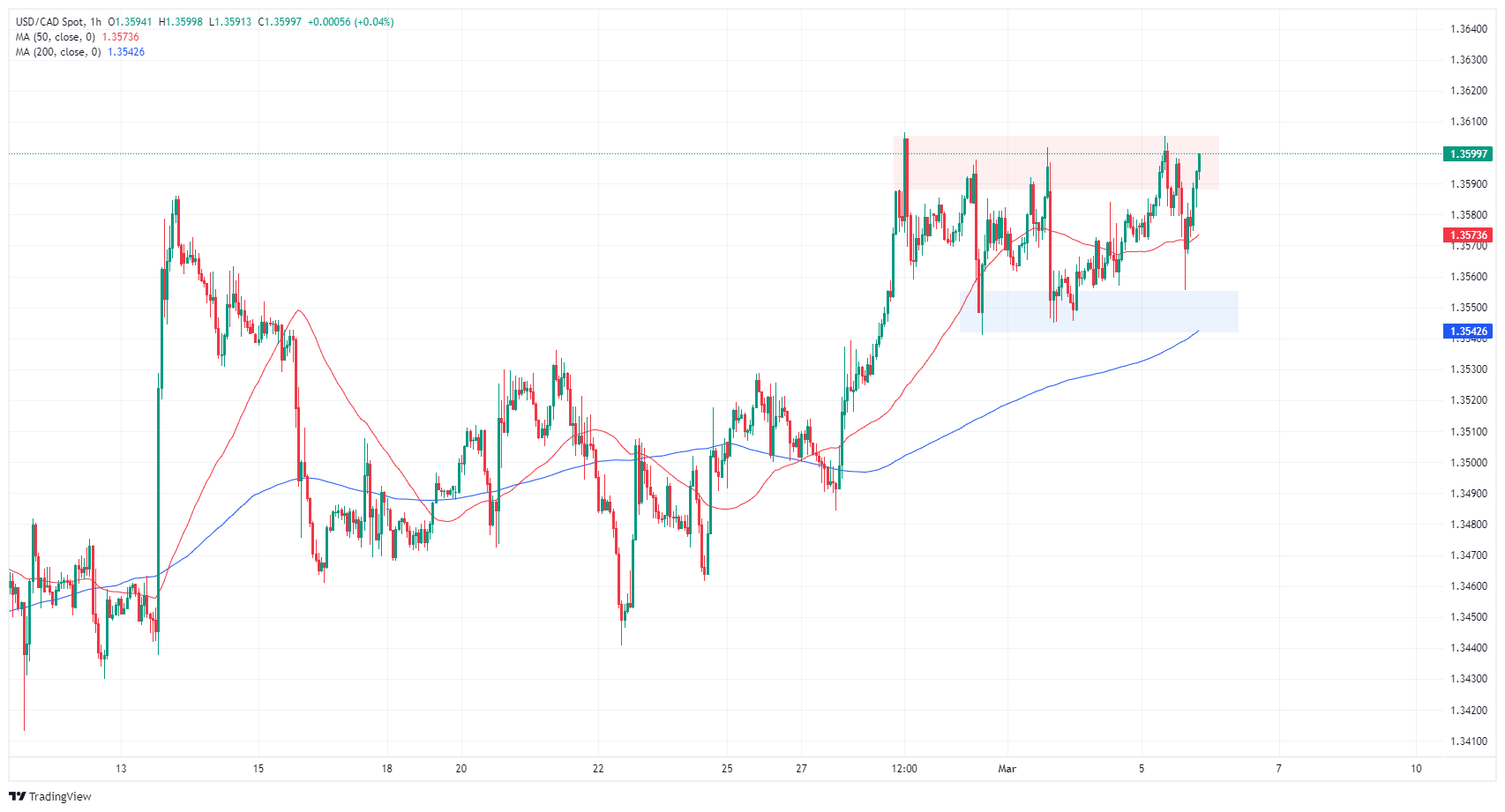
USD/CAD daily chart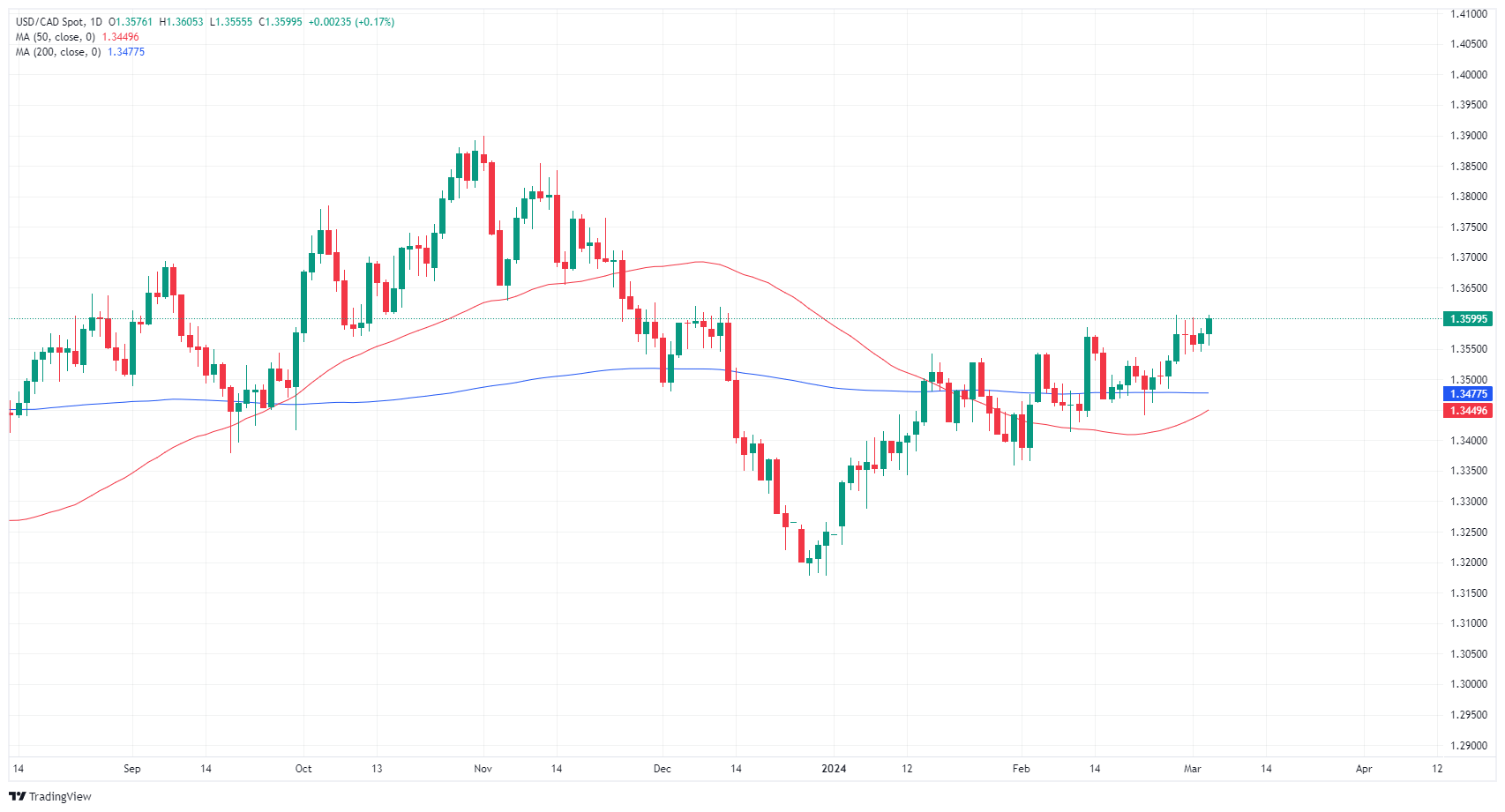
Canadian Dollar FAQs
The key factors driving the Canadian Dollar (CAD) are the level of interest rates set by the Bank of Canada (BoC), the price of Oil, Canada’s largest export, the health of its economy, inflation and the Trade Balance, which is the difference between the value of Canada’s exports versus its imports. Other factors include market sentiment – whether investors are taking on more risky assets (risk-on) or seeking safe-havens (risk-off) – with risk-on being CAD-positive. As its largest trading partner, the health of the US economy is also a key factor influencing the Canadian Dollar.
The Bank of Canada (BoC) has a significant influence on the Canadian Dollar by setting the level of interest rates that banks can lend to one another. This influences the level of interest rates for everyone. The main goal of the BoC is to maintain inflation at 1-3% by adjusting interest rates up or down. Relatively higher interest rates tend to be positive for the CAD. The Bank of Canada can also use quantitative easing and tightening to influence credit conditions, with the former CAD-negative and the latter CAD-positive.
The price of Oil is a key factor impacting the value of the Canadian Dollar. Petroleum is Canada’s biggest export, so Oil price tends to have an immediate impact on the CAD value. Generally, if Oil price rises CAD also goes up, as aggregate demand for the currency increases. The opposite is the case if the price of Oil falls. Higher Oil prices also tend to result in a greater likelihood of a positive Trade Balance, which is also supportive of the CAD.
While inflation had always traditionally been thought of as a negative factor for a currency since it lowers the value of money, the opposite has actually been the case in modern times with the relaxation of cross-border capital controls. Higher inflation tends to lead central banks to put up interest rates which attracts more capital inflows from global investors seeking a lucrative place to keep their money. This increases demand for the local currency, which in Canada’s case is the Canadian Dollar.
Macroeconomic data releases gauge the health of the economy and can have an impact on the Canadian Dollar. Indicators such as GDP, Manufacturing and Services PMIs, employment, and consumer sentiment surveys can all influence the direction of the CAD. A strong economy is good for the Canadian Dollar. Not only does it attract more foreign investment but it may encourage the Bank of Canada to put up interest rates, leading to a stronger currency. If economic data is weak, however, the CAD is likely to fall.
Bank of Canada FAQs
The Bank of Canada (BoC), based in Ottawa, is the institution that sets interest rates and manages monetary policy for Canada. It does so at eight scheduled meetings a year and ad hoc emergency meetings that are held as required. The BoC primary mandate is to maintain price stability, which means keeping inflation at between 1-3%. Its main tool for achieving this is by raising or lowering interest rates. Relatively high interest rates will usually result in a stronger Canadian Dollar (CAD) and vice versa. Other tools used include quantitative easing and tightening.
In extreme situations, the Bank of Canada can enact a policy tool called Quantitative Easing. QE is the process by which the BoC prints Canadian Dollars for the purpose of buying assets – usually government or corporate bonds – from financial institutions. QE usually results in a weaker CAD. QE is a last resort when simply lowering interest rates is unlikely to achieve the objective of price stability. The Bank of Canada used the measure during the Great Financial Crisis of 2009-11 when credit froze after banks lost faith in each other’s ability to repay debts.
Quantitative tightening (QT) is the reverse of QE. It is undertaken after QE when an economic recovery is underway and inflation starts rising. Whilst in QE the Bank of Canada purchases government and corporate bonds from financial institutions to provide them with liquidity, in QT the BoC stops buying more assets, and stops reinvesting the principal maturing on the bonds it already holds. It is usually positive (or bullish) for the Canadian Dollar.
Author

Joshua Gibson
FXStreet
Joshua joins the FXStreet team as an Economics and Finance double major from Vancouver Island University with twelve years' experience as an independent trader focusing on technical analysis.