Canadian Dollar on second day of declines, giving up ground as markets pivot out of Loonie
- The Canadian Dollar is seeing pullback as investors seek Greenback pastures.
- Canada Trade Balance improves but fails to inspire CAD bidding.
- Broad-market risk sentiment is wobbling, sending safe havens higher.

The Canadian Dollar (CAD) is moving lower, giving up last week’s gains against the US Dollar (USD) as broader market sentiment twists on Tuesday. A large miss for Chinese trade data coupled with hawkish statements from Federal Reserve (Fed) officials are jointly hampering risk appetite.
Canada trade balance figures improved over previous figures, Exports and Imports both printed slight gains for September. Canadian Exports edged higher to $67.03 billion from $65.28 billion (revised upward from $64.56 billion), while Imports saw minor gains to $64.99 billion from August’s $64.33 billion, which was also revised higher from $63.84 billion.
Canada’s overall International Merchandise Trade for September increased to CAD $2.04 billion from August’s $950 million, revised higher from $720 million.
Daily Digest Market Movers: Canadian Dollar paring back recent gains as markets rotate into US Dollar once more
- The CAD is losing steam with global markets seeking safe harbor as last week’s risk-on mood evaporates.
- A miss for China trade figures sent early Tuesday’s markets into the red after Chinese Trade Balance numbers unexpectedly declined.
- Hawkish Fed appearances are chipping away at last week’s rally as Fed officials reiterate that the US central bank is not pre-committed to an end of rate hikes.
- Crude Oil prices are slumping in risk-off flows, further cutting support from the CAD.
- Russia reaffirmed their production reduction, potentially extending through next year’s first quarter, to little Crude Oil market effect.
- The US is acquiring additional Crude shipments to shore up national reserves, and throughput at both Chinese and US refineries is missing demand expectations, leaving more barrels in the pipeline than expected.
- US Treasury yields are easing, 10-year T-note down to 4.587% from 4.66%.
Technical Analysis: Canadian Dollar heading back to 1.3800 as US Dollar bids return
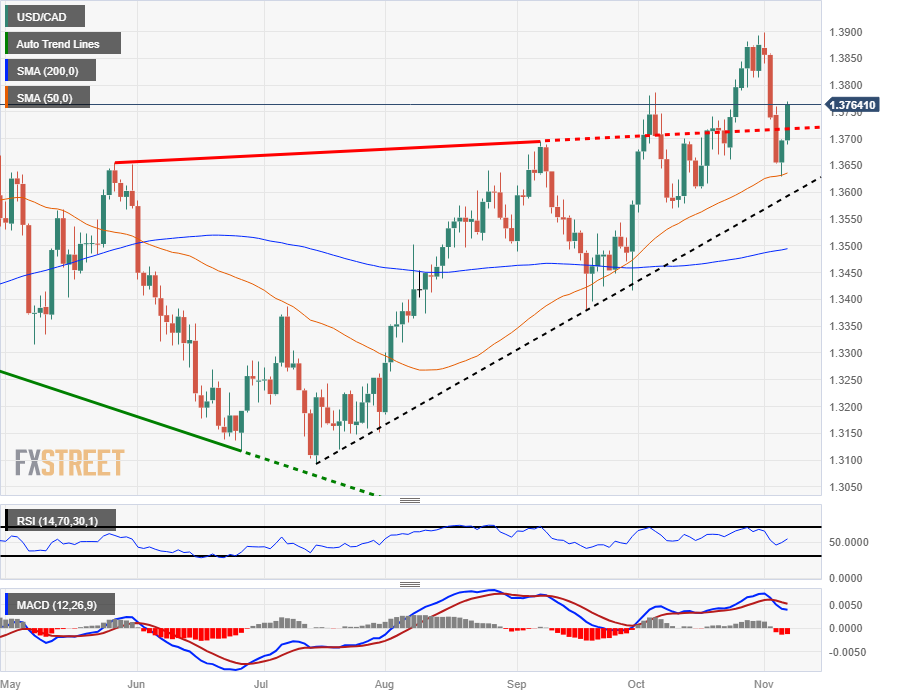
The Canadian Dollar (CAD) has pared back about half of last week’s gains against the US Dollar (USD), sending the USD/CAD back toward the 1.3800 handle after taking a clean bounce from the 50-day Simple Moving Average (SMA) near 1.3630.
A bullish continuation from here will see the pair marking an accelerating pace of higher lows as the USD/CAD begins to break away to the topside from a bullish trendline rising from July’s bottom bids near 1.3100. The near-term technical ceiling for bullish Greenback bidders sits at the last swing high into the 1.3900 handle.
The US Dollar is up over 5% against the Loonie from 2023’s low bids of 1.3092 and up over 1.5% on the year.
USD/CAD Daily Chart
Canadian Dollar price this week
The table below shows the percentage change of Canadian Dollar (CAD) against listed major currencies this week. Canadian Dollar was the weakest against the US Dollar.
| USD | EUR | GBP | CAD | AUD | JPY | NZD | CHF | |
| USD | 0.40% | 0.67% | 0.73% | 1.33% | 0.66% | 1.02% | 0.15% | |
| EUR | -0.39% | 0.31% | 0.34% | 0.94% | 0.27% | 0.62% | -0.24% | |
| GBP | -0.69% | -0.30% | 0.03% | 0.64% | -0.04% | 0.32% | -0.55% | |
| CAD | -0.73% | -0.33% | -0.05% | 0.61% | -0.07% | 0.29% | -0.58% | |
| AUD | -1.32% | -0.92% | -0.62% | -0.58% | -0.65% | -0.29% | -1.16% | |
| JPY | -0.67% | -0.28% | -0.20% | 0.11% | 0.69% | 0.33% | -0.51% | |
| NZD | -1.03% | -0.62% | -0.34% | -0.28% | 0.32% | -0.37% | -0.82% | |
| CHF | -0.17% | 0.23% | 0.53% | 0.56% | 1.16% | 0.51% | 0.85% |
The heat map shows percentage changes of major currencies against each other. The base currency is picked from the left column, while the quote currency is picked from the top row. For example, if you pick the Euro from the left column and move along the horizontal line to the Japanese Yen, the percentage change displayed in the box will represent EUR (base)/JPY (quote).
US Dollar FAQs
What is the US Dollar?
The US Dollar (USD) is the official currency of the United States of America, and the ‘de facto’ currency of a significant number of other countries where it is found in circulation alongside local notes. It is the most heavily traded currency in the world, accounting for over 88% of all global foreign exchange turnover, or an average of $6.6 trillion in transactions per day, according to data from 2022.
Following the second world war, the USD took over from the British Pound as the world’s reserve currency. For most of its history, the US Dollar was backed by Gold, until the Bretton Woods Agreement in 1971 when the Gold Standard went away.
How do the decisions of the Federal Reserve impact the US Dollar?
The most important single factor impacting on the value of the US Dollar is monetary policy, which is shaped by the Federal Reserve (Fed). The Fed has two mandates: to achieve price stability (control inflation) and foster full employment. Its primary tool to achieve these two goals is by adjusting interest rates.
When prices are rising too quickly and inflation is above the Fed’s 2% target, the Fed will raise rates, which helps the USD value. When inflation falls below 2% or the Unemployment Rate is too high, the Fed may lower interest rates, which weighs on the Greenback.
What is Quantitative Easing and how does it influence the US Dollar?
In extreme situations, the Federal Reserve can also print more Dollars and enact quantitative easing (QE). QE is the process by which the Fed substantially increases the flow of credit in a stuck financial system.
It is a non-standard policy measure used when credit has dried up because banks will not lend to each other (out of the fear of counterparty default). It is a last resort when simply lowering interest rates is unlikely to achieve the necessary result. It was the Fed’s weapon of choice to combat the credit crunch that occurred during the Great Financial Crisis in 2008. It involves the Fed printing more Dollars and using them to buy US government bonds predominantly from financial institutions. QE usually leads to a weaker US Dollar.
What is Quantitative Tightening and how does it influence the US Dollar?
Quantitative tightening (QT) is the reverse process whereby the Federal Reserve stops buying bonds from financial institutions and does not reinvest the principal from the bonds it holds maturing in new purchases. It is usually positive for the US Dollar.
Author

Joshua Gibson
FXStreet
Joshua joins the FXStreet team as an Economics and Finance double major from Vancouver Island University with twelve years' experience as an independent trader focusing on technical analysis.