|

Can the 14,700 support hold the key for DAX?

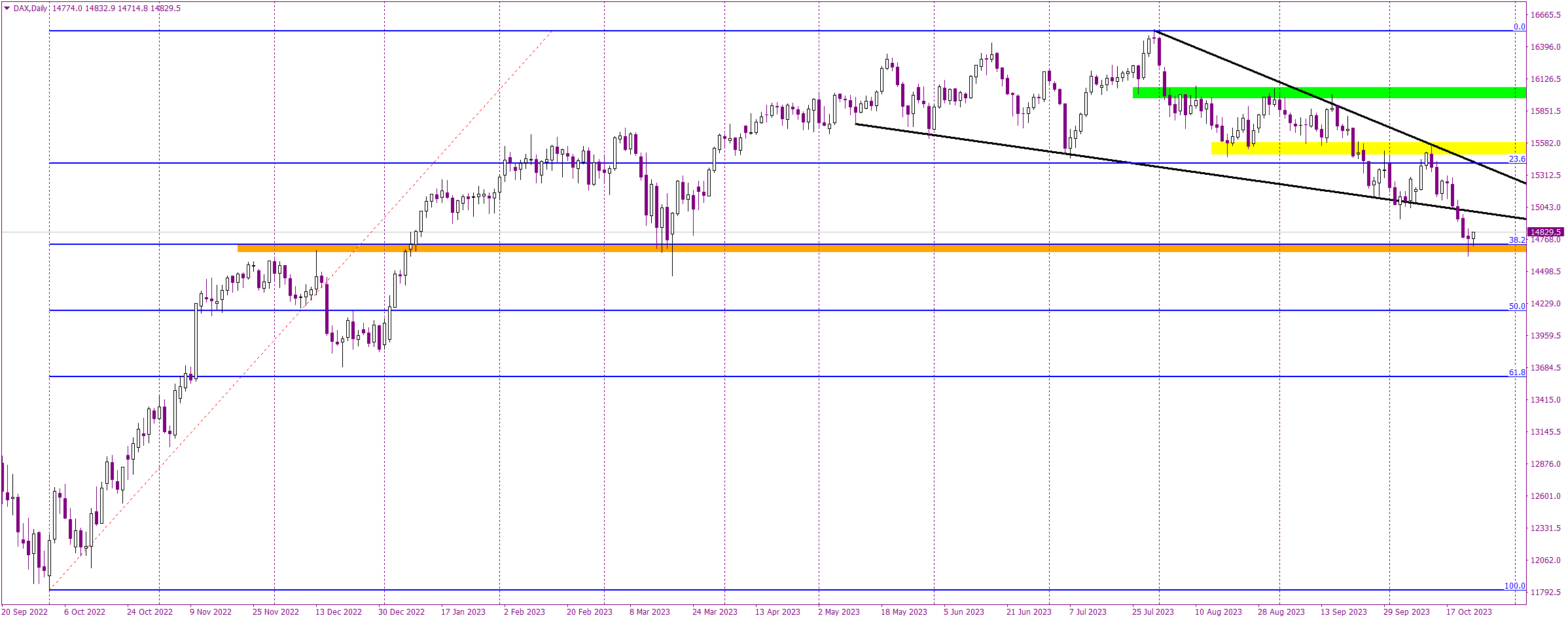
DAX finds itself at a crossroads today. Positioned at an undeniably pivotal juncture, the index currently oscillates around a significant horizontal support of 14,700 points, vividly highlighted by an orange line. Casting a glance back in time, this level has repeatedly demonstrated its prominence. Not only did it serve as a resistance toward the close of last year, but it also morphed into a support in March, standing firm as the bulls and bears tussled for dominance. Moreover, this isn’t just any ordinary support. It coincides perfectly with the 38.2% Fibonacci retracement level, underscoring its vital importance in the grander scheme of things.
DAX

Yesterday's trading session provided a glimpse into the potential of this support. The bears, in a bid to push the index further south, were thwarted in their endeavors, leading to a bounce off this crucial level. The end result? A doji candle, one that traditionally signals indecision but offers a glimmer of hope for those bullish on DAX. But to truly understand the current scenario, one must zoom out and analyze the broader landscape. Until recently, the downward movement was comfortably nestled within a wedge pattern, demarcated by black lines. However, the past week witnessed a breach, with prices slicing through the lower boundary of this pattern. This shift is a glaring testament to the mounting bearish pressure, and it's clear that the bulls are in a tight spot.

For those mulling over trading strategies, here's the lowdown: a robust bounce from this level, accompanied by substantial volume and a strong bullish candle, could act as a green light for a long position. Conversely, if the price were to shatter the orange support and close beneath it, it would not only be a bearish signal but potentially the proverbial 'writing on the wall' for DAX's bullish prospects.

Author

Tomasz Wisniewski

Tomasz Wisniewski

Axiory Global Ltd.

Tomasz was born in Warsaw, Poland on 25th October, 1985.

More from Tomasz Wisniewski
Share:

Editor's Picks

GBP/USD bounces off four-day lows, still below 1.3500

GBP/USD sticks to the bearish tone on Thursday, coming down to the 1.3480 region in the latter part of the NA session. In the meantime, Cable’s weakness comes as investors continue to assess mixed UK data, poor US results, and the persistent uncertainty surrounding the US-Iran conflict.

EUR/USD looks apathetic around 1.1530

EUR/USD reverses Wednesday’s downtick and trades with modest gains in the 1.1530 region following the end of the NA session on Thursday. The pair’s tepid advance comes on the back of the absence of clear direction in the US Dollar despite tensions from the Middle East appear far from alleviated. Later on Friday, investors are expected to monitor the the releases of another revision of GDP figures in the Euroland, US Retail Sales and the preliminary U-Mich gauge.

Gold remains on the defensive below $4,350; downside seems cushioned

Gold trades below $4,350 during the Asian session on Friday and looks to extend the previous day's pullback from the highest level since June 5 as the US-Iran standoff continues to underpin the US Dollar's reserve-currency status. However, reduced bets for an immediate Fed rate hike, amid signs of cooling US inflation, should act as a tailwind for the non-yielding bullion and help limit deeper losses.

Dogecoin reclaims $0.07 support as whales step in
Dogecoin (DOGE) edges above the daily open, trading above $0.070 as of Thursday. While this uptick offers a positive signal, DOGE continues to trade within a broader bearish context, down approximately 12% from its July peak of $0.079. Still, should the $0.070 support level hold, the mild recovery could gather pace, targeting resistance at $0.080 and potentially the key $0.100 threshold.
Why credit markets aren’t pricing $570B of AI debt

Forecasts put global artificial intelligence related debt issuance near $570 billion this year, with roughly $236 billion of it priced by the end of May at four times the prior year's pace. Data centre securitisation alone has gone from about $4 billion a year through 2022 to roughly $10 billion in each of 2023 and 2024, and then $27 billion in 2025.

Why is Crude Oil priced for a reopening the ships haven't made?
Fourteen vessels crossed the Strait of Hormuz on Tuesday. Before the war, the count ran near 120 a day. In the sessions since the waterway was publicly declared open, Brent has drifted back to $87 and West Texas Intermediate (WTI) to $81, both a little lower again on Wednesday, with daily momentum on each unwound from the top of its range in late July to the low twenties now.