Breaking: RBA SoMP's, level of A$ broadly consistent with fundamentals

The Reserve Bank of Australia has released the May Statement on Monetary Policy.
''The central bank upgraded forecasts for the country’s economy on Friday led by record low interest rates and generous fiscal support, though inflation and wages growth are still seen lagging in a sign monetary policy will remain “highly accommodative” for years to come,'' Reuters reports.
''In its 82-page quarterly Statement on Monetary Policy, the Reserve Bank of Australia (RBA) predicted economic growth could almost hit double figures in the current quarter, a huge turnaround from last year's pandemic-induced recession.''
''Yet it emphasised the economy remains well short of full employment and wage growth is just too slow.''
These updated forecasts as follows will be closely scrutinised by markets:
RBA statement on monetary policy
Economy beating forecasts but policy needs to remain highly accommodative.
Will not raise rates until actual inflation in target range, unlikely until 2024.
RBAraises growth forecasts, GDP expected to have reached pre-pandemic levels in q1 2021.
RBA sees unemployment June 2021 at 5.25%, dec 2021 at 5.0%, dec 2022 at 4.5%, June 2023 at 4.5%.
RBA sees underlying inflation June 2021 at 1.5%, dec 2021 at 1.5%, dec 2022 at 1.75%, June 2023 at 2.0%.
RBA sees June 2021 GDP at 9.25%, Dec 2021 at 4.75%, Dec 2022 at 3.5%, June 2023 at 3%.
RBA sees wage growth June 2021 at 1.5%, Dec 2021 at 1.75%, Dec 2022 at 2.25%, June 2023 at 2.25%.
Wage growth has been especially slow, expected to remain low.
Will be "some years" before wage growth fast enough to lift inflation to target.
End of jobkeeper losses to be more than offset by labour demand overall.
RBA baseline scenario assumes vaccinations pick up in 2h, borders reopen in early 2022.
RBA upside scenario sees unemployment at 3.75% by mid-2023, core inflation at 2.25%.
Border closure had limited overall impact so far, could push up wages if extended.
RBA household consumption and savings an important source of uncertainty.
Boost to household incomes, wealth to offset drag from slow population growth.
Closely monitoring home lending to ensure standards are maintained
Level of A$ broadly consistent with fundamentals.
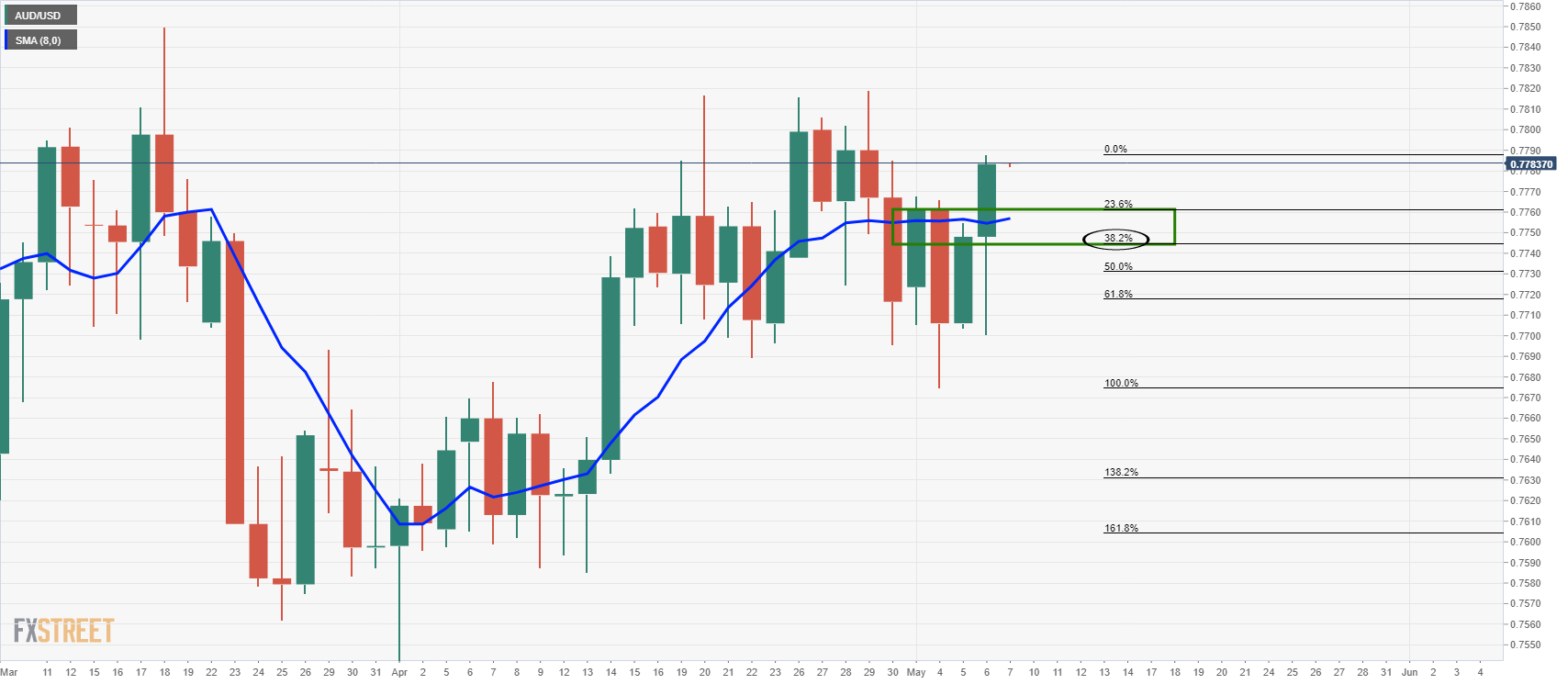
AUD/USD implications
The market has moved over this very quickly and shrugged it off.
The focus is in the US dollar while the commodity markets have already priced in a faster than first though recovery from the covid crisis.
The Aussie has benefitted from this and has already made a move ahead of today's Nonfarm payrolls to where it now consolidates anticipation.
Daily chart
Description of the RBA Monetary Policy Statement
The RBA Monetary Policy Statement released by the Reserve bank of Australia reviews economic and financial conditions determines the appropriate stance of monetary policy and assesses the risks to its long-run goals of price stability and sustainable economic growth.
It is considered as a clear guide to the future RBA interest rate policy. Any changes in this report affect the AUD volatility.
If the RBA statement shows a hawkish outlook, that is seen as positive (or bullish) for the AUD, while a dovish outlook is seen as negative (or bearish).
Author

FXStreet Team
FXStreet
Composed of a group of economic journalists and FX experts, the FXStreet content team produces and oversees all content published on FXStreet. It provides a purely journalistic approach to the Forex market.