|

Breaking: Gold rises to $1,800 for the first time in a month

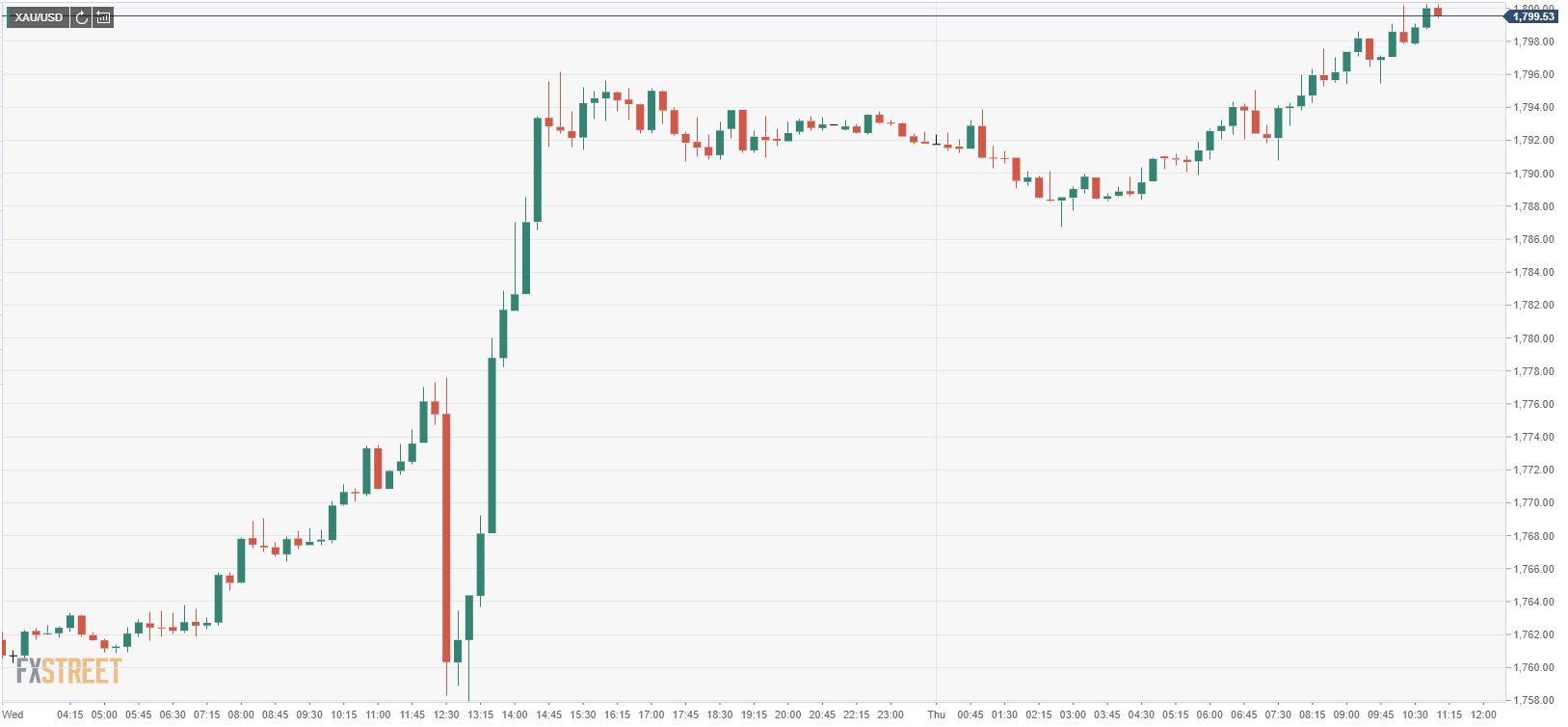
Following Wednesday's impressive upsurge, gold preserved its bullish momentum in the first half of the day Thursday and touched $1,800 for the first time since mid-September.

At the time of press, the XAU/USD pair was up 0.4% on the day at $1,800.15.

Falling US Treasury bond yields seem to be fueling gold's rally in the second half of the week. After bond markets returned to action on Tuesday, the benchmark 10-year US Treasury bond yield lost nearly 6% and was last seen falling 0.9% on the day at 1.525%. 

Moreover, the poor performance of US Treasury yields continues to weigh on the greenback with the US Dollar Index dropping to fresh 10-day lows near 93.80.

Later in the session, the weekly Initial Jobless Claims and September Producer Price Index data will be featured in the US economic docket. 

Gold Price Forecast: XAU/USD to see further gains on a daily close above 200-DMA.

Gold 15-min chart
Technical levels to watch for

XAU/USD

Overview
Today last price1800.01
Today Daily Change7.05
Today Daily Change %0.39
Today daily open1792.96
 
Trends
Daily SMA201757.5
Daily SMA501776.98
Daily SMA1001800.3
Daily SMA2001796.79
 
Levels
Previous Daily High1796.17
Previous Daily Low1757.97
Previous Weekly High1781.38
Previous Weekly Low1746.07
Previous Monthly High1834.02
Previous Monthly Low1721.71
Daily Fibonacci 38.2%1781.58
Daily Fibonacci 61.8%1772.56
Daily Pivot Point S11768.56
Daily Pivot Point S21744.17
Daily Pivot Point S31730.36
Daily Pivot Point R11806.76
Daily Pivot Point R21820.57
Daily Pivot Point R31844.96

Author

FXStreet Team

Composed of a group of economic journalists and FX experts, the FXStreet content team produces and oversees all content published on FXStreet. It provides a purely journalistic approach to the Forex market.


More from FXStreet Team
Share:

Editor's Picks

USD/JPY: Japanese Yen tumbles as Fed signals higher rate path

The Japanese Yen depreciated against the US Dollar on Wednesday after the US Federal Reserve delivered a hawkish hold, with most officials expecting one rate hike towards the end of the year, while the new Fed Chair, Warsh, reiterated the Fed’s commitment to achieving the 2% inflation goal. At the time of writing, the USD/JPY trades at 160.66 after bouncing off the daily low of 160.11.

AUD/USD benefits from softer USD as US-Iran deal counters Fed's hawkish tilt

AUD/USD edges higher during the Asian session on Thursday as the US Dollar retreats from its highest level since late March, touched in reaction to the Fed's hawkish tilt the previous day. The US and Iran signed a MoU aimed at ending the war and reopening the Strait of Hormuz, boosting investors' confidence and undermining the safe-haven USD. Furthermore, the RBA's signal that additional rate hikes remain possible, if inflation persists, acts as a tailwind for the Aussie.

Gold slumps to near $4,250 as Fed holds rates but flags potential hike this year

Gold price tumbles to around $4,280 during the early Asian session on Thursday. The precious metal faces some selling pressure after the US Federal Reserve decided to hold its benchmark interest rate steady but signaled a hike in borrowing costs later this year. 

Bitcoin remains under bearish pressure despite recent rebound — Glassnode

Bitcoin remains well below key onchain metrics, with realized losses continuing to dominate capital flows despite a partial price recovery. The top crypto rebounded from lows near $60,000 to the $65,000 range after the US-Iran peace deal reversed much of the war premium that had weighed on risk assets.

The next big AI trade may not be about chips or software
Artificial intelligence has already created some of the biggest winners in modern market history. Chipmakers have surged, data centre construction is booming, and electricity demand forecasts are changing globally.
Why a hawkish RBA is no longer enough to lift the Australian Dollar

The Reserve Bank of Australia delivered more than what markets expected: a hawkish hold that should have supported the Aussie. But markets widely ignored it, focusing instead on slowing economic growth and proving that central bank messaging alone isn’t always enough to drive currencies.