Boeing stock slides following continued engineering setbacks
- BA stock sank more tha 4% on Tuesday.
- On Monday, the FAA issued a directive due to concerns over several 787 models.
- Boeing's 777X test flights hit a snag involving engine mount part cracks.
- Victims' families want Boeing to pay a higher penalty for its deadly 787 MAX software failure.

The Boeing Company (BA) shed 4.2% on Tuesday after the previous day’s headlines threw a wrench into last week’s slight recovery.
Engineering issues have continued to plague the aerospace leader, which hasn’t seemed to catch a break since its famous failures concerning its 737 MAX model over the past decade.
The Dow Jones Industrial Average, of which Boeing is a member, rotated lower on Tuesday, losing 0.15%. However, it outperformed both the S&P 500 and NASDAQ indices.
Dow Jones pulls flat after choppy Tuesday
Boeing stock news
On Monday, Boeing’s management opted to ground its 777X test fleet after discovering cracks in the model’s engine mount setup. The company had just begun test flights for the 777X with US government regulators on board in July.
The plane is already a half decade behind schedule, and now this issue threatens to push the first deliveries back further. Until now, Boeing has been planning on delivering its first 777X units in 2025 and already has 540 orders logged.
On the same day, Monday, the US Federal Aviation Administration (FAA) issued an airworthiness directive for Boeing’s 787 Dreamliner. The directive comes in response to an incident in March when a LATAM Airlines 787 Dreamliner dove violently mid-flight, injuring about 50 passengers in the process.
The US regulator said it found that the issues stemmed from a sudden disconnection of the auto-pilot due to an issue with the captain’s seat. The regulator ordered airlines to run tests of their 787-8, 787-9 and 787-10 Dreamliner variants.
On the flipside, the US State Department this week also approved a $3.5 billion sale of Apache helicopters to the government of South Korea. Boeing produces Apache helicopters due to its acquisition of McDonnell Douglas back in 1997.
Boeing was back in the news last week when families of victims of 737 MAX crashes in Ethiopia and Indonesia asked a Texas judge to deny a criminal plea agreement by the company. Boeing agreed in July to pay more than $243 million in criminal damages due to hiding deficiencies in the 737 MAX software from federal regulators. Victims' families, however, want the judge to order a heavier fine.
Dow Jones FAQs
The Dow Jones Industrial Average, one of the oldest stock market indices in the world, is compiled of the 30 most traded stocks in the US. The index is price-weighted rather than weighted by capitalization. It is calculated by summing the prices of the constituent stocks and dividing them by a factor, currently 0.152. The index was founded by Charles Dow, who also founded the Wall Street Journal. In later years it has been criticized for not being broadly representative enough because it only tracks 30 conglomerates, unlike broader indices such as the S&P 500.
Many different factors drive the Dow Jones Industrial Average (DJIA). The aggregate performance of the component companies revealed in quarterly company earnings reports is the main one. US and global macroeconomic data also contributes as it impacts on investor sentiment. The level of interest rates, set by the Federal Reserve (Fed), also influences the DJIA as it affects the cost of credit, on which many corporations are heavily reliant. Therefore, inflation can be a major driver as well as other metrics which impact the Fed decisions.
Dow Theory is a method for identifying the primary trend of the stock market developed by Charles Dow. A key step is to compare the direction of the Dow Jones Industrial Average (DJIA) and the Dow Jones Transportation Average (DJTA) and only follow trends where both are moving in the same direction. Volume is a confirmatory criteria. The theory uses elements of peak and trough analysis. Dow’s theory posits three trend phases: accumulation, when smart money starts buying or selling; public participation, when the wider public joins in; and distribution, when the smart money exits.
There are a number of ways to trade the DJIA. One is to use ETFs which allow investors to trade the DJIA as a single security, rather than having to buy shares in all 30 constituent companies. A leading example is the SPDR Dow Jones Industrial Average ETF (DIA). DJIA futures contracts enable traders to speculate on the future value of the index and Options provide the right, but not the obligation, to buy or sell the index at a predetermined price in the future. Mutual funds enable investors to buy a share of a diversified portfolio of DJIA stocks thus providing exposure to the overall index.
Boeing stock chart
Boeing stock sure looks like a loser. Though it is already trading in the vicinity of this year's lows in the lower half of the $160s, the Relative Strength Index (RSI) still looks neutral. Any bottom feeders should wait until the RSI drops below 30 before adding shares.
The 20-day Simple Moving Average (SMA) is once again trading beneath the 50-day SMA, which is itself below the 200-day counterpart. This demonstrates the deep downtrend that Boeing finds itself in. BA shares will need to overcome the 200-day at $197 before mainstream traders will decide to take another look.
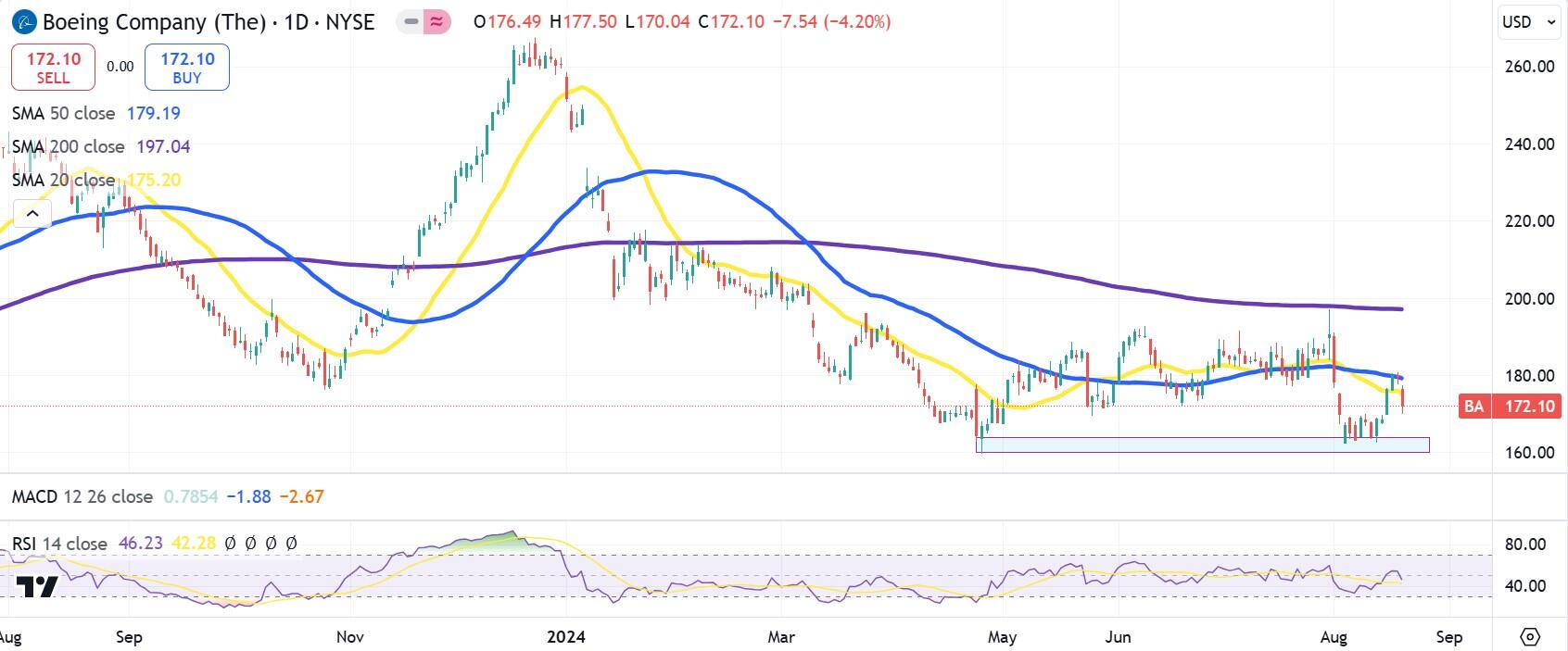
Boeing daily stock chart
Author

Clay Webster
FXStreet
Clay Webster grew up in the US outside Buffalo, New York and Lancaster, Pennsylvania. He began investing after college following the 2008 financial crisis.















