BoC's Macklem: The recent strengthening of CAD has had some impact on inflation

Bank of Canada Governor Tiff Macklem provides insights into the central bank’s policy outlook while responding to enquiries from reporters. This follows the bank’s decision to maintain its policy rate at 2.75%, a move that was widely expected by markets.

BoC press conference key highlights
We will be looking carefully at the next two CPI reports.
There is some underlying volatility in inflation.
I don't want to focus too closely on one month's data.
Uncertainty around US tariffs remains elevated.
Comments about the need for a possible future rate cut are not forward guidance.
The recent strengthening of CAD has had some effect on inflation.
The economy is somewhere between the scenarios outlined in April.
Since April, the likelihood of the bank's more severe scenario appears to have come down somewhat.
Canada's budget delay is not the biggest source of uncertainty.
We're putting more emphasis on soft data and information from business
Renewed US trade deal would allow activity to rebound
This section below was published at 13:45 GMT to cover the Bank of Canada's policy announcements and the initial market reaction.
On Wednesday, the Bank of Canada (BoC) held its policy rate steady at 2.75%, aligning with the expectations of market analysts.
BoC policy statement key highlights
Uncertainty over US tariffs remains high; we will seek more information on US trade policy and its impacts.
The BoC also cites unexpected firmness in recent inflation data and the fact the Canadian economy is softer, but not sharply weaker.
We will support economic growth while ensuring inflation remains well-controlled.
The Governing Council is proceeding carefully with particular attention to the risks and uncertainties facing the Canadian economy.
We are focused on ensuring Canadians continue to have confidence in price stability.
Says watching the extent to which US tariffs cut demand for exports, how quickly cost increases are passed on to consumer prices, and how inflation expectations evolve.
The Canadian economy is expected to be considerably weaker in Q2 than in Q1, with strength in exports and inventories reversing.
April's annual inflation rate excluding taxes was 2.3%, slightly stronger than expected.
The bank says it will continue to assess timing and strength of downward and upward pressures on inflation.
Market reaction
The Canadian Dollar (CAD) maintains its constructive stance on Wednesday, motivating USD/CAD to trade with modest losses around the 1.3700 neighbourhood following the BoC’s decision to leave rates unchanged.
Canadian Dollar PRICE Today
The table below shows the percentage change of Canadian Dollar (CAD) against listed major currencies today. Canadian Dollar was the strongest against the US Dollar.
| USD | EUR | GBP | JPY | CAD | AUD | NZD | CHF | |
|---|---|---|---|---|---|---|---|---|
| USD | -0.30% | -0.18% | -0.19% | -0.15% | -0.49% | -0.40% | -0.27% | |
| EUR | 0.30% | 0.08% | 0.08% | 0.12% | -0.20% | -0.12% | -0.00% | |
| GBP | 0.18% | -0.08% | -0.04% | 0.04% | -0.28% | -0.20% | -0.10% | |
| JPY | 0.19% | -0.08% | 0.04% | 0.05% | -0.35% | -0.15% | -0.08% | |
| CAD | 0.15% | -0.12% | -0.04% | -0.05% | -0.33% | -0.25% | -0.13% | |
| AUD | 0.49% | 0.20% | 0.28% | 0.35% | 0.33% | 0.08% | 0.20% | |
| NZD | 0.40% | 0.12% | 0.20% | 0.15% | 0.25% | -0.08% | 0.10% | |
| CHF | 0.27% | 0.00% | 0.10% | 0.08% | 0.13% | -0.20% | -0.10% |
The heat map shows percentage changes of major currencies against each other. The base currency is picked from the left column, while the quote currency is picked from the top row. For example, if you pick the Canadian Dollar from the left column and move along the horizontal line to the US Dollar, the percentage change displayed in the box will represent CAD (base)/USD (quote).
This section below was published as a preview of the Bank of Canada's (BoC) monetary policy announcements at 09:00 GMT.
- The Bank of Canada (BoC) is seen keeping rates unchanged.
- The Canadian Dollar navigates the area of yearly highs vs. the US Dollar.
- Headline CPI in Canada drifted below the central bank’s target.
- Trade policies should prevail at Governor Macklem’s press conference.
Market analysts generally predict that the Bank of Canada (BoC) will keep its interest rate at 2.75% on Wednesday, adding to the pauses recorded at the March and April monetary policy meetings.
In the meantime, the Canadian Dollar (CAD) has been steadily appreciating since it fell to yearly lows in the 1.4400 zone against the US Dollar (USD). The Loonie is currently navigating the area of YTD highs in the proximity of the 1.3700 region.
Meanwhile, the focus has been on US President Donald Trump's trade policies, particularly those pertaining to tariffs, since he took office again in January. It is anticipated that this particular topic will take centre stage during the BoC event, influencing both Governor Tiff Macklem's remarks and media enquiries.
As growing global uncertainties, mostly caused by the White House's inconsistent stance on tariffs, compel a reexamination of trade policy, the Bank of Canada is planning to keep interest rates paused once again for June. Given this uncertainty, it is probable that the BoC's announcement and Governor Macklem's subsequent news conference this week will be cautious in tone.
Following the bank’s decision to keep rates unchanged on April 16, Governor Tiff Macklem underlined again the bank's symmetric approach to its inflation objective, expressing worry when inflation veers either over or below the 2% level. He stressed that the phrase "decisively", used in earlier exchanges, shouldn't be taken as a policy cue.
Regarding the general state of the economy, Macklem underlined the need for adaptation in view of continuous uncertainty, especially with regard to taxes. Once trade circumstances stabilise, the Bank may go back to a more defined base case projection.
Carolyn Rogers, senior deputy governor, dismissed recent market swings, saying it is too early to draw fundamental conclusions. She underlined that institutions are properly funded with some ability to withstand volatility and that Canadian financial markets remain orderly.
Regarding monetary policy, Macklem said that the Governing Council debated between maintaining rates constant or cutting 25 basis points. Rogers also mentioned several Council members who were really hopeful and not anticipating further inflationary pressure.
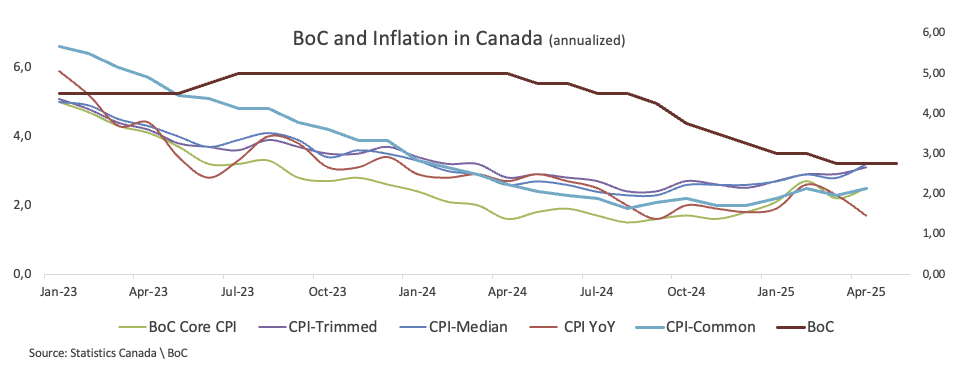
Previewing the BoC’s interest rate decision, analysts Taylor Schleich and Ethan Currie at the National Bank of Canada noted, "We expect the Bank of Canada to leave its policy rate unchanged at 2.75%... The labour market—which carries a lot of weight—is consistent with further rate relief, but the inflation picture right now isn’t giving the green light. There are also still key unknowns on trade impacts, inflation expectations and fiscal policy which further obscure the picture.”
When will the BoC release its monetary policy decision, and how could it affect USD/CAD?
The Bank of Canada will announce its policy decision on Wednesday at 13:45 GMT, with Governor Tiff Macklem holding a press conference at 14:30 GMT thereafter.
Market observers do not expect significant surprises; however, they anticipate that the central bank will maintain its emphasis on the effects of US tariffs on the Canadian economy. This perspective may also have repercussions for CAD fluctuations.
Senior Analyst Pablo Piovano from FXStreet highlighted that “USD/CAD has recently broken below its key 200-day Simple Moving Average (SMA) at 1.4020, subsequently opening the taps for extra weakness in the next few weeks.”
“USD/CAD has hit a fresh 2025 bottom at 1.3673 on June 2, exclusively following dynamics around the US Dollar. Once this level is cleared, extra losses could extend to the September 2024 low at 1.3418 reached on September 25,” Piovano added.
Piovano notes that “on the upside, the pair should encounter initial resistance at its May top of 1.4015 recorded on May 12 and May 13. This region of monthly peaks appears reinforced by the vicinity of the key 200-day SMA. If the pair manages to surpass the latter, it could embark on a potential visit to the next upside targets at the April high at 1.4414 set on April 1, ahead of the March top at 1.4542 recorded on March 4, and ultimately the 2025 peak at 1.4792 reached on February 3.”
“Currently, the Relative Strength Index (RSI) has dropped below the 40 level, suggesting further weakness remains in the pipeline. In addition, the ongoing bearish trend looks solid, as indicated by the Average Directional Index (ADX) around the 27 zone,” Piovano concludes.
Canadian Dollar FAQs
The key factors driving the Canadian Dollar (CAD) are the level of interest rates set by the Bank of Canada (BoC), the price of Oil, Canada’s largest export, the health of its economy, inflation and the Trade Balance, which is the difference between the value of Canada’s exports versus its imports. Other factors include market sentiment – whether investors are taking on more risky assets (risk-on) or seeking safe-havens (risk-off) – with risk-on being CAD-positive. As its largest trading partner, the health of the US economy is also a key factor influencing the Canadian Dollar.
The Bank of Canada (BoC) has a significant influence on the Canadian Dollar by setting the level of interest rates that banks can lend to one another. This influences the level of interest rates for everyone. The main goal of the BoC is to maintain inflation at 1-3% by adjusting interest rates up or down. Relatively higher interest rates tend to be positive for the CAD. The Bank of Canada can also use quantitative easing and tightening to influence credit conditions, with the former CAD-negative and the latter CAD-positive.
The price of Oil is a key factor impacting the value of the Canadian Dollar. Petroleum is Canada’s biggest export, so Oil price tends to have an immediate impact on the CAD value. Generally, if Oil price rises CAD also goes up, as aggregate demand for the currency increases. The opposite is the case if the price of Oil falls. Higher Oil prices also tend to result in a greater likelihood of a positive Trade Balance, which is also supportive of the CAD.
While inflation had always traditionally been thought of as a negative factor for a currency since it lowers the value of money, the opposite has actually been the case in modern times with the relaxation of cross-border capital controls. Higher inflation tends to lead central banks to put up interest rates which attracts more capital inflows from global investors seeking a lucrative place to keep their money. This increases demand for the local currency, which in Canada’s case is the Canadian Dollar.
Macroeconomic data releases gauge the health of the economy and can have an impact on the Canadian Dollar. Indicators such as GDP, Manufacturing and Services PMIs, employment, and consumer sentiment surveys can all influence the direction of the CAD. A strong economy is good for the Canadian Dollar. Not only does it attract more foreign investment but it may encourage the Bank of Canada to put up interest rates, leading to a stronger currency. If economic data is weak, however, the CAD is likely to fall.
Interest rates FAQs
Interest rates are charged by financial institutions on loans to borrowers and are paid as interest to savers and depositors. They are influenced by base lending rates, which are set by central banks in response to changes in the economy. Central banks normally have a mandate to ensure price stability, which in most cases means targeting a core inflation rate of around 2%. If inflation falls below target the central bank may cut base lending rates, with a view to stimulating lending and boosting the economy. If inflation rises substantially above 2% it normally results in the central bank raising base lending rates in an attempt to lower inflation.
Higher interest rates generally help strengthen a country’s currency as they make it a more attractive place for global investors to park their money.
Higher interest rates overall weigh on the price of Gold because they increase the opportunity cost of holding Gold instead of investing in an interest-bearing asset or placing cash in the bank. If interest rates are high that usually pushes up the price of the US Dollar (USD), and since Gold is priced in Dollars, this has the effect of lowering the price of Gold.
The Fed funds rate is the overnight rate at which US banks lend to each other. It is the oft-quoted headline rate set by the Federal Reserve at its FOMC meetings. It is set as a range, for example 4.75%-5.00%, though the upper limit (in that case 5.00%) is the quoted figure. Market expectations for future Fed funds rate are tracked by the CME FedWatch tool, which shapes how many financial markets behave in anticipation of future Federal Reserve monetary policy decisions.
Author

FXStreet Team
FXStreet
Composed of a group of economic journalists and FX experts, the FXStreet content team produces and oversees all content published on FXStreet. It provides a purely journalistic approach to the Forex market.