Australian Dollar remains stable, upside seems limited due to heightened risk aversion
- The Australian Dollar appreciates despite escalating trade tensions.
- The PBOC injected CNY300 billion through the one-year Medium-term Lending Facility (MLF), keeping the rate steady at 2%.
- President Trump said tariffs on Canada and Mexico ‘will go forward’.

The Australian Dollar (AUD) recovers its daily losses as the US Dollar (USD) weakens amid declining US Treasury yields on Tuesday. Investors eagerly anticipate Australia’s monthly inflation report on Wednesday, as it’s expected to offer crucial insights into the future course of monetary policy after the Reserve Bank of Australia’s (RBA) recent hawkish rate cut.
The People’s Bank of China (PBOC) injected CNY300 billion on Tuesday via the one-year Medium-term Lending Facility (MLF), maintaining the rate at 2%. Additionally, the PBOC injected CNY318.5 billion through seven-day reverse repos at 1.50%, consistent with the prior rate. Given the close trade relationship between China and Australia, any shifts in the Chinese economy could impact the Australian Dollar.
According to a gated Bloomberg report early Tuesday, the Trump administration is aiming to tighten chip export controls on China. The US is considering stricter restrictions on Nvidia chip exports and may impose additional limitations on Chinese companies like SMIC and CXMT.
The AUD/USD pair faces challenges due to rising risk sentiment as US President Donald Trump said late Monday that sweeping US tariffs on imports from Canada and Mexico “will go forward” when a month-long delay on their implementation expires next week. Trump claimed that the US has “been taken advantage of” by foreign nations and reiterated his plan to impose so-called reciprocal tariffs.
The AUD received support as Australia’s close trading partner China released its annual policy statement for 2025 on Sunday. The statement details strategies to advance rural reforms and promote comprehensive rural revitalization. Additionally, China’s state-supported developers are aggressively increasing land purchases at premium prices, driven by the government’s relaxation of home price restrictions to revitalize the troubled property market.
Australian Dollar appreciates as US Dollar remains tepid amid falling yields
- The US Dollar Index (DXY), which measures the USD against six major currencies, falls to near 106.50 with 2-year and 10-year yields on US Treasury bonds declining to 4.14% and 4.37%, respectively, at the time of writing.
- Federal Reserve Bank of Chicago President Austan Goolsbee remarked on Monday that the US central bank needs greater clarity before considering interest rate cuts.
- President Trump signed a memorandum on Friday instructing the Committee on Foreign Investment in the United States (CFIUS) to limit Chinese investments in strategic sectors. Reuters cited a White House official saying that the national security memorandum seeks to encourage foreign investment while safeguarding US national security interests from potential threats posed by foreign adversaries like China.
- The US Composite PMI fell to 50.4 in February, down from 52.7 in the previous month. In contrast, the Manufacturing PMI rose to 51.6 in February from 51.2 in January, surpassing the forecast of 51.5. Meanwhile, the Services PMI declined to 49.7 in February from 52.9 in January, falling short of the expected 53.0.
- US Initial Jobless Claims for the week ending February 14 rose to 219,000, exceeding the expected 215,000. Meanwhile, Continuing Jobless Claims increased to 1.869 million, slightly below the forecast of 1.87 million.
- The Reserve Bank of Australia (RBA) lowered its Official Cash Rate (OCR) by 25 basis points to 4.10% last week—the first rate cut in four years. Reserve Bank of Australia (RBA) Governor Michele Bullock acknowledged the impact of high interest rates but cautioned that it was too soon to declare victory over inflation. She also emphasized the labor market's strength and clarified that future rate cuts are not guaranteed, despite market expectations.
Technical Analysis: Australian Dollar tests nine-day EMA barrier near 0.6350
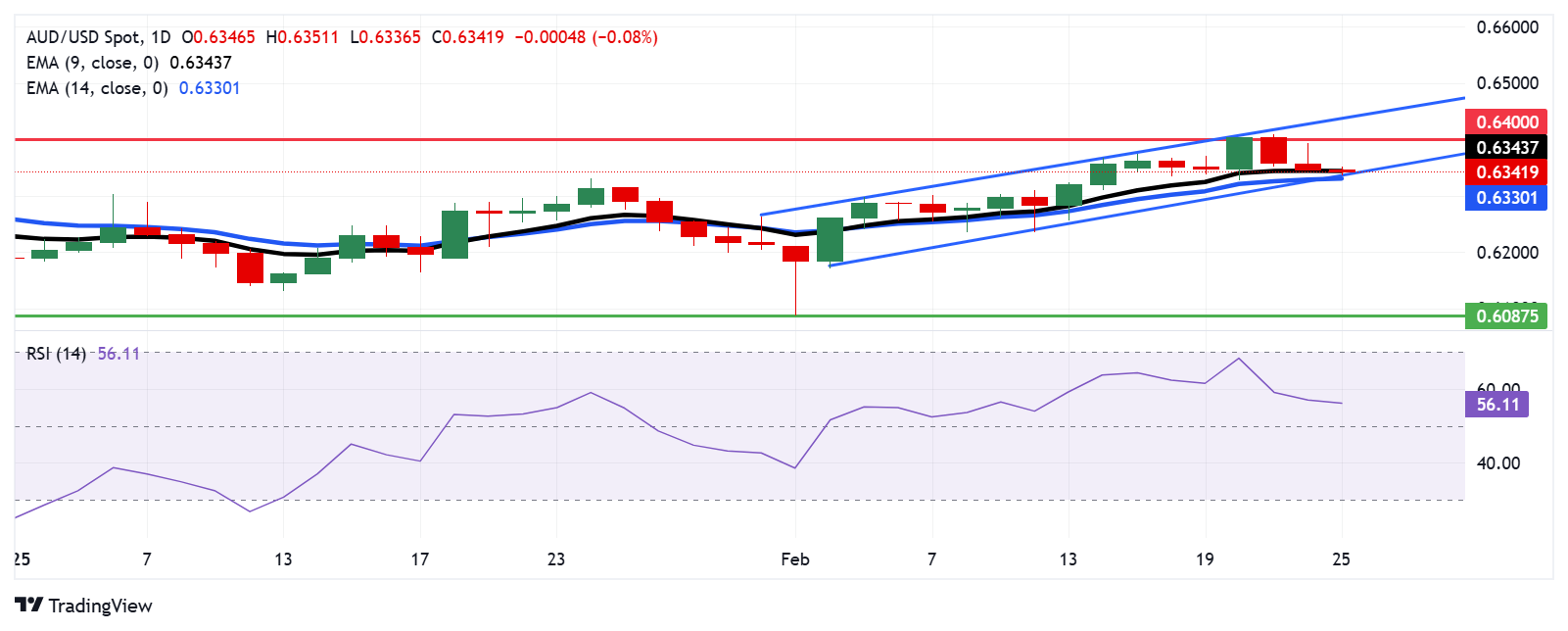
AUD/USD trades near 0.6340 on Tuesday, moving within an ascending channel that reflects bullish market sentiment. The 14-day Relative Strength Index (RSI) stays above 50, supporting the positive outlook.
On the upside, the AUD/USD pair tests the immediate barrier at a nine-day Exponential Moving Average (EMA) of 0.6343. A successful break above this level could improve the bullish bias and support the pair to test the key psychological resistance at 0.6400, with the next hurdle at the ascending channel’s upper boundary around 0.6440.
The AUD/USD pair could find immediate support at the 14-day EMA of 0.6329, aligned with the channel’s lower boundary.
AUD/USD: Daily Chart
Australian Dollar PRICE Today
The table below shows the percentage change of Australian Dollar (AUD) against listed major currencies today. Australian Dollar was the strongest against the Japanese Yen.
| USD | EUR | GBP | JPY | CAD | AUD | NZD | CHF | |
|---|---|---|---|---|---|---|---|---|
| USD | -0.08% | -0.07% | 0.09% | -0.08% | -0.08% | 0.00% | -0.01% | |
| EUR | 0.08% | 0.00% | 0.17% | -0.01% | -0.01% | 0.08% | 0.07% | |
| GBP | 0.07% | -0.00% | 0.17% | -0.01% | -0.01% | 0.08% | 0.07% | |
| JPY | -0.09% | -0.17% | -0.17% | -0.18% | -0.17% | -0.10% | -0.10% | |
| CAD | 0.08% | 0.01% | 0.01% | 0.18% | 0.00% | 0.09% | 0.08% | |
| AUD | 0.08% | 0.00% | 0.00% | 0.17% | -0.01% | 0.09% | 0.07% | |
| NZD | -0.01% | -0.08% | -0.08% | 0.10% | -0.09% | -0.09% | -0.02% | |
| CHF | 0.00% | -0.07% | -0.07% | 0.10% | -0.08% | -0.07% | 0.02% |
The heat map shows percentage changes of major currencies against each other. The base currency is picked from the left column, while the quote currency is picked from the top row. For example, if you pick the Australian Dollar from the left column and move along the horizontal line to the US Dollar, the percentage change displayed in the box will represent AUD (base)/USD (quote).
Risk sentiment FAQs
In the world of financial jargon the two widely used terms “risk-on” and “risk off'' refer to the level of risk that investors are willing to stomach during the period referenced. In a “risk-on” market, investors are optimistic about the future and more willing to buy risky assets. In a “risk-off” market investors start to ‘play it safe’ because they are worried about the future, and therefore buy less risky assets that are more certain of bringing a return, even if it is relatively modest.
Typically, during periods of “risk-on”, stock markets will rise, most commodities – except Gold – will also gain in value, since they benefit from a positive growth outlook. The currencies of nations that are heavy commodity exporters strengthen because of increased demand, and Cryptocurrencies rise. In a “risk-off” market, Bonds go up – especially major government Bonds – Gold shines, and safe-haven currencies such as the Japanese Yen, Swiss Franc and US Dollar all benefit.
The Australian Dollar (AUD), the Canadian Dollar (CAD), the New Zealand Dollar (NZD) and minor FX like the Ruble (RUB) and the South African Rand (ZAR), all tend to rise in markets that are “risk-on”. This is because the economies of these currencies are heavily reliant on commodity exports for growth, and commodities tend to rise in price during risk-on periods. This is because investors foresee greater demand for raw materials in the future due to heightened economic activity.
The major currencies that tend to rise during periods of “risk-off” are the US Dollar (USD), the Japanese Yen (JPY) and the Swiss Franc (CHF). The US Dollar, because it is the world’s reserve currency, and because in times of crisis investors buy US government debt, which is seen as safe because the largest economy in the world is unlikely to default. The Yen, from increased demand for Japanese government bonds, because a high proportion are held by domestic investors who are unlikely to dump them – even in a crisis. The Swiss Franc, because strict Swiss banking laws offer investors enhanced capital protection.
Author

Akhtar Faruqui
FXStreet
Akhtar Faruqui is a Forex Analyst based in New Delhi, India. With a keen eye for market trends and a passion for dissecting complex financial dynamics, he is dedicated to delivering accurate and insightful Forex news and analysis.

















