Australian Dollar rises as US Dollar struggles due to possible Israel-Hamas ceasefire
- The Australian Dollar gains support from improved risk sentiment due to potential ceasefire between Israel and Hamas.
- China’s Retail Sales climbed 6.4% YoY in May, against the market expectations of 5.0% rise.
- The Iranian Revolutionary Guard fired multiple missiles targeting Israeli military-industrial centers and fuel facilities.

The Australian Dollar (AUD) recovers its daily losses against the US Dollar (USD) as the risk sentiment improves, driven by Israel's revised proposal in hostage negotiations with Hamas, which could lead to a temporary ceasefire. However, the AUD/USD pair faced challenges due to escalating tensions in the Middle East.
In China, Australia's close trade partner, Retail Sales rose 6.4% year-over-year in May, surpassing the 5.0% expected and April’s 5.1% increase. Meanwhile, Industrial Production increased 5.8% YoY but below the 5.9% forecast and 6.1% prior. Moreover, the National Bureau of Statistics (NBS) in China noted that domestic economy is expected to have remained generally stable for the first half (H1) of 2025. However, economic growth in China may struggle since the second quarter due to uncertain trade policies.
Israel and Iran continue attacking each other despite international calls for diplomacy and de-escalation, per CNN. Iran fired multiple waves of ballistic missiles toward Israel. The Iranian Revolutionary Guard said their missiles successfully targeted Israeli military-industrial centers and fuel facilities.
According to local Officials, 224 people have been killed in Iran and 14 in Israel. At least 1,277 people have been injured since Israel launched the wave of attacks on Friday, according to the Iran's Ministry of Health.
Iran informed mediators Qatar and Oman that Tehran "will not negotiate while under attack," according to an official briefed on the negotiations. The source said that “Reports Iran has approached Oman and Qatar with a request to engage the United States to broker a ceasefire with Israel and potentially renew nuclear negotiations are inaccurate.”
Australian Dollar advances as US Dollar loses daily gains
- The US Dollar Index (DXY), which measures the value of the US Dollar against six major currencies, is losing intraday gains and trading lower at around 98.20 at the time of writing.
- The University of Michigan (UoM) reported on Friday that the Consumer Sentiment Index climbed to 60.5 in June from 52.2 prior. This reading came in above the market consensus of 53.5.
- The US Producer Price Index (PPI) climbed 0.1% month-over-month in May, compared to a decline of 0.2% (revised from -0.5%). This reading came in softer than the expected 0.2% rise. Meanwhile, the core PPI, excluding food and energy, increased 0.1% MoM in May versus -0.2% prior (revised from -0.4%), below the consensus of 0.3%.
- The US Federal Reserve (Fed) is expected to keep its policy rate unchanged within the 4.25%–4.50% range in its upcoming decision on Wednesday. Traders now expect a 25 basis point rate cut by September.
- Reuters reported Thursday that President Trump expanded steel tariffs starting June 23 on imported “steel derivative products,” including household appliances, such as dishwashers, washing machines, refrigerators, etc. The tariffs were initially imposed at 25% in March and later doubled to 50% for most countries. This is the second time the scope of affected products has been expanded.
- President Trump posted on Truth Social on Wednesday that the trade deal with China is done and added that it is subject to his and Chinese President Xi Jinping's final approval. "We are getting a total of 55% tariffs, China is getting 10%. Relationship is excellent! Thank you for your attention to this matter."
- China will grant only six-month rare-earth export licenses for US automakers and manufacturers, which suggests that China wants to have control over critical minerals as leverage in future talks, per the Wall Street Journal (gated).
Australian Dollar holds losses below nine-day barrier near 0.6500
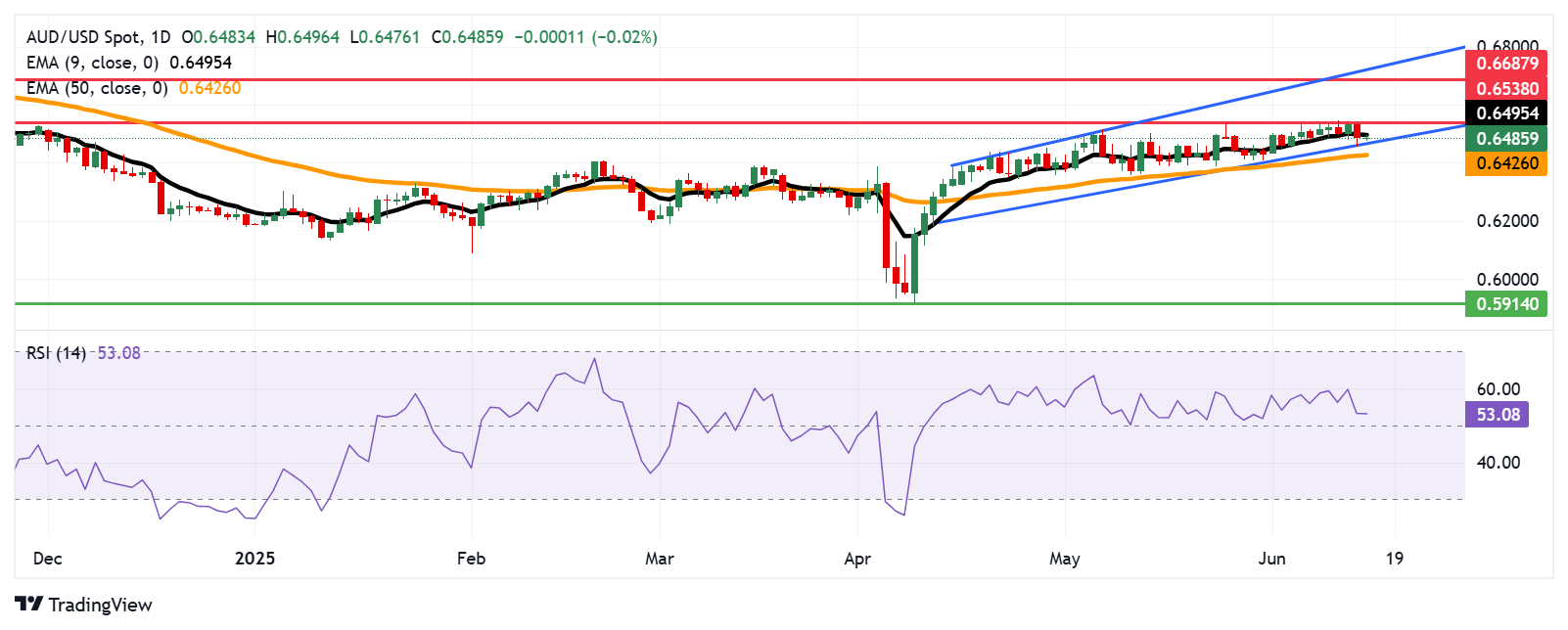
The AUD/USD pair is trading around 0.6480 on Monday. The bullish bias persists, as the daily chart’s technical analysis indicates that the pair remains within the ascending channel. Additionally, the 14-day Relative Strength Index (RSI) is positioned slightly above the 50 mark, indicating a prevailing bullish outlook. However, the pair remains below the nine-day Exponential Moving Average (EMA), suggesting that short-term price momentum is weaker.
The immediate resistance appears at the nine-day EMA of 0.6495, followed by the seven-month high of 0.6538, which was reached on June 5. A break above this level could support the pair to target the eight-month high at 0.6687, followed by the upper boundary of the ascending channel around 0.6730.
On the downside, the AUD/USD pair may test the ascending channel’s lower boundary around the 0.6470. A break below the channel would indicate the weakening of the bullish bias and put downward pressure on the pair to test the 50-day EMA at 0.6425.
(The story was corrected on June 16 at 3:54 GMT to remove the reference to "The US Michigan Consumer Sentiment will be eyed later on Friday" in the first market mover.)
AUD/USD: Daily Chart
Australian Dollar PRICE Today
The table below shows the percentage change of Australian Dollar (AUD) against listed major currencies today. Australian Dollar was the strongest against the Japanese Yen.
| USD | EUR | GBP | JPY | CAD | AUD | NZD | CHF | |
|---|---|---|---|---|---|---|---|---|
| USD | -0.30% | -0.16% | -0.13% | -0.06% | -0.33% | -0.18% | 0.15% | |
| EUR | 0.30% | 0.03% | 0.15% | 0.25% | 0.10% | 0.12% | 0.46% | |
| GBP | 0.16% | -0.03% | 0.16% | 0.23% | 0.08% | 0.10% | 0.43% | |
| JPY | 0.13% | -0.15% | -0.16% | 0.08% | -0.49% | -0.41% | -0.12% | |
| CAD | 0.06% | -0.25% | -0.23% | -0.08% | -0.20% | -0.12% | 0.21% | |
| AUD | 0.33% | -0.10% | -0.08% | 0.49% | 0.20% | 0.02% | 0.36% | |
| NZD | 0.18% | -0.12% | -0.10% | 0.41% | 0.12% | -0.02% | 0.33% | |
| CHF | -0.15% | -0.46% | -0.43% | 0.12% | -0.21% | -0.36% | -0.33% |
The heat map shows percentage changes of major currencies against each other. The base currency is picked from the left column, while the quote currency is picked from the top row. For example, if you pick the Australian Dollar from the left column and move along the horizontal line to the US Dollar, the percentage change displayed in the box will represent AUD (base)/USD (quote).
Australian Dollar FAQs
One of the most significant factors for the Australian Dollar (AUD) is the level of interest rates set by the Reserve Bank of Australia (RBA). Because Australia is a resource-rich country another key driver is the price of its biggest export, Iron Ore. The health of the Chinese economy, its largest trading partner, is a factor, as well as inflation in Australia, its growth rate and Trade Balance. Market sentiment – whether investors are taking on more risky assets (risk-on) or seeking safe-havens (risk-off) – is also a factor, with risk-on positive for AUD.
The Reserve Bank of Australia (RBA) influences the Australian Dollar (AUD) by setting the level of interest rates that Australian banks can lend to each other. This influences the level of interest rates in the economy as a whole. The main goal of the RBA is to maintain a stable inflation rate of 2-3% by adjusting interest rates up or down. Relatively high interest rates compared to other major central banks support the AUD, and the opposite for relatively low. The RBA can also use quantitative easing and tightening to influence credit conditions, with the former AUD-negative and the latter AUD-positive.
China is Australia’s largest trading partner so the health of the Chinese economy is a major influence on the value of the Australian Dollar (AUD). When the Chinese economy is doing well it purchases more raw materials, goods and services from Australia, lifting demand for the AUD, and pushing up its value. The opposite is the case when the Chinese economy is not growing as fast as expected. Positive or negative surprises in Chinese growth data, therefore, often have a direct impact on the Australian Dollar and its pairs.
Iron Ore is Australia’s largest export, accounting for $118 billion a year according to data from 2021, with China as its primary destination. The price of Iron Ore, therefore, can be a driver of the Australian Dollar. Generally, if the price of Iron Ore rises, AUD also goes up, as aggregate demand for the currency increases. The opposite is the case if the price of Iron Ore falls. Higher Iron Ore prices also tend to result in a greater likelihood of a positive Trade Balance for Australia, which is also positive of the AUD.
The Trade Balance, which is the difference between what a country earns from its exports versus what it pays for its imports, is another factor that can influence the value of the Australian Dollar. If Australia produces highly sought after exports, then its currency will gain in value purely from the surplus demand created from foreign buyers seeking to purchase its exports versus what it spends to purchase imports. Therefore, a positive net Trade Balance strengthens the AUD, with the opposite effect if the Trade Balance is negative.
Author

Akhtar Faruqui
FXStreet
Akhtar Faruqui is a Forex Analyst based in New Delhi, India. With a keen eye for market trends and a passion for dissecting complex financial dynamics, he is dedicated to delivering accurate and insightful Forex news and analysis.

















