Australian Dollar holds losses as US Dollar remains solid ahead of US CPI
- The Australian Dollar steadies as traders adopt caution ahead of the US November Consumer Price Index data.
- The AUD faced challenges after the RBA maintained its interest rates at 4.35% in December.
- The US CPI and core inflation are estimated to rise to 2.7% and 3.3%, respectively, year-over-year in November.


The Australian Dollar (AUD) remains subdued against the US Dollar (USD) on Wednesday. The AUD/USD pair faced challenges due to the broadly stronger US dollar (USD). Traders now focus on the release of crucial US November Consumer Price Index (CPI) data, which are expected to be released later in the North American session.
The US CPI inflation is estimated to rise to 2.7% YoY in November from 2.6% in October. Meanwhile, the core CPI, excluding Food & Energy, is expected to remain consistent at a 3.3% increase YoY. Any indications of stalled progress could significantly diminish the likelihood of a Federal Reserve’s (Fed) rate cut, potentially boosting the US Dollar. Traders are now pricing in nearly an 85.8% chance of Fed rate reductions by 25 basis points on December 18, according to the CME FedWatch Tool.
The AUD received downward pressure after the Reserve Bank of Australia’s (RBA) decision to keep the Official Cash Rate (OCR) unchanged at 4.35% in its final policy meeting in December. RBA Governor Michele Bullock highlighted that while upside inflation risks have eased, they persist and require ongoing vigilance. The RBA will closely monitor all economic data, including employment figures, to guide future policy decisions.
Australian Dollar declined after the RBA decision to keep interest rates unchanged
- China President Xi Jinping stated on Tuesday, "China has full confidence in achieving this year's economic target." Xi emphasized that China will continue to serve as the largest engine of global economic growth and asserted that there would be no winners in tariff wars, trade wars, or tech wars.
- China's Trade Balance (CNY) increased to CNY 692.8 billion in November, up from CNY 679.1 billion in the previous month. Exports grew by 1.5% year-over-year in November, compared to the 11.2% rise in October. Meanwhile, imports increased by 1.2% YoY, recovering from the 3.7% decline recorded earlier.
- The Australian Unemployment Rate remained at 4.1% in October for the third consecutive month. The economy added 9,700 full-time jobs and 6,200 part-time roles, making a net change of 15,900 positions.
- The RBA’s closely watched inflation gauge, the annual Trimmed Mean Consumer Price Index (CPI), slowed to 3.5% from 4.0% in the third quarter but stayed well above the Bank’s 2%- 3% target.
- Australia's economy grew at its slowest annual pace since the pandemic in the third quarter. The OZ nation’s Gross Domestic Product (GDP) rose 0.3% in the September quarter, missing market forecasts of 0.4%. Weaker-than-expected GDP growth made markets almost fully price in a rate cut next April at 96% (from 73% before), according to Refinitive interest rate probabilities data.
- US November NFP data from Friday showed a robust 227,000 gain, well above expectations, and stable Average Hourly Earnings growth at 0.4% MoM.
- The AUD received support from improved sentiment and stimulus expectations from China. China’s leaders announced plans for proactive fiscal and looser monetary policies to accelerate domestic consumption in 2024.
- Weak Chinese CPI data (-0.6% in November, worse than expected) highlights challenges in the recovery but bolsters stimulus speculation.
Technical Analysis: Australian Dollar falls towards 0.6350 near yearly lows
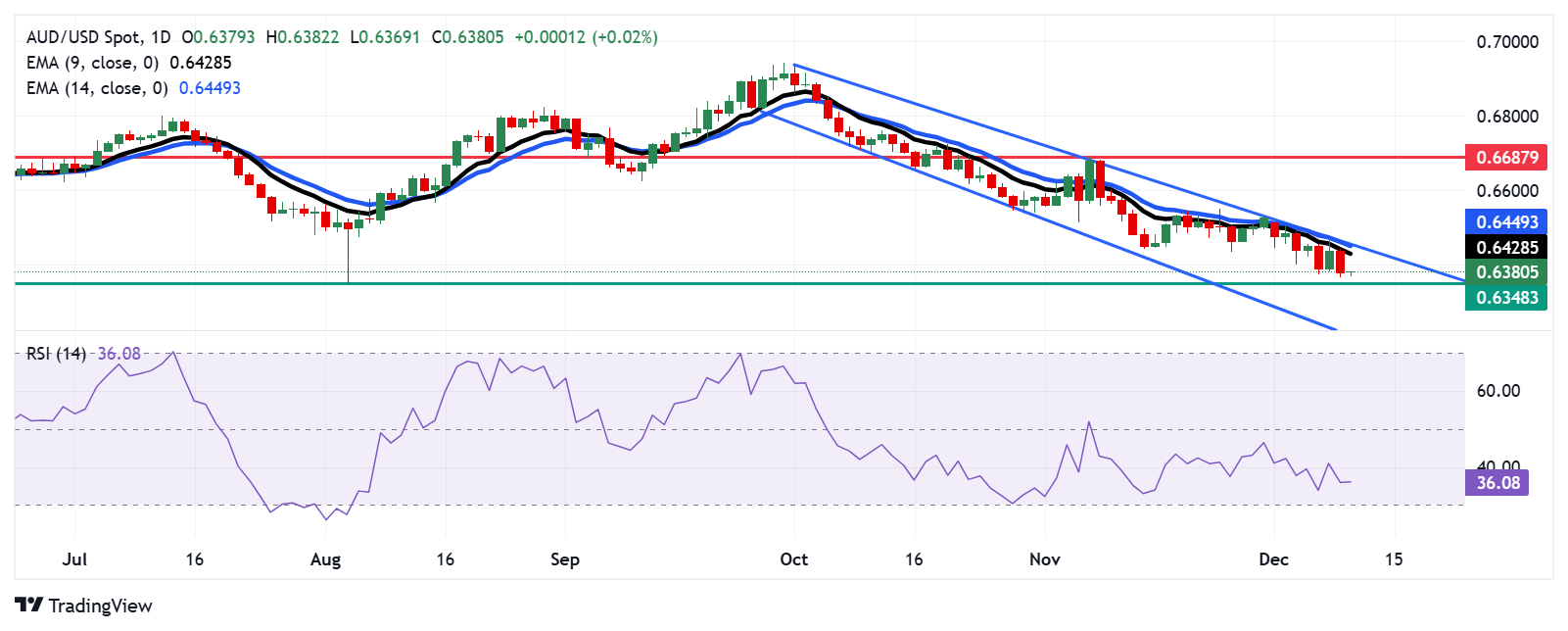
AUD/USD trades near 0.6370 on Wednesday. The technical analysis of a daily chart shows strengthening bearish momentum as the pair moves downwards within a descending channel pattern. Additionally, the 14-day Relative Strength Index (RSI) is positioned slightly above 30, indicating sustained negative sentiment.
The immediate support appears around its yearly low of 0.6348, last seen on August 5. A break below this level could strengthen the bearish bias and put downward pressure on the AUD/USD pair to navigate the region around the descending channel’s lower boundary at 0.6220 level.
On the upside, the AUD/USD pair may find initial resistance around the nine-day Exponential Moving Average (EMA) at 0.6428, followed by the 14-day EMA at 0.6449, which aligns closely with the upper boundary of the descending channel. A decisive breakout above this channel could pave the way for a potential rally toward the seven-week high of 0.6687.
AUD/USD: Daily Chart
Australian Dollar PRICE Today
The table below shows the percentage change of Australian Dollar (AUD) against listed major currencies today. Australian Dollar was the strongest against the New Zealand Dollar.
| USD | EUR | GBP | JPY | CAD | AUD | NZD | CHF | |
|---|---|---|---|---|---|---|---|---|
| USD | 0.00% | 0.04% | -0.18% | -0.05% | 0.11% | 0.10% | 0.05% | |
| EUR | -0.00% | 0.03% | -0.16% | -0.05% | 0.10% | 0.10% | 0.05% | |
| GBP | -0.04% | -0.03% | -0.21% | -0.09% | 0.07% | 0.06% | 0.02% | |
| JPY | 0.18% | 0.16% | 0.21% | 0.13% | 0.29% | 0.27% | 0.24% | |
| CAD | 0.05% | 0.05% | 0.09% | -0.13% | 0.16% | 0.15% | 0.10% | |
| AUD | -0.11% | -0.10% | -0.07% | -0.29% | -0.16% | -0.01% | -0.06% | |
| NZD | -0.10% | -0.10% | -0.06% | -0.27% | -0.15% | 0.01% | -0.04% | |
| CHF | -0.05% | -0.05% | -0.02% | -0.24% | -0.10% | 0.06% | 0.04% |
The heat map shows percentage changes of major currencies against each other. The base currency is picked from the left column, while the quote currency is picked from the top row. For example, if you pick the Australian Dollar from the left column and move along the horizontal line to the US Dollar, the percentage change displayed in the box will represent AUD (base)/USD (quote).
Economic Indicator
Consumer Price Index (YoY)
Inflationary or deflationary tendencies are measured by periodically summing the prices of a basket of representative goods and services and presenting the data as The Consumer Price Index (CPI). CPI data is compiled on a monthly basis and released by the US Department of Labor Statistics. The YoY reading compares the prices of goods in the reference month to the same month a year earlier.The CPI is a key indicator to measure inflation and changes in purchasing trends. Generally speaking, a high reading is seen as bullish for the US Dollar (USD), while a low reading is seen as bearish.
Read more.Next release: Wed Dec 11, 2024 13:30
Frequency: Monthly
Consensus: 2.7%
Previous: 2.6%
Source: US Bureau of Labor Statistics
The US Federal Reserve has a dual mandate of maintaining price stability and maximum employment. According to such mandate, inflation should be at around 2% YoY and has become the weakest pillar of the central bank’s directive ever since the world suffered a pandemic, which extends to these days. Price pressures keep rising amid supply-chain issues and bottlenecks, with the Consumer Price Index (CPI) hanging at multi-decade highs. The Fed has already taken measures to tame inflation and is expected to maintain an aggressive stance in the foreseeable future.
Author
Akhtar Faruqui
FXStreet
Akhtar Faruqui is a Forex Analyst based in New Delhi, India. With a keen eye for market trends and a passion for dissecting complex financial dynamics, he is dedicated to delivering accurate and insightful Forex news and analysis.