Australian Dollar remains stronger as US Dollar steadies following shutdown ending
- Australian Dollar gains on improved labor market data released on Thursday.
- Australia’s unemployment rate declined to 4.3% in October from 4.5% in September, beating market expectations of 4.4%.
- President Trump signed the bill to end the record 43-day US government shutdown.

The Australian Dollar (AUD) gains ground against the US Dollar (USD) on Thursday, extending its gains for the second consecutive day. The AUD/USD pair appreciates as the AUD receives support following the release of improved employment data from Australia.
The Australian Bureau of Statistics (ABS) released the Unemployment Rate on Thursday, which declined to 4.3% in October from 4.5% in September, against the market expectations of 4.4%. Meanwhile, the Employment Change arrived at 42.2K in the same month from 12.8K (revised from 14.9K) prior, sharply exceeding the market forecast of 20K.
Australia’s Full-Time Employment rose by 55.3K in October, from a rise of 6.5K in the previous reading (revised from 8.7K). Participation Rate steadies at 67%, while the Part-Time Employment decreased by 13.1K in October, versus an increase of 6.3K prior.
The AUD gained support from cautious sentiment surrounding the Reserve Bank of Australia (RBA) policy outlook. RBA Deputy Governor Andrew Hauser said on Wednesday, “Our best estimate is that monetary policy remains restrictive, though the committee continues to debate this.” Hauser added that if the policy is no longer mildly restrictive, it would have significant implications for future decisions.
US Dollar moves little after ending government shutdown
- The US Dollar Index (DXY), which measures the value of the US Dollar against six major currencies, is holding ground and trading around 99.50 at the time of writing. The Greenback moves little after US President Donald Trump signed the government funding bill on Thursday, marking the official end of the record 43-day government shutdown the United States (US) history.
- The US Dollar also gained support from hawkish Fedspeak, which decreased the odds of a Federal Reserve (Fed) rate cut in December. The CME FedWatch Tool shows markets pricing in nearly a 60% chance of a 25-basis-point Fed rate cut in December, down from 67% a day ago.
- Atlanta Fed President Raphael Bostic addressed economic trends at the Atlanta Economic Club on Wednesday. Bostic cautioned that easing policy too soon could “feed the inflation beast,” while noting that a sharp downturn in the labor market is unlikely in the near term.
- Boston Fed President Susan Collins said that “Elevated inflation warrants still mildly restrictive policy,” adding that she has not seen “an increase in downside employment risks since the Summer.”
- Automatic Data Processing (ADP) released the US Employment Change on Tuesday, showing an average weekly job loss of 11,250 in the four weeks to October 25. Weaker-than-expected private US labor data increased the likelihood of the Federal Reserve (Fed) policy easing.
- Challenger, Gray & Christmas announced that US employers slashed 153,074 jobs in October, up from the 55,597 cuts announced in October 2024.
- China's Ministry of Commerce said on Monday that it would temporarily lift its ban on approving exports of “dual-use items” related to gallium, germanium, antimony, and super-hard materials to the US. The suspension takes effect from Sunday until November 27, 2026. Any change in the Chinese economy could impact the AUD as China is a major trading partner for Australia.
Australian Dollar eyes rectangle’s upper boundary
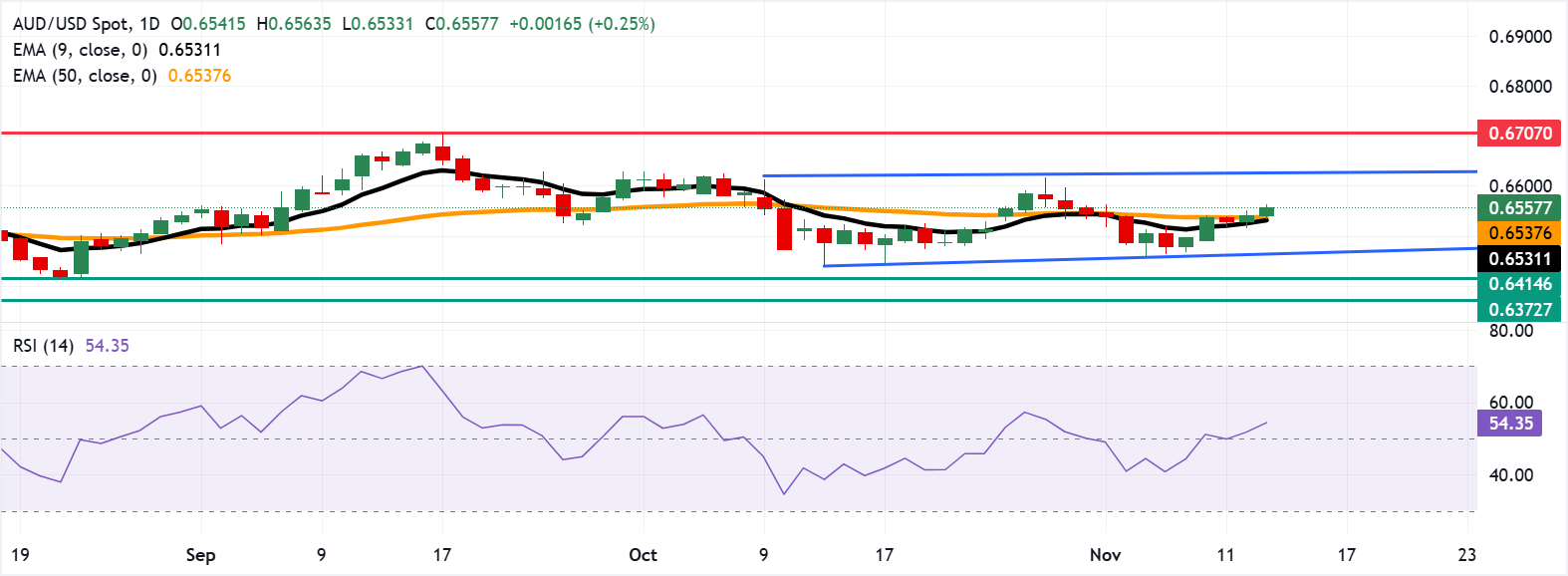
The AUD/USD pair is trading around 0.6560 on Thursday. On the daily chart, the pair appears to be consolidating within a rectangular range, reflecting sideways movement. Nonetheless, it remains above the nine-day Exponential Moving Average (EMA), suggesting firm short-term bullish momentum.
The AUD/USD pair could target the rectangle’s upper boundary around 0.6630. A break above the rectangle would cause the emergence of the bullish bias and support the pair to test the 13-month high of 0.6707, recorded on September 17.
On the downside, the immediate support lies at the 50-day EMA of 0.6537, followed by the nine-day EMA at 0.6531. A break below these levels would weaken the medium- and short-term price momentum and prompt the AUD/USD pair to test the lower boundary of the rectangle around 0.6470, followed by the five-month low of 0.6414, which was recorded on August 21.
Australian Dollar Price Today
The table below shows the percentage change of Australian Dollar (AUD) against listed major currencies today. Australian Dollar was the strongest against the New Zealand Dollar.
| USD | EUR | GBP | JPY | CAD | AUD | NZD | CHF | |
|---|---|---|---|---|---|---|---|---|
| USD | 0.06% | 0.08% | 0.09% | 0.07% | -0.26% | 0.30% | 0.16% | |
| EUR | -0.06% | 0.02% | 0.04% | 0.01% | -0.32% | 0.24% | 0.10% | |
| GBP | -0.08% | -0.02% | 0.02% | -0.01% | -0.34% | 0.23% | 0.08% | |
| JPY | -0.09% | -0.04% | -0.02% | -0.06% | -0.37% | 0.15% | 0.05% | |
| CAD | -0.07% | -0.01% | 0.01% | 0.06% | -0.32% | 0.22% | 0.09% | |
| AUD | 0.26% | 0.32% | 0.34% | 0.37% | 0.32% | 0.56% | 0.44% | |
| NZD | -0.30% | -0.24% | -0.23% | -0.15% | -0.22% | -0.56% | -0.14% | |
| CHF | -0.16% | -0.10% | -0.08% | -0.05% | -0.09% | -0.44% | 0.14% |
The heat map shows percentage changes of major currencies against each other. The base currency is picked from the left column, while the quote currency is picked from the top row. For example, if you pick the Australian Dollar from the left column and move along the horizontal line to the US Dollar, the percentage change displayed in the box will represent AUD (base)/USD (quote).
Australian Dollar FAQs
One of the most significant factors for the Australian Dollar (AUD) is the level of interest rates set by the Reserve Bank of Australia (RBA). Because Australia is a resource-rich country another key driver is the price of its biggest export, Iron Ore. The health of the Chinese economy, its largest trading partner, is a factor, as well as inflation in Australia, its growth rate and Trade Balance. Market sentiment – whether investors are taking on more risky assets (risk-on) or seeking safe-havens (risk-off) – is also a factor, with risk-on positive for AUD.
The Reserve Bank of Australia (RBA) influences the Australian Dollar (AUD) by setting the level of interest rates that Australian banks can lend to each other. This influences the level of interest rates in the economy as a whole. The main goal of the RBA is to maintain a stable inflation rate of 2-3% by adjusting interest rates up or down. Relatively high interest rates compared to other major central banks support the AUD, and the opposite for relatively low. The RBA can also use quantitative easing and tightening to influence credit conditions, with the former AUD-negative and the latter AUD-positive.
China is Australia’s largest trading partner so the health of the Chinese economy is a major influence on the value of the Australian Dollar (AUD). When the Chinese economy is doing well it purchases more raw materials, goods and services from Australia, lifting demand for the AUD, and pushing up its value. The opposite is the case when the Chinese economy is not growing as fast as expected. Positive or negative surprises in Chinese growth data, therefore, often have a direct impact on the Australian Dollar and its pairs.
Iron Ore is Australia’s largest export, accounting for $118 billion a year according to data from 2021, with China as its primary destination. The price of Iron Ore, therefore, can be a driver of the Australian Dollar. Generally, if the price of Iron Ore rises, AUD also goes up, as aggregate demand for the currency increases. The opposite is the case if the price of Iron Ore falls. Higher Iron Ore prices also tend to result in a greater likelihood of a positive Trade Balance for Australia, which is also positive of the AUD.
The Trade Balance, which is the difference between what a country earns from its exports versus what it pays for its imports, is another factor that can influence the value of the Australian Dollar. If Australia produces highly sought after exports, then its currency will gain in value purely from the surplus demand created from foreign buyers seeking to purchase its exports versus what it spends to purchase imports. Therefore, a positive net Trade Balance strengthens the AUD, with the opposite effect if the Trade Balance is negative.
Author

Akhtar Faruqui
FXStreet
Akhtar Faruqui is a Forex Analyst based in New Delhi, India. With a keen eye for market trends and a passion for dissecting complex financial dynamics, he is dedicated to delivering accurate and insightful Forex news and analysis.

















