Australian Dollar rises on hawkish RBA outlook
- AUD/USD appreciates as the Reserve Bank of Australia's hawkish policy stance boosts the Australian Dollar.
- SocGen analysts note the RBA maintained a hawkish tone, with Governor Bullock warning the bank would act if needed.
- US Retail Sales fell 0.6% in July, lowering market expectations for upcoming Fed rate hikes.

AUD/USD gains ground for the second successive day, trading around 0.7090 during the Asian hours on Monday. The pair appreciates as the Australian Dollar (AUD) gains on the hawkish policy stance by the Reserve Bank of Australia (RBA).
RBA stance stays hawkish as Bullock keeps tightening option open
Analysts at Societe Generale highlight that the Reserve Bank of Australia maintained a firm tone, noting that “the statement was hawkish” and that Governor Michele Bullock “declared the bank would not hesitate to act if needed,” underscoring the RBA’s readiness to tighten policy further should inflation fail to moderate as expected.
Rabobank’s strategy team remains doubtful that the RBA’s tightening cycle is complete, stressing that recent communication from Governor Bullock does not fully close the door on further action. Against this backdrop, the bank reiterates that it is “unconvinced” the current policy stance will be sufficient and therefore “continue to expect one more hike later this year.”
The AUD/USD pair appreciates as the US Dollar (USD) declines amid weaker-than-expected US economic data and shifting central bank expectations.
US Census Bureau reported on Friday that Retail Sales fell by 0.6% month-over-month in July, following a 0.2% rise in June, coming in below the market consensus of 0.1% growth. On an annual basis, Retail Sales rose 5.0% in July compared to 6.8% in the previous month.
Traders have reduced their bets on Federal Reserve rate hikes following a slew of softer US data, including CPI, PPI, and Retail Sales. Markets are now pricing in a 33.1% chance of a rate hike next month, down from 44% last week according to the CME FedWatch tool.
Goolsbee’s softer inflation tone nudges Dollar expectations toward a less hawkish Fed path
Fed’s Goolsbee delivered a notably softer tone on inflation, with the FXS Speechtracker score at 4.6/10, well below the 6.8/10 historical average and signaling a less hawkish stance relative to the established baseline. Emphasis on “a little bit better” inflation readings, the transitory nature of tariff and oil shocks, and confidence that inflation can move back toward 2% if these fade points to growing comfort with the disinflation trend, even as the US economy is described as “steady.” Overall, the message tilts incrementally dovish at the margin, subtly lowering the perceived bar for future easing if the data cooperate.
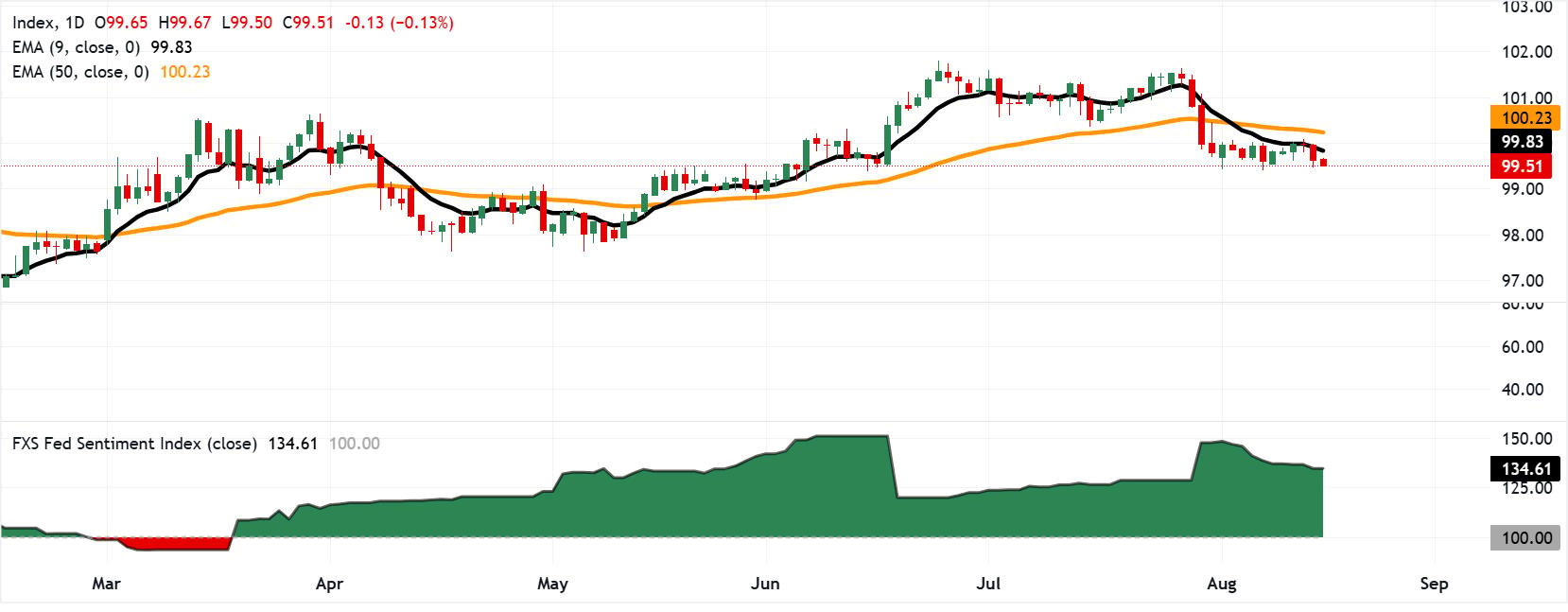
The FXS Fed Sentiment Index fell by 2.36 points to 134.61, indicating a modest dovish shift in perceived policy tone following the remarks. However, with the index still well above the 100 neutral line, the Fed remains firmly in hawkish territory despite the pullback, suggesting the Dollar retains underlying policy support even as markets price a slightly less aggressive stance.
Author

Akhtar Faruqui
FXStreet
Akhtar Faruqui is a Forex Analyst based in New Delhi, India. With a keen eye for market trends and a passion for dissecting complex financial dynamics, he is dedicated to delivering accurate and insightful Forex news and analysis.