Australian Dollar holds losses as the US Dollar appreciates due to safe-haven flows
- The Australian Dollar gained ground as the RBA Meeting Minutes emphasized the importance of maintaining a restrictive monetary policy.
- The PBoC's Monetary Policy Committee (MPC) decided to maintain the current interest rate at 3.1% for November.
- The US Dollar receives support from safe-haven flows amid escalating tensions in the Russia-Ukraine conflict.

The Australian Dollar (AUD) depreciates against the US Dollar (USD) on Wednesday, following the People’s Bank of China’s (PBoC) interest rate decision. The PBoC's Monetary Policy Committee (MPC) opted to keep the benchmark interest rate unchanged at 3.1% for November.
Australian Treasurer Jim Chalmers stated that "tumbling iron ore prices and a softening labor market have impacted government revenue." following his Ministerial Statement on the economy on Wednesday. Chalmers outlined Australia's tough fiscal outlook, citing the weakening of China, a key trading partner, and the slowdown in the job market as contributing factors.
The AUD/USD pair may face downward pressure as the US Dollar (USD) gains ground on safe-haven flows amid escalating tensions in the Russia-Ukraine conflict. According to a Reuters report late Tuesday, Ukraine deployed US-supplied ATACMS missiles to strike Russian territory for the first time, signaling a significant escalation on the 1,000th day of the conflict. However, market concerns eased slightly after Russian Foreign Minister Sergei Lavrov stated that the government would "do everything possible" to prevent the outbreak of nuclear war.
The Reserve Bank of Australia's (RBA) November Meeting Minutes indicated that the central bank’s board remains cautious about the potential for inflation to rise further, emphasizing the need for restrictive monetary policy. Board members also indicate no "immediate need" to adjust the cash rate, though they left the door open for future changes, noting that nothing can be ruled in or out.
The US Dollar (USD) appreciates as investors anticipate pro-inflationary policies from the incoming Trump administration, including tax cuts and higher tariffs. These measures could elevate inflation, possibly influencing the Federal Reserve to slow the pace of rate cuts.
The Australian Dollar loses ground due to safe-haven outflows
- Jeffrey Schmid, President of the Federal Reserve Bank of Kansas City, stated on Tuesday that he expects both inflation and employment to move closer to the Fed's targets. Schmid explained that rate cuts signal the Fed's confidence in inflation trending toward its 2% goal. He also noted that while large fiscal deficits won't necessarily drive inflation, the Fed may need to counteract potential pressures with higher interest rates.
- An official from China’s National Development and Reform Commission (NDRC) stated on Tuesday that the country has "ample policy room and tools to support economic recovery." The official expressed confidence in China's economic trajectory, anticipating that the recovery momentum will persist through November and December. Any change in the Chinese economy could impact the Australian markets as both nations are close trade partners.
- Fed Chair Jerome Powell downplayed the likelihood of imminent rate cuts, highlighting the economy's resilience, robust labor market, and persistent inflationary pressures. Powell remarked, "The economy is not sending any signals that we need to be in a hurry to lower rates."
- On Friday, Chicago Fed President Austan Goolsbee stated that markets often overreact to changes in interest rates. Goolsbee emphasized the importance of the Fed adopting a cautious, gradual approach in moving toward the neutral rate.
- Meanwhile, Boston Fed President Susan Collins tempered expectations for continued rate cuts in the near term while maintaining market confidence in a potential rate reduction in December. Collins stated, "I don't see a big urgency to lower rates, but I want to preserve a healthy economy."
- Last week, RBA Governor Michele Bullock emphasized that current interest rates are sufficiently restrictive and will remain unchanged until the central bank is confident about the inflation outlook.
- US Retail Sales increased by 0.4% month-over-month in October, exceeding the market consensus of 0.3%. Additionally, the NY Empire State Manufacturing Index for November posted an unexpected surge, coming in at 31.2 compared to the anticipated 0.7 decline, signaling robust manufacturing activity.
- China’s Retail Sales rose by 4.8% year-over-year in October, surpassing the expected 3.8% and the 3.2% increase seen in September. Meanwhile, Industrial Production grew by 5.3% YoY, below the forecasted 5.6% and the 5.4% growth recorded in the previous period.
Technical Analysis: Australian Dollar surpasses nine-day EMA to approach 0.6550
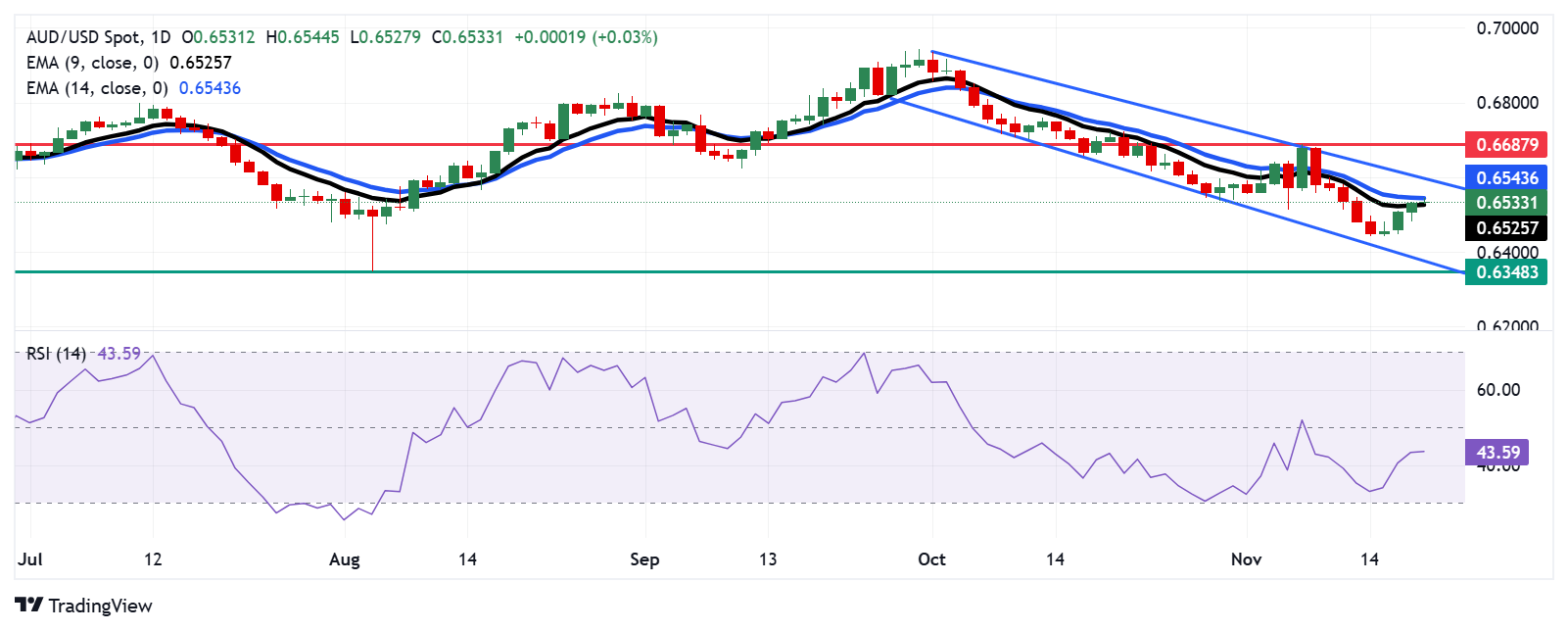
AUD/USD traded near 0.6530 on Wednesday. Technical analysis of the daily chart indicates a continued decline within a descending channel pattern, underscoring a bearish outlook. The 14-day Relative Strength Index (RSI) is below the 50 mark, further validating the prevailing bearish sentiment.
In terms of support, the AUD/USD pair may approach the lower boundary of the descending channel at the 0.6380 level. A decisive break below the descending channel could amplify selling pressure, potentially driving the pair toward its yearly low of 0.6348, last recorded on August 5.
On the upside, a breach above the nine-day EMA at 0.6525 weakens the bearish bias and supports the AUD/USD pair to test the 14-day EMA at 0.6543 level further. Surpassing this level could pave the way for a rally toward the four-week high of 0.6687 level.
AUD/USD: Daily Chart
Australian Dollar PRICE Today
The table below shows the percentage change of Australian Dollar (AUD) against listed major currencies today. Australian Dollar was the weakest against the British Pound.
| USD | EUR | GBP | JPY | CAD | AUD | NZD | CHF | |
|---|---|---|---|---|---|---|---|---|
| USD | 0.05% | -0.09% | 0.45% | -0.06% | 0.06% | 0.16% | 0.19% | |
| EUR | -0.05% | -0.14% | 0.41% | -0.12% | 0.00% | 0.09% | 0.14% | |
| GBP | 0.09% | 0.14% | 0.51% | 0.02% | 0.15% | 0.23% | 0.28% | |
| JPY | -0.45% | -0.41% | -0.51% | -0.50% | -0.38% | -0.29% | -0.24% | |
| CAD | 0.06% | 0.12% | -0.02% | 0.50% | 0.14% | 0.22% | 0.26% | |
| AUD | -0.06% | -0.00% | -0.15% | 0.38% | -0.14% | 0.09% | 0.14% | |
| NZD | -0.16% | -0.09% | -0.23% | 0.29% | -0.22% | -0.09% | 0.04% | |
| CHF | -0.19% | -0.14% | -0.28% | 0.24% | -0.26% | -0.14% | -0.04% |
The heat map shows percentage changes of major currencies against each other. The base currency is picked from the left column, while the quote currency is picked from the top row. For example, if you pick the Australian Dollar from the left column and move along the horizontal line to the US Dollar, the percentage change displayed in the box will represent AUD (base)/USD (quote).
Australian Dollar FAQs
One of the most significant factors for the Australian Dollar (AUD) is the level of interest rates set by the Reserve Bank of Australia (RBA). Because Australia is a resource-rich country another key driver is the price of its biggest export, Iron Ore. The health of the Chinese economy, its largest trading partner, is a factor, as well as inflation in Australia, its growth rate and Trade Balance. Market sentiment – whether investors are taking on more risky assets (risk-on) or seeking safe-havens (risk-off) – is also a factor, with risk-on positive for AUD.
The Reserve Bank of Australia (RBA) influences the Australian Dollar (AUD) by setting the level of interest rates that Australian banks can lend to each other. This influences the level of interest rates in the economy as a whole. The main goal of the RBA is to maintain a stable inflation rate of 2-3% by adjusting interest rates up or down. Relatively high interest rates compared to other major central banks support the AUD, and the opposite for relatively low. The RBA can also use quantitative easing and tightening to influence credit conditions, with the former AUD-negative and the latter AUD-positive.
China is Australia’s largest trading partner so the health of the Chinese economy is a major influence on the value of the Australian Dollar (AUD). When the Chinese economy is doing well it purchases more raw materials, goods and services from Australia, lifting demand for the AUD, and pushing up its value. The opposite is the case when the Chinese economy is not growing as fast as expected. Positive or negative surprises in Chinese growth data, therefore, often have a direct impact on the Australian Dollar and its pairs.
Iron Ore is Australia’s largest export, accounting for $118 billion a year according to data from 2021, with China as its primary destination. The price of Iron Ore, therefore, can be a driver of the Australian Dollar. Generally, if the price of Iron Ore rises, AUD also goes up, as aggregate demand for the currency increases. The opposite is the case if the price of Iron Ore falls. Higher Iron Ore prices also tend to result in a greater likelihood of a positive Trade Balance for Australia, which is also positive of the AUD.
The Trade Balance, which is the difference between what a country earns from its exports versus what it pays for its imports, is another factor that can influence the value of the Australian Dollar. If Australia produces highly sought after exports, then its currency will gain in value purely from the surplus demand created from foreign buyers seeking to purchase its exports versus what it spends to purchase imports. Therefore, a positive net Trade Balance strengthens the AUD, with the opposite effect if the Trade Balance is negative.
Author

Akhtar Faruqui
FXStreet
Akhtar Faruqui is a Forex Analyst based in New Delhi, India. With a keen eye for market trends and a passion for dissecting complex financial dynamics, he is dedicated to delivering accurate and insightful Forex news and analysis.