Australian Dollar depreciates as US Dollar remains solid ahead of Fed policy decision
- The Australian Dollar loses ground as traders exercise caution ahead of the Fed's interest rate decision.
- Australia’s Treasurer Jim Chalmers criticized the Trump administration’s trade policies, calling them "self-defeating and self-sabotaging."
- The Fed is expected to keep interest rates unchanged on Wednesday, citing persistent inflation concerns and ongoing economic uncertainty.

The Australian Dollar (AUD) remains subdued for the second consecutive day on Wednesday. The AUD/USD pair depreciates as the US Dollar (USD) stays firm, supported by stable US yields ahead of the Federal Reserve’s (Fed) interest rate decision later in the day. No rate changes are expected amid persistent inflation concerns and heightened economic uncertainty.
Australia's Westpac Leading Economic Index increased by 0.1% month-over-month in February 2025, maintaining the same pace as the previous month. Meanwhile, the six-month annualized growth rate in the index, which forecasts economic activity relative to the trend over the next three to nine months, rose to 0.8% from 0.6% in January.
Treasurer Jim Chalmers addressed trade tensions in a speech on Tuesday, rejecting a "race to the bottom" on tariffs. Chalmers criticized the Trump administration’s trade policies as "self-defeating and self-sabotaging," emphasizing Australia’s need to focus on economic resilience rather than retaliation. He also condemned the US decision to exclude Australia from steel and aluminum tariff exemptions, calling it "disappointing, unnecessary, senseless, and wrong," as per "The Guardian".
On Monday, Reserve Bank of Australia (RBA) Assistant Governor (Economic) Sarah Hunter reiterated the central bank’s cautious stance on rate cuts. The RBA’s February statement signaled a more conservative approach than market expectations, with a strong focus on monitoring US policy decisions and their potential impact on Australia’s inflation outlook.
Australian Dollar faces headwinds amid market caution ahead of Fed decision
- The US Dollar Index (DXY), which tracks the USD against six major currencies, is trading positively near 103.40 at the time of writing. However, the Greenback faces headwinds as weak US economic data and renewed tariff threats from President Donald Trump add to investor uncertainty.
- Market participants are closely watching the Federal Reserve’s updated economic projections for insights into the future path of US interest rates. Any hawkish signals from Fed policymakers could provide support for the USD against its peers.
- The US Census Bureau reported on Monday that Retail Sales increased by 0.2% month-over-month in February, falling short of the market expectation of 0.7%. This followed a revised decline of -1.2% in January (previously reported as -0.9%). On a yearly basis, Retail Sales grew by 3.1%, down from the revised 3.9% in January (previously 4.2%).
- On Tuesday, US President Donald Trump and Russian President Vladimir Putin agreed to an immediate pause in strikes targeting energy infrastructure in the Ukraine war. In a Truth Social post following his call with Putin, Trump stated that both sides had committed to a 30-day halt on attacks against each other's energy infrastructure, mirroring statements from the Kremlin.
- However, Putin declined to endorse a broader month-long ceasefire negotiated by Trump’s team with Ukrainian officials in Saudi Arabia, signaling continued tensions despite the temporary agreement on energy targets.
- US President Donald Trump reaffirmed plans to impose reciprocal and sectoral tariffs on April 2. Trump confirmed that there would be no exemptions for steel and aluminum and mentioned that reciprocal tariffs on specific countries would be implemented alongside auto duties.
- Australian Prime Minister Anthony Albanese confirmed that Australia will not impose reciprocal tariffs on the US, emphasizing that retaliatory measures would only raise costs for Australian consumers and fuel inflation.
- China introduced a special action plan over the weekend aimed at boosting consumption and improving market sentiment across the region. The plan includes measures to raise wages, encourage household spending, and stabilize stock and real estate markets. Any positive developments related to the Chinese stimulus plan could further support the AUD, given China’s role as a key trading partner for Australia.
- China's retail sales grew by 4.0% year-over-year in January-February, improving from December’s 3.7% increase. Meanwhile, industrial production rose 5.9% YoY during the same period, exceeding the 5.3% forecast but slightly lower than the previous reading of 6.2%.
Australian Dollar finds resistance at 0.6400 near three-month highs
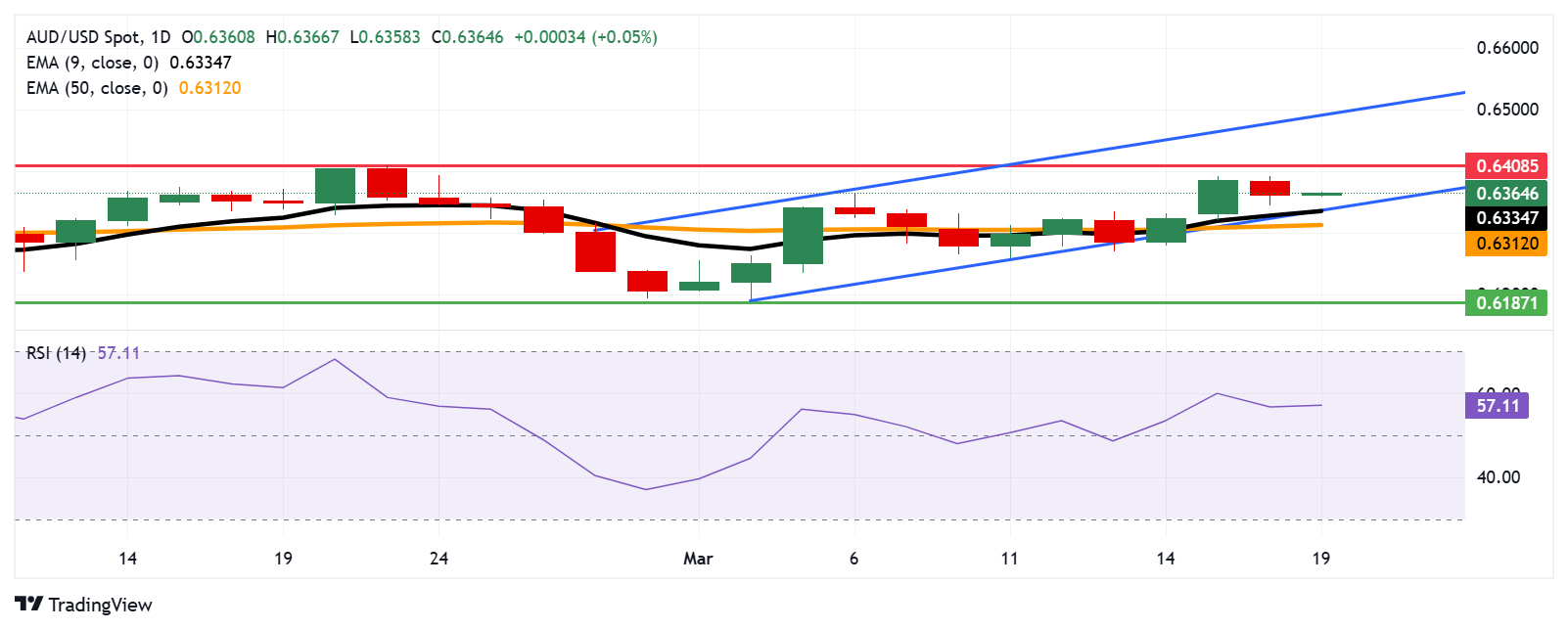
The AUD/USD pair is trading around 0.6360 on Wednesday, maintaining its bullish trajectory as it continues to climb within the ascending channel on the daily chart. The 14-day Relative Strength Index (RSI) remains above 50, reinforcing the positive momentum.
On the upside, the AUD/USD pair may attempt to retest its three-month high of 0.6408, last reached on February 21. A breakout above this level could strengthen the bullish bias, potentially driving the pair toward the upper boundary of the ascending channel near 0.6490.
Key support lies at the nine-day Exponential Moving Average (EMA) of 0.6334, aligned with the lower boundary of the ascending channel. Further support is seen at the 50-day EMA at 0.6312. A decisive break below this critical zone could weaken the bullish outlook, exposing the AUD/USD pair to further downside pressure toward the six-week low of 0.6187, recorded on March 5.
AUD/USD: Daily Chart
Australian Dollar PRICE Today
The table below shows the percentage change of Australian Dollar (AUD) against listed major currencies today. Australian Dollar was the weakest against the US Dollar.
| USD | EUR | GBP | JPY | CAD | AUD | NZD | CHF | |
|---|---|---|---|---|---|---|---|---|
| USD | 0.24% | 0.20% | 0.16% | 0.13% | 0.23% | 0.24% | 0.00% | |
| EUR | -0.24% | -0.05% | -0.08% | -0.12% | -0.00% | 0.00% | -0.24% | |
| GBP | -0.20% | 0.05% | -0.02% | -0.07% | 0.05% | 0.05% | -0.21% | |
| JPY | -0.16% | 0.08% | 0.02% | -0.06% | 0.06% | 0.04% | -0.18% | |
| CAD | -0.13% | 0.12% | 0.07% | 0.06% | 0.12% | 0.14% | -0.14% | |
| AUD | -0.23% | 0.00% | -0.05% | -0.06% | -0.12% | -0.00% | -0.20% | |
| NZD | -0.24% | -0.00% | -0.05% | -0.04% | -0.14% | 0.00% | -0.25% | |
| CHF | -0.00% | 0.24% | 0.21% | 0.18% | 0.14% | 0.20% | 0.25% |
The heat map shows percentage changes of major currencies against each other. The base currency is picked from the left column, while the quote currency is picked from the top row. For example, if you pick the Australian Dollar from the left column and move along the horizontal line to the US Dollar, the percentage change displayed in the box will represent AUD (base)/USD (quote).
Economic Indicator
Fed Interest Rate Decision
The Federal Reserve (Fed) deliberates on monetary policy and makes a decision on interest rates at eight pre-scheduled meetings per year. It has two mandates: to keep inflation at 2%, and to maintain full employment. Its main tool for achieving this is by setting interest rates – both at which it lends to banks and banks lend to each other. If it decides to hike rates, the US Dollar (USD) tends to strengthen as it attracts more foreign capital inflows. If it cuts rates, it tends to weaken the USD as capital drains out to countries offering higher returns. If rates are left unchanged, attention turns to the tone of the Federal Open Market Committee (FOMC) statement, and whether it is hawkish (expectant of higher future interest rates), or dovish (expectant of lower future rates).
Read more.Next release: Wed Mar 19, 2025 18:00
Frequency: Irregular
Consensus: 4.5%
Previous: 4.5%
Source: Federal Reserve
BRANDED CONTENT
Finding a broker with low spreads can make a big difference in your trading success. Discover our top picks for low-spread brokers, each offering unique benefits to fit your strategy.
Author

Akhtar Faruqui
FXStreet
Akhtar Faruqui is a Forex Analyst based in New Delhi, India. With a keen eye for market trends and a passion for dissecting complex financial dynamics, he is dedicated to delivering accurate and insightful Forex news and analysis.