Australian Dollar surges as US Dollar weakens ahead of Initial Jobless Claims
- The Australian Dollar advances after the release of domestic trade balance data on Thursday.
- Australia’s Trade Surplus widened to 5,365 million MoM in June, against the expected 3,250 million.
- Trump warned that he may impose additional tariffs on China over its purchases of Russian Oil.

The Australian Dollar (AUD) edges higher against the US Dollar (USD) on Thursday, following a 0.5% gain in the previous session. The AUD/USD pair gains ground following the release of trade balance data.
The Australian Bureau of Statistics (ABS) reported that Australia’s Trade Surplus increased to 5,365 million month-over-month in June, surpassing the expected 3,250 million and the previous 1,604 million (revised from 2,238 million). The monthly Exports rose by 6.0% in June, while Imports fell by 3.1%.
China's Trade Balance arrived at CNY705.10 billion in July, expanding from the previous figure of CNY585.96 billion. Exports rose 8.0% YoY in July following 7.2% in June, while imports increased 4.8% YoY against 2.3% recorded previously. In US Dollar (USD) terms, China’s Trade Balance arrived at +98.24 billion versus +105 billion expected and +114.77 billion priors.
US President Donald Trump warned China, Australia’s close trading partner, that he could impose further tariffs similar to the 25% levies announced earlier on India over its Russian Oil purchases, depending on what happens, per Reuters.
The Reserve Bank of Australia (RBA) is widely anticipated to deliver a 25 basis point rate cut next week, which would bring the cash rate down to 3.60%. The case for easing has grown stronger as core inflation slowed to 2.7% in June, well within the RBA’s 2–3% target, along with rising unemployment and slowing wage growth.
Australian Dollar advances as US Dollar weakens ahead of Jobless Claims
- The US Dollar Index (DXY), which measures the value of the US Dollar against six major currencies, is appreciating and trading around 98.30 at the time of writing. The US weekly Initial Jobless Claims will likely be eyed later on Thursday.
- The July US Nonfarm Payrolls (NFP) report pointed to a cooling labor market. boosted expectations that the US Federal Reserve (Fed) will deliver a 25 basis point rate cut in September. Markets have priced in nearly a 95% possibility of a 25 basis point (bps) cut at the September meeting, up from 48% a week ago, according to the CME FedWatch tool.
- Federal Reserve Bank of San Francisco President Mary Daly said on Wednesday that the Fed still has some ground to cover on its fight with inflation pressures despite overall progress. Daly highlighted that the Fed may be forced to act soon without having the full picture.
- Boston Fed President Susan Collins and Fed Board of Governors member Lisa Cook cautioned that persistent uncertainty remains a major obstacle to effective policy transmission and challenges the central bank’s ability to manage interest rates efficiently.
- US President Donald Trump announced on Tuesday that he will appoint the Fed’s Chair and Kugler’s replacement by the end of the week, and confirmed his choices for Chairman, including White House economic adviser Kevin Hassett, former Fed governor Kevin Warsh, and two other people. Trump also confirmed that Treasury Secretary Scott Bessent is not his choice for the Fed’s Chair.
- The Institute for Supply Management (ISM) Services PMI declined to 50.1 in July, down from 50.8 in the previous month and falling short of the expected reading of 51.5. Meanwhile, the ISM Services Prices Paid advanced to 69.9 from 67.5, the Employment Index ticked lower to 46.4 from 47.2, and the New Orders Index deflated to 50.3 from 51.3.
- The US and China were unable to reach an agreement on extending the 90-day tariff pause during their latest round of talks in Stockholm, Sweden. The current pause is set to expire on August 12, with the final decision resting in the hands of US President Donald Trump. In the meantime, US tariffs have been lowered from 145% to 30%, while Chinese tariffs have been reduced from 125% to 10%.
- China's Caixin Services Purchasing Managers' Index unexpectedly jumped to 52.6 in July from 50.6 in June. The market forecast was for a 50.2 print in the reported period.
- Australia’s Ai Group Manufacturing PMI rose by 4.9 points to -23.9 in July, indicating a slight improvement but still pointing to a deep contraction in the sector. Meanwhile, the Ai Group Australian Industry Index, a key gauge of private-sector activity, climbed 5.8 points to -3.2, its strongest reading in three years, continuing the gradual recovery trend that began in mid-2024.
- Australia was spared from the latest United States (US) tariff hikes, indicating that President Donald Trump had left the 10% baseline tariffs on Australian goods unchanged.
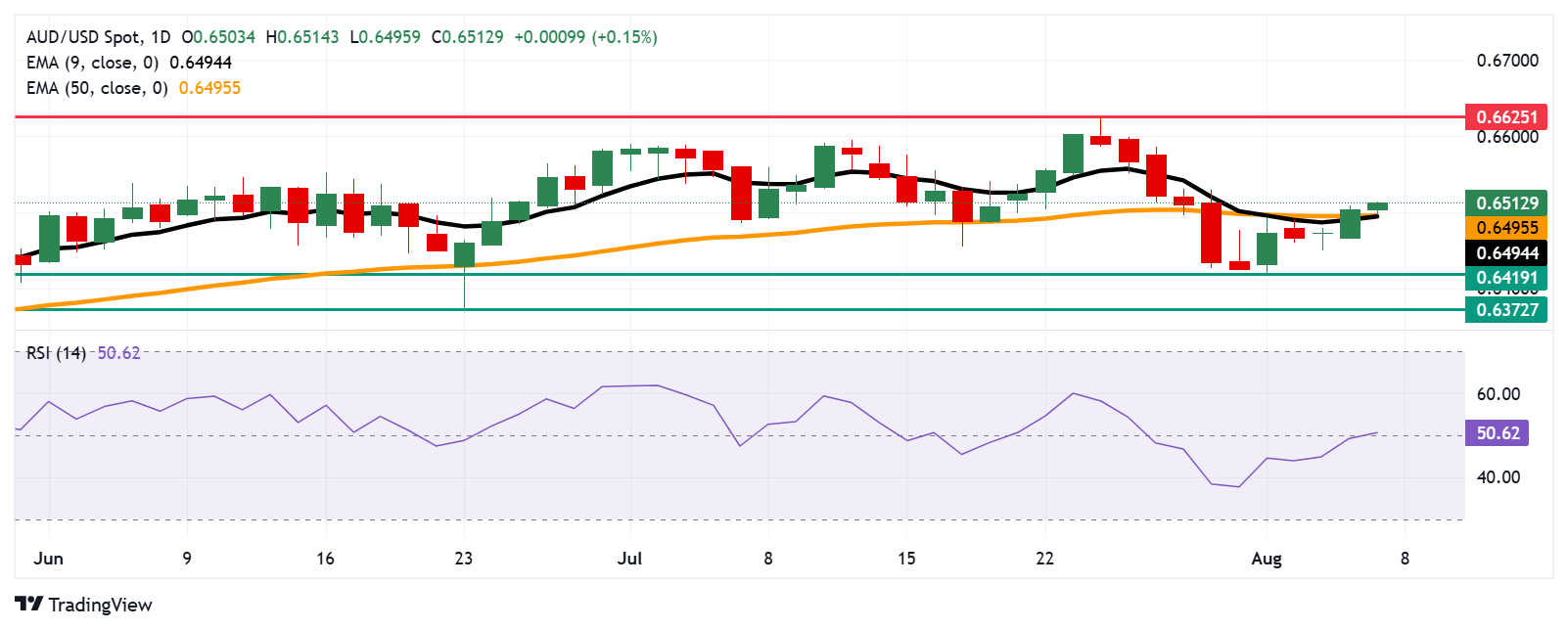
Australian Dollar holds position near 0.6500 after breaking above nine-day EMA
The AUD/USD pair is trading around 0.6500 on Thursday. Technical analysis on the daily chart suggests a bearish bias, with the 14-day Relative Strength Index (RSI) holding below the 50 level. However, the pair has moved above the nine-day Exponential Moving Average (EMA), signaling that short-term momentum is stronger.
On the downside, the AUD/USD pair may test the 50-day EMA at 0.6495, aligned with the nine-day EMA at 0.6494. A break below these levels could weaken the short- and medium-term price momentum and put downward pressure on the pair to test the two-month low of 0.6419, which was recorded on August 1, followed by a three-month low at 0.6372, recorded on June 23.
The AUD/USD pair could approach the psychological level of 0.6600, followed by the nine-month high at 0.6625, which was recorded on July 24.
AUD/USD: Daily Chart
Australian Dollar PRICE Today
The table below shows the percentage change of Australian Dollar (AUD) against listed major currencies today. Australian Dollar was the strongest against the US Dollar.
| USD | EUR | GBP | JPY | CAD | AUD | NZD | CHF | |
|---|---|---|---|---|---|---|---|---|
| USD | -0.13% | -0.13% | -0.24% | -0.10% | -0.34% | -0.42% | -0.17% | |
| EUR | 0.13% | -0.01% | -0.10% | 0.02% | -0.22% | -0.34% | -0.05% | |
| GBP | 0.13% | 0.00% | -0.08% | 0.05% | -0.20% | -0.33% | -0.02% | |
| JPY | 0.24% | 0.10% | 0.08% | 0.13% | -0.07% | -0.23% | 0.12% | |
| CAD | 0.10% | -0.02% | -0.05% | -0.13% | -0.24% | -0.38% | -0.05% | |
| AUD | 0.34% | 0.22% | 0.20% | 0.07% | 0.24% | -0.12% | 0.19% | |
| NZD | 0.42% | 0.34% | 0.33% | 0.23% | 0.38% | 0.12% | 0.33% | |
| CHF | 0.17% | 0.05% | 0.02% | -0.12% | 0.05% | -0.19% | -0.33% |
The heat map shows percentage changes of major currencies against each other. The base currency is picked from the left column, while the quote currency is picked from the top row. For example, if you pick the Australian Dollar from the left column and move along the horizontal line to the US Dollar, the percentage change displayed in the box will represent AUD (base)/USD (quote).
Economic Indicator
Initial Jobless Claims
The Initial Jobless Claims released by the US Department of Labor is a measure of the number of people filing first-time claims for state unemployment insurance. A larger-than-expected number indicates weakness in the US labor market, reflects negatively on the US economy, and is negative for the US Dollar (USD). On the other hand, a decreasing number should be taken as bullish for the USD.
Read more.Next release: Thu Aug 07, 2025 12:30
Frequency: Weekly
Consensus: 221K
Previous: 218K
Source: US Department of Labor
Every Thursday, the US Department of Labor publishes the number of previous week’s initial claims for unemployment benefits in the US. Since this reading could be highly volatile, investors may pay closer attention to the four-week average. A downtrend is seen as a sign of an improving labour market and could have a positive impact on the USD’s performance against its rivals and vice versa.
Author

Akhtar Faruqui
FXStreet
Akhtar Faruqui is a Forex Analyst based in New Delhi, India. With a keen eye for market trends and a passion for dissecting complex financial dynamics, he is dedicated to delivering accurate and insightful Forex news and analysis.

















