Australian Dollar remains stronger as US Dollar struggles ahead of ISM Manufacturing PMI
- Australian Dollar receives support from cautious sentiment surrounding the RBA policy stance.
- China's RatingDog Manufacturing Purchasing Managers' Index fell to 50.6 in October from 51.2 in September.
- The US Dollar strengthens as expectations for a December Fed rate cut fade.

Australian Dollar (AUD) advances against the US Dollar (USD), halting its three-day losing streak on Monday. The AUD/USD pair may continue to lose ground as the US Dollar (USD) gains amid dampening expectations of a US Federal Reserve (Fed) interest rate cut in December.
The AUD failed to draw any impact from the release of economic data from Australia and China on Monday. The TD-MI Inflation Gauge rose 0.3% month-on-month (MoM) in October, easing slightly from a 0.4% gain in September but marking the second consecutive monthly increase. Meanwhile, the annual Inflation Gauge rose 3.1%, edging higher from the previous 3.0%.
Australia’s Building Permits rose 12.0% MoM, after falling 3.6% in August and beating market expectations of a 5.5% growth. ANZ Job Advertisements fell 2.2% month-on-month in October, following a revised 3.5% drop in the previous month. This marked the fourth straight monthly decline.
China's RatingDog Manufacturing Purchasing Managers' Index (PMI) declined to 50.6 in October from 51.2 in September. The market forecast was for a 50.9 print. It is important to note that any shift in China’s economic conditions could also affect the Australian dollar (AUD), given the close trade ties between China and Australia.
US President Donald Trump said he plans to block China from accessing Nvidia’s most advanced semiconductor technology, according to CBS News. His remarks could reignite US-China trade tensions, which had eased after his meeting with Chinese President Xi Jinping last Thursday during the APEC Summit in South Korea.
Traders turned cautious ahead of Tuesday’s RBA policy decision, with the bank expected to hold rates after three earlier cuts, as Q2 headline and trimmed mean inflation stayed within the 2–3% target range.
US Dollar receives support from diminished likelihood of Fed rate cuts
- The US Dollar Index (DXY), which measures the value of the US Dollar (USD) against six major currencies, is losing daily gains and trading around 99.70 at the time of writing. The US ISM Manufacturing Purchasing Managers Index (PMI) report is due later on Monday.
- Fed funds futures traders are now pricing in a 69% chance of a cut in December, down from 93% a week ago, according to the CME FedWatch Tool.
- Fed Chair Jerome Powell said during the post-meeting press conference that another rate cut in December is far from certain. Powell also cautioned that policymakers may need to take a wait-and-see approach until official data reporting resumes.
- The US Fed delivered a 25-basis-point rate cut on Wednesday, lowering its benchmark rate to a range of 3.75%–4.0% in a 10–2 vote. The decision was not unanimous, as Fed Governor Stephen Miran supported a larger 50-basis-point cut, while Kansas City Fed President Jeffrey Schmid voted to keep rates unchanged.
- Traders may adopt caution due to the prolonged government shutdown, which could fuel economic concerns in the United States (US). The US government impasse has now entered its sixth week with no easy endgame in sight amid a deadlock in Congress on the Republican-backed funding bill.
- The White House announced that China will suspend extra export controls on rare earths and end probes into US semiconductor firms, in exchange for the US pausing some tariffs and canceling a planned 100% levy on Chinese exports.
- China’s NBS Manufacturing Purchasing Managers' Index dropped sharply to 49.0 in October, following 49.8 recorded in September. The reading came in above the expected 49.6 figure in the reported month. Meanwhile, the NBS Non-Manufacturing PMI unexpectedly rose slightly to 50.1 against the previous and the market consensus of 50.0 readings.
- The RBA Trimmed Mean CPI for Q3 rose 1.0% and 3.0% on a quarterly and annual basis, respectively. Markets estimated an increase of 0.8% QoQ and 2.7% YoY in the quarter to September. The monthly Consumer Price Index jumped by 3.5% YoY in August, compared to the previous reading of a 3.0% increase. This figure came in hotter than the expectation of 3.1%.
- Australia’s hotter-than-expected Q3 inflation and August CPI data reduced expectations for near-term rate cuts by the Reserve Bank of Australia (RBA). RBA Governor Bullock noted that the labor market remains somewhat tight, despite the unexpected rise in the unemployment rate.
Australian Dollar hovers around 0.6550 as consolidation prevails
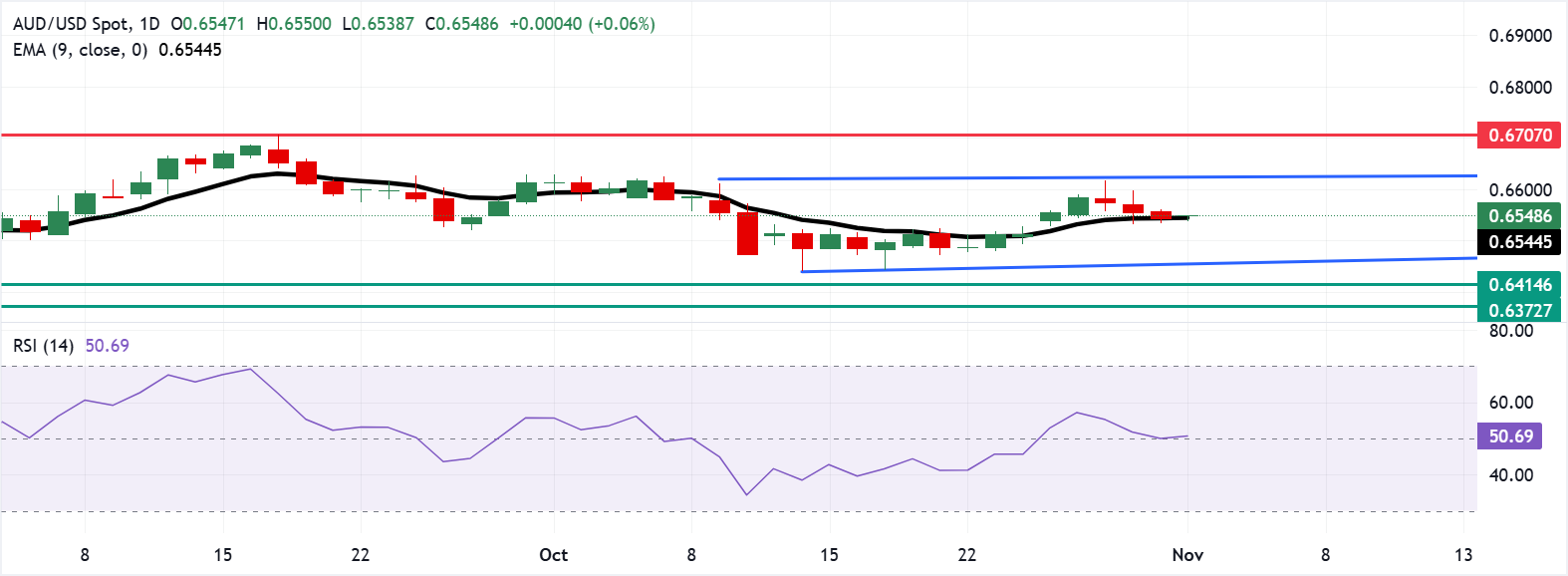
The AUD/USD pair is trading around 0.6550 on Monday. Technical analysis of a daily chart suggests a consolidation phase as the pair moves sideways within a rectangle pattern. However, the pair is positioned slightly above the nine-day Exponential Moving Average (EMA), indicating that short-term price momentum is stronger.
The initial barrier lies at the psychological level of 0.6600, followed by the rectangle’s upper boundary around 0.6630. Further advances above the rectangle would signal a bullish bias and support the AUD/USD pair in exploring the region around the 13-month high of 0.6707, recorded on September 17.
On the downside, the primary support lies at the nine-day EMA of 0.6544. A break below this level would weaken the short-term price momentum and prompt the AUD/USD pair to navigate the region around the lower boundary of the rectangle around 0.6460, followed by the five-month low of 0.6414.
AUD/USD: Daily Chart
Australian Dollar Price Today
The table below shows the percentage change of Australian Dollar (AUD) against listed major currencies today. Australian Dollar was the strongest against the Japanese Yen.
| USD | EUR | GBP | JPY | CAD | AUD | NZD | CHF | |
|---|---|---|---|---|---|---|---|---|
| USD | 0.00% | 0.06% | 0.08% | -0.00% | -0.27% | -0.22% | -0.03% | |
| EUR | -0.01% | 0.06% | 0.05% | -0.01% | -0.28% | -0.22% | -0.02% | |
| GBP | -0.06% | -0.06% | 0.00% | -0.08% | -0.32% | -0.28% | -0.07% | |
| JPY | -0.08% | -0.05% | 0.00% | -0.07% | -0.32% | -0.15% | -0.07% | |
| CAD | 0.00% | 0.01% | 0.08% | 0.07% | -0.29% | -0.20% | -0.01% | |
| AUD | 0.27% | 0.28% | 0.32% | 0.32% | 0.29% | 0.06% | 0.28% | |
| NZD | 0.22% | 0.22% | 0.28% | 0.15% | 0.20% | -0.06% | 0.20% | |
| CHF | 0.03% | 0.02% | 0.07% | 0.07% | 0.00% | -0.28% | -0.20% |
The heat map shows percentage changes of major currencies against each other. The base currency is picked from the left column, while the quote currency is picked from the top row. For example, if you pick the Australian Dollar from the left column and move along the horizontal line to the US Dollar, the percentage change displayed in the box will represent AUD (base)/USD (quote).
Interest rates FAQs
Interest rates are charged by financial institutions on loans to borrowers and are paid as interest to savers and depositors. They are influenced by base lending rates, which are set by central banks in response to changes in the economy. Central banks normally have a mandate to ensure price stability, which in most cases means targeting a core inflation rate of around 2%. If inflation falls below target the central bank may cut base lending rates, with a view to stimulating lending and boosting the economy. If inflation rises substantially above 2% it normally results in the central bank raising base lending rates in an attempt to lower inflation.
Higher interest rates generally help strengthen a country’s currency as they make it a more attractive place for global investors to park their money.
Higher interest rates overall weigh on the price of Gold because they increase the opportunity cost of holding Gold instead of investing in an interest-bearing asset or placing cash in the bank. If interest rates are high that usually pushes up the price of the US Dollar (USD), and since Gold is priced in Dollars, this has the effect of lowering the price of Gold.
The Fed funds rate is the overnight rate at which US banks lend to each other. It is the oft-quoted headline rate set by the Federal Reserve at its FOMC meetings. It is set as a range, for example 4.75%-5.00%, though the upper limit (in that case 5.00%) is the quoted figure. Market expectations for future Fed funds rate are tracked by the CME FedWatch tool, which shapes how many financial markets behave in anticipation of future Federal Reserve monetary policy decisions.
Author

Akhtar Faruqui
FXStreet
Akhtar Faruqui is a Forex Analyst based in New Delhi, India. With a keen eye for market trends and a passion for dissecting complex financial dynamics, he is dedicated to delivering accurate and insightful Forex news and analysis.