Australian Dollar rises as US Dollar loses on increased risk aversion
- Australian Dollar gains after TD-MI Inflation Gauge rose to 3.5% YoY in December.
- China’s GDP rose 1.2% QoQ in Q4 2025, accelerating from Q3 and beating expectations.
- The Greenback struggles as rising risk aversion intensifies amid escalating US–Greenland uncertainty.

The Australian Dollar strengthened against the US Dollar (USD) on Monday following the release of Australia’s TD-MI Inflation Gauge, which rose to 3.5% year-over-year (YoY) in December, up from 3.2% previously. On a monthly basis, inflation surged 1.0% month-over-month (MoM) in December 2025, the fastest pace since December 2023 and a sharp acceleration from 0.3% in the prior two months.
The AUD/USD pair gains ground following China’s key economic data. It is important to note that any change in the Chinese economy could impact the Australian Dollar as both countries are close trading partners.
Data from the National Bureau of Statistics showed that China’s Industrial Production rose 5.2% year-over-year YoY in December, accelerating from 4.8% in November, supported by resilient export-driven manufacturing activity. China’s Gross Domestic Product (GDP) rose 1.2% quarter-over-quarter in Q4 2025, accelerating from 1.1% in Q3 and exceeding the market consensus of 1.0%. On an annual basis, GDP grew 4.5% in Q4, easing from 4.8% in the previous quarter but coming in above expectations of a 4.4% reading.
Meanwhile, December Retail Sales rose 0.9% YoY, undershooting forecasts of 1.2% and November’s 1.3%. In contrast, Industrial Production increased 5.2% YoY, beating estimates of 5.0% and improving from 4.8% in November.
US Dollar weakens as uncertainty surrounding the US–Greenland issue escalates
- The US Dollar Index (DXY), which measures the value of the US Dollar against six major currencies, is losing ground and trading around 99.20 at the time of writing. The US markets are closed in observance of the Martin Luther King Jr. Day holiday on Monday.
- The Greenback faces challenges amid increased risk aversion, driven by escalating uncertainty surrounding the US–Greenland issue. US President Donald Trump said on Saturday that he would impose tariffs on eight European countries opposing his proposal to acquire Greenland.
- According to Bloomberg, Trump stated that a 10% tariff would be levied on goods from EU members Denmark, Sweden, France, Germany, the Netherlands, and Finland, as well as Britain and Norway, effective February 1, until the US is permitted to purchase Greenland.
- US labor market data have pushed back expectations for further Federal Reserve (Fed) rate cuts until June. Fed officials have signaled little urgency to ease policy further until there is clearer evidence that inflation is sustainably moving toward the 2% target.
- Morgan Stanley analysts revised their 2026 outlook, now forecasting one rate cut in June followed by another in September, compared with their previous expectation of cuts in January and April.
- The US Department of Labor (DOL) reported on Thursday that Initial Jobless Claims unexpectedly fell to 198K in the week ended January 10, below market expectations of 215K and down from the prior week’s revised 207K. The data confirmed that layoffs remain limited and that the labor market is holding up despite an extended period of high borrowing costs.
- US Core Consumer Price Index (CPI), excluding food and energy, rose 0.2% in December, below market expectations, while annual core inflation held at 2.6%, matching a four-year low. The data provided a clearer sign of easing inflation after earlier releases were skewed by shutdown effects. Meanwhile, CPI increased by 0.3% month-over-month in December 2025, matching market expectations and repeating the rise seen in September. The annual inflation remains at 2.7% increase as expected.
- RBA policymakers acknowledged that inflation has eased significantly from its 2022 peak, though recent data suggest renewed upward momentum. Headline CPI slowed to 3.4% YoY in November, the lowest reading since August, but remains above the RBA’s 2–3% target band. Meanwhile, trimmed mean CPI edged down to 3.2% from October’s eight-month high of 3.3%.
- The RBA assessed that inflation risks have modestly tilted to the upside, while downside risks, particularly from global conditions, have diminished. Board members expect only one additional rate cut this year, with underlying inflation projected to remain above 3% in the near term before easing to around 2.6% by 2027.
- The ASX 30-Day Interbank Cash Rate Futures for February 2026 were trading at 96.35 as of January 16, implying a 22% probability of a rate hike to 3.85% at the next RBA Board meeting.
Australian Dollar eyes 0.6700 near nine-day EMA barrier
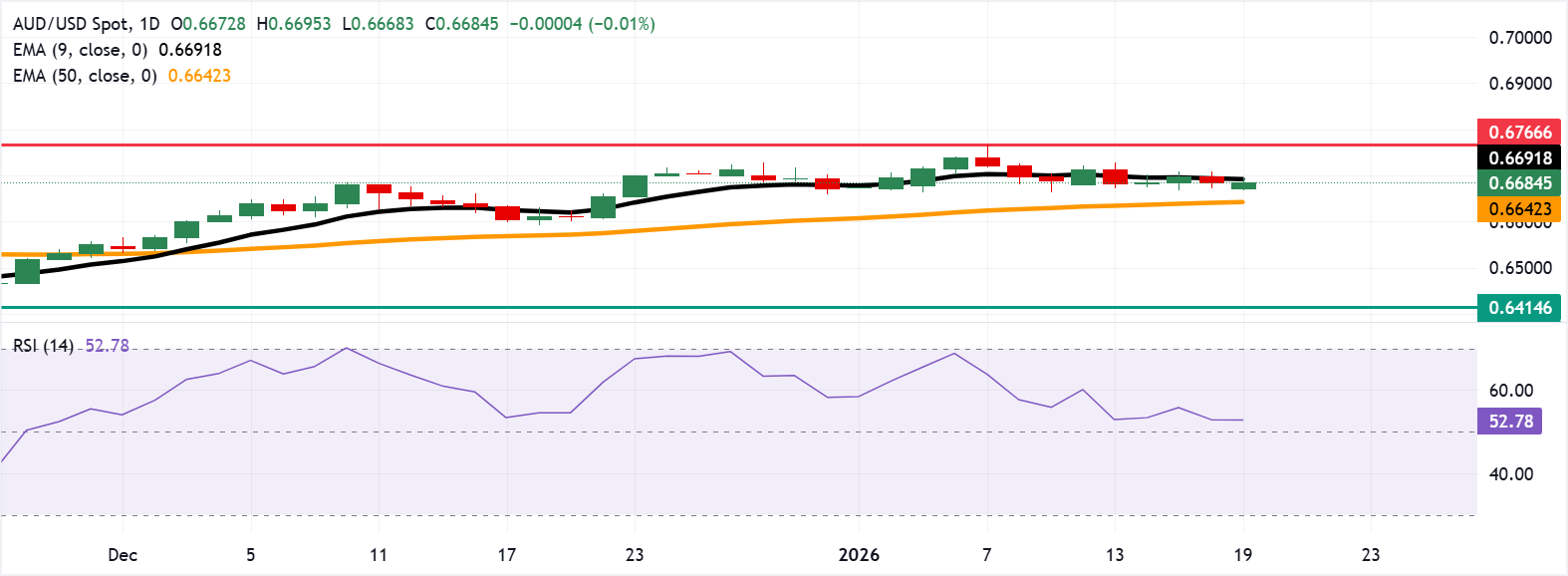
The AUD/USD pair is trading around 0.6680 on Monday. Daily chart analysis shows the pair consolidates around the nine-day Exponential Moving Average (EMA), suggesting a neutral bias for a shorter term. The 14-day Relative Strength Index (RSI) at 52.78 remains above the midpoint, supporting upside momentum.
The daily break below the short-term average could expose the 50-day EMA at 0.6642 as initial support. Further losses would open the downside toward 0.6414, the lowest since June 2025.
A successful surpassing of the nine-day EMA of 0.6690 would reinforce the bullish bias and support the AUD/USD pair to target 0.6766, its highest level since October 2024.
Australian Dollar Price Today
The table below shows the percentage change of Australian Dollar (AUD) against listed major currencies today. Australian Dollar was the strongest against the US Dollar.
| USD | EUR | GBP | JPY | CAD | AUD | NZD | CHF | |
|---|---|---|---|---|---|---|---|---|
| USD | -0.25% | -0.13% | -0.13% | -0.17% | -0.17% | -0.38% | -0.53% | |
| EUR | 0.25% | 0.12% | 0.13% | 0.08% | 0.09% | -0.13% | -0.28% | |
| GBP | 0.13% | -0.12% | 0.02% | -0.04% | -0.04% | -0.25% | -0.40% | |
| JPY | 0.13% | -0.13% | -0.02% | -0.06% | -0.05% | -0.26% | -0.42% | |
| CAD | 0.17% | -0.08% | 0.04% | 0.06% | 0.01% | -0.20% | -0.36% | |
| AUD | 0.17% | -0.09% | 0.04% | 0.05% | -0.01% | -0.22% | -0.36% | |
| NZD | 0.38% | 0.13% | 0.25% | 0.26% | 0.20% | 0.22% | -0.16% | |
| CHF | 0.53% | 0.28% | 0.40% | 0.42% | 0.36% | 0.36% | 0.16% |
The heat map shows percentage changes of major currencies against each other. The base currency is picked from the left column, while the quote currency is picked from the top row. For example, if you pick the Australian Dollar from the left column and move along the horizontal line to the US Dollar, the percentage change displayed in the box will represent AUD (base)/USD (quote).
Australian Dollar FAQs
One of the most significant factors for the Australian Dollar (AUD) is the level of interest rates set by the Reserve Bank of Australia (RBA). Because Australia is a resource-rich country another key driver is the price of its biggest export, Iron Ore. The health of the Chinese economy, its largest trading partner, is a factor, as well as inflation in Australia, its growth rate and Trade Balance. Market sentiment – whether investors are taking on more risky assets (risk-on) or seeking safe-havens (risk-off) – is also a factor, with risk-on positive for AUD.
The Reserve Bank of Australia (RBA) influences the Australian Dollar (AUD) by setting the level of interest rates that Australian banks can lend to each other. This influences the level of interest rates in the economy as a whole. The main goal of the RBA is to maintain a stable inflation rate of 2-3% by adjusting interest rates up or down. Relatively high interest rates compared to other major central banks support the AUD, and the opposite for relatively low. The RBA can also use quantitative easing and tightening to influence credit conditions, with the former AUD-negative and the latter AUD-positive.
China is Australia’s largest trading partner so the health of the Chinese economy is a major influence on the value of the Australian Dollar (AUD). When the Chinese economy is doing well it purchases more raw materials, goods and services from Australia, lifting demand for the AUD, and pushing up its value. The opposite is the case when the Chinese economy is not growing as fast as expected. Positive or negative surprises in Chinese growth data, therefore, often have a direct impact on the Australian Dollar and its pairs.
Iron Ore is Australia’s largest export, accounting for $118 billion a year according to data from 2021, with China as its primary destination. The price of Iron Ore, therefore, can be a driver of the Australian Dollar. Generally, if the price of Iron Ore rises, AUD also goes up, as aggregate demand for the currency increases. The opposite is the case if the price of Iron Ore falls. Higher Iron Ore prices also tend to result in a greater likelihood of a positive Trade Balance for Australia, which is also positive of the AUD.
The Trade Balance, which is the difference between what a country earns from its exports versus what it pays for its imports, is another factor that can influence the value of the Australian Dollar. If Australia produces highly sought after exports, then its currency will gain in value purely from the surplus demand created from foreign buyers seeking to purchase its exports versus what it spends to purchase imports. Therefore, a positive net Trade Balance strengthens the AUD, with the opposite effect if the Trade Balance is negative.
Author

Akhtar Faruqui
FXStreet
Akhtar Faruqui is a Forex Analyst based in New Delhi, India. With a keen eye for market trends and a passion for dissecting complex financial dynamics, he is dedicated to delivering accurate and insightful Forex news and analysis.















