Australian Dollar holds losses as US Dollar recovers ground ahead of PCE Price Index
- The Australian Dollar offers its daily gains due to risk aversion as Iran declines to resume nuclear negotiations.
- President Trump may announce his preferred candidate to lead the Federal Reserve next year.
- The US Dollar depreciated due to risk-on sentiment following a fragile US-brokered Israel-Iran ceasefire.

The Australian Dollar (AUD) retraces daily gains on Friday, halting its four-day winning streak. The AUD/USD pair edges lower following Iranian Foreign Minister Abbas Araghchi's comments, noting that Tehran has no intention of resuming nuclear negotiations with the United States. “No agreement or arrangement has been made to resume negotiations. Neither any promise has been given, nor any discussion has taken place on this matter,” Araghchi said as per CNN.
However, the AUD/USD pair gained ground as the US Dollar (USD) struggled due to renewed concerns over the US Federal Reserve’s (Fed) independence. US President Donald Trump could weaken Fed Chair Jerome Powell’s authority by announcing his preferred candidate to lead the central bank next year. Trump said that he has a list of potential Powell successors down to “three or four people,” without naming the finalists.
The US Dollar also faced challenges amid improving risk appetite, driven by a fragile US-brokered Israel-Iran ceasefire. Traders will likely focus on the developments surrounding US-Iran talks and Middle East conflicts.
US President Donald Trump noted that the United States (US) and Iran would hold a meeting next week but questioned the need for a diplomatic solution on Iran's nuclear program, citing the damage that American bombing had done to key sites, per Bloomberg.
Australian Dollar struggles as US Dollar recovers ground due to risk-off mood
- The US Dollar Index (DXY), which measures the value of the US Dollar against six major currencies, is trading at around 97.40 at the time of writing. Traders await the US May Personal Consumption Expenditures (PCE) Price Index data later on Friday.
- US President Donald Trump may announce a successor for Federal Reserve (Fed) Chair Jerome Powell by September or October. Trump might consider former Fed Governor Kevin Warsh and National Economic Council Director Kevin Hassett, according to the Wall Street Journal.
- Chicago Fed President Austan Goolsbee said on Thursday that the political waves are not a factor in decision-making, nor would the naming of a shadow chair, per CNBC.
- Fed Chair Jerome Powell noted on Wednesday that Trump's tariff policies may cause a one-time price hike, but they could also lead to more persistent inflation. The Fed should be careful in considering further rate cuts.
- Fed’s Powell highlighted during his testimony before the Congressional Budget Committee on Tuesday, strengthening his case for delaying rate cuts, likely until sometime in the fourth quarter. Powell added, “When the time is right, expect rate cuts to continue.” He also said that data suggests that at least some of the tariffs will hit consumers and will start to see more tariff inflation starting in June.
- Minneapolis Fed President Neel Kashkari reaffirmed the Fed's wait-and-see stance on potential tariff impacts on inflation and the broader economy in general before making any hard decisions on moving interest rates.
- Kansas City Fed President Jeff Schmid said early Wednesday that the central bank should wait to see how uncertainty surrounding tariffs and other policies impacts the economy before adjusting interest rates. Schmid added that the resilience of the economy gives us the time to observe how prices and the economy develop, per Bloomberg.
- A US intelligence report indicated that US strikes on Iranian nuclear sites have set back Tehran's program by only a matter of months, per Reuters. Additionally, Iranian Foreign Minister Abbas Araghchi said that the country's nuclear program continues, per the local news agency Al Arabiya.
- China’s state planner, the National Development and Reform Commission (NDRC), said on Thursday that they are “confident in minimizing uncertainty and negative impact of external shocks.” They also noted that “With policy implementation and introduction, we are confident and capable of minimizing the adverse impacts from external shock.”
- China’s Premier Li Qiang made some encouraging comments on the economic outlook in his appearance on Thursday. Li said that the domestic economy shows strong resilience and development potential. China’s economic data shows stability in Q2, he added.
- Australian Bureau of Statistics (ABS) reported vacancies rose by 2.9% in the three months to May, partly recovering from a 4.3% decline in the previous quarter ended February. Australia’s labor demand remained resilient despite a soft economy as job vacancies rebounded in the May quarter, driven by openings in the construction and professional sectors. However, job openings stood at 339,400 in May, down 2.8% from a year earlier, the smallest annual decline in the past two years.
Australian Dollar hovers around 0.6550 support near seven-month highs
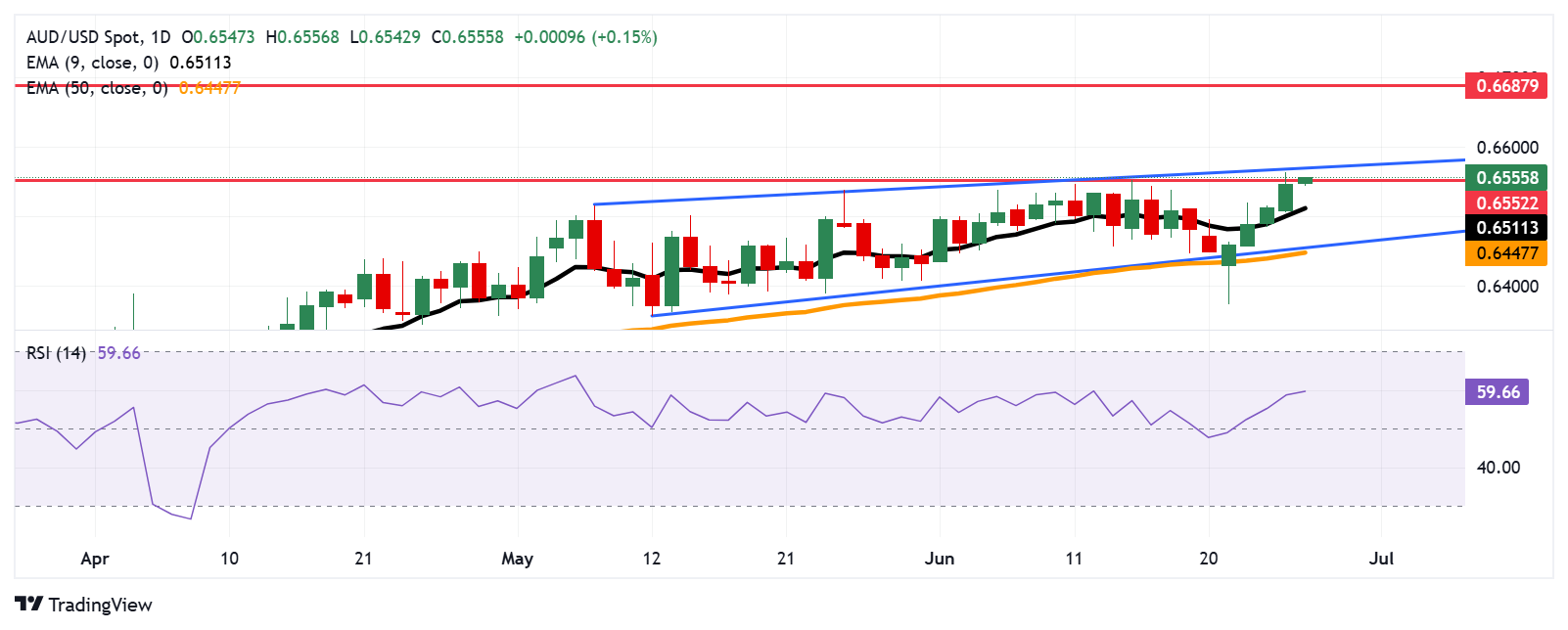
AUD/USD is trading around 0.6550 on Friday. The daily technical analysis indicates a persistent bullish bias as the pair remains within the ascending channel pattern. The 14-day Relative Strength Index (RSI) is positioned above the 50 mark. Additionally, the pair rises above the nine-day Exponential Moving Average (EMA), indicating that short-term price momentum is stronger.
On the upside, the AUD/USD pair is testing the seven-month high of 0.6552, which was recorded on June 16, followed by the upper boundary of the ascending channel around 0.6570.
The nine-day EMA at 0.6511 is poised to act as primary support. A break below this level would weaken the short-term price momentum and put downward pressure on the AUD/USD pair to test the lower boundary of the ascending channel around 0.6450, aligned with the 50-day EMA at 0.6447.
AUD/USD: Daily Chart
Australian Dollar PRICE Today
The table below shows the percentage change of Australian Dollar (AUD) against listed major currencies today. Australian Dollar was the weakest against the New Zealand Dollar.
| USD | EUR | GBP | JPY | CAD | AUD | NZD | CHF | |
|---|---|---|---|---|---|---|---|---|
| USD | 0.09% | 0.05% | 0.01% | 0.03% | 0.09% | 0.02% | 0.17% | |
| EUR | -0.09% | -0.09% | -0.08% | -0.07% | -0.03% | -0.21% | 0.02% | |
| GBP | -0.05% | 0.09% | 0.02% | -0.02% | 0.05% | -0.07% | 0.20% | |
| JPY | -0.01% | 0.08% | -0.02% | -0.00% | 0.05% | -0.18% | 0.21% | |
| CAD | -0.03% | 0.07% | 0.02% | 0.00% | 0.09% | -0.14% | 0.18% | |
| AUD | -0.09% | 0.03% | -0.05% | -0.05% | -0.09% | -0.18% | 0.14% | |
| NZD | -0.02% | 0.21% | 0.07% | 0.18% | 0.14% | 0.18% | 0.32% | |
| CHF | -0.17% | -0.02% | -0.20% | -0.21% | -0.18% | -0.14% | -0.32% |
The heat map shows percentage changes of major currencies against each other. The base currency is picked from the left column, while the quote currency is picked from the top row. For example, if you pick the Australian Dollar from the left column and move along the horizontal line to the US Dollar, the percentage change displayed in the box will represent AUD (base)/USD (quote).
Economic Indicator
Core Personal Consumption Expenditures - Price Index (YoY)
The Core Personal Consumption Expenditures (PCE), released by the US Bureau of Economic Analysis on a monthly basis, measures the changes in the prices of goods and services purchased by consumers in the United States (US). The PCE Price Index is also the Federal Reserve’s (Fed) preferred gauge of inflation. The YoY reading compares the prices of goods in the reference month to the same month a year earlier. The core reading excludes the so-called more volatile food and energy components to give a more accurate measurement of price pressures." Generally, a high reading is bullish for the US Dollar (USD), while a low reading is bearish.
Read more.Next release: Fri Jun 27, 2025 12:30
Frequency: Monthly
Consensus: 2.6%
Previous: 2.5%
Source: US Bureau of Economic Analysis
After publishing the GDP report, the US Bureau of Economic Analysis releases the Personal Consumption Expenditures (PCE) Price Index data alongside the monthly changes in Personal Spending and Personal Income. FOMC policymakers use the annual Core PCE Price Index, which excludes volatile food and energy prices, as their primary gauge of inflation. A stronger-than-expected reading could help the USD outperform its rivals as it would hint at a possible hawkish shift in the Fed’s forward guidance and vice versa.
Author

Akhtar Faruqui
FXStreet
Akhtar Faruqui is a Forex Analyst based in New Delhi, India. With a keen eye for market trends and a passion for dissecting complex financial dynamics, he is dedicated to delivering accurate and insightful Forex news and analysis.