Australian Dollar trades with mild losses as Trump tariff concerns linger
- The Australian Dollar edges lower in Tuesday's early European session.
- Renewed USD demand and Trump’s tariff threats weigh on the pair; hawkish expectations of the RBA might limit its downside.
- Investors brace for the US October JOLTs Job Openings and Fedspeak on Tuesday.

The Australian Dollar (AUD) extends its downside to near 0.6470 during the early European session on Tuesday. The stronger US Dollar (USD) to the three-day highs drags the pair lower. Additionally, the eruption of a global trade war under returning US President-elect Donald Trump could exert some selling pressure on the Aussie.
Nonetheless, the hawkish comments by Reserve Bank of Australia (RBA) Governor Michele Bullock might help limit the AUD’s losses. The RBA Governor Bullock said last week that the core inflation remains too high to consider near-term interest rate cuts, which increased the demand for the AUD. Later on Tuesday, the US JOLTs Job Openings for October will be published. Also, the Federal Reserve’s (Fed) Adriana Kugler and Austan Goolsbee are set to speak. The Australian Gross Domestic Product (GDP) for the third quarter (Q3) will be closely watched on Wednesday.
Australian Dollar weakens amid Trump’s tariff threats
- Australia's current account deficit came in higher than expected in the third quarter, arriving at a deficit of A$14.1 billion from A$16.4 billion shortfall in Q2 (revised from A$-10.7 billion). This figure was above forecasts of an A$10.0 billion shortfall.
- Australia’s Retail Sales climbed by 0.6% MoM in October, compared to a rise of 0.1% in September, according to the Australian Bureau of Statistics (ABS) on Monday. The reading was above the estimations of a 0.3% growth.
- The US ISM Manufacturing PMI rose to 48.4 in November versus 46.5 prior. This reading came in stronger than the market expectation of 47.5.
- Atlanta Fed President Raphael Bostic said on Monday that he’s undecided on whether a rate cut is needed in the December meeting but still believes Fed officials should continue lowering rates over the coming months, per Bloomberg.
- New York Fed President John Williams stated on Monday that the Fed officials will likely need to cut the interest rates further to move policy to a neutral stance now that risks to inflation and employment have become more balanced.
- Fed Governor Christopher Waller noted that he was leaning toward supporting an interest rate cut at the December meeting amid expectations for inflation to continue to ease toward the Fed's 2% target.
Technical Analysis: Australian Dollar’s bearish trend continues
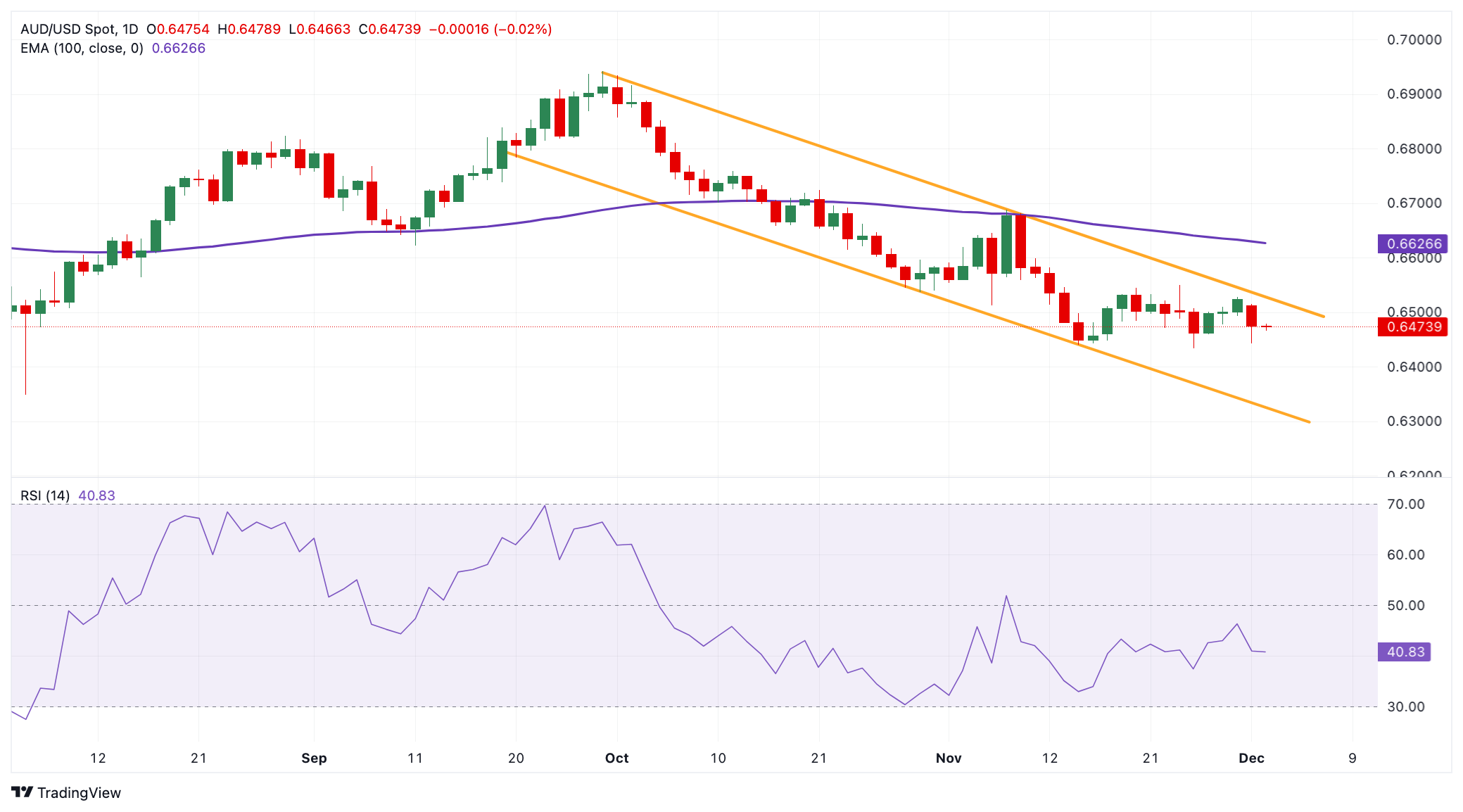
The Australian Dollar weakens on the day. The AUD/USD pair remains in a downtrend on the daily chart, characterized by the price holding below the key 100-day Exponential Moving Average (EMA). Additionally, the 14-day Relative Strength Index (RSI) stands below the 50-midline, supporting the sellers in the near term.
Bearish candlesticks below 0.6434, the low of November 26, may attract Aussie bears and drag AUD/USD to the lower limit of the descending trend channel of 0.6330. Extended losses could see a drop to 0.6285, the low of October 3, 2023.
On the other hand, sustained trading above the upper boundary of the trend channel of 0.6530 could set the pair to 0.6626, the 100-day EMA. Bullish candlesticks above this level could pave the way to 0.6687, the high of November 7.
Australian Dollar FAQs
One of the most significant factors for the Australian Dollar (AUD) is the level of interest rates set by the Reserve Bank of Australia (RBA). Because Australia is a resource-rich country another key driver is the price of its biggest export, Iron Ore. The health of the Chinese economy, its largest trading partner, is a factor, as well as inflation in Australia, its growth rate and Trade Balance. Market sentiment – whether investors are taking on more risky assets (risk-on) or seeking safe-havens (risk-off) – is also a factor, with risk-on positive for AUD.
The Reserve Bank of Australia (RBA) influences the Australian Dollar (AUD) by setting the level of interest rates that Australian banks can lend to each other. This influences the level of interest rates in the economy as a whole. The main goal of the RBA is to maintain a stable inflation rate of 2-3% by adjusting interest rates up or down. Relatively high interest rates compared to other major central banks support the AUD, and the opposite for relatively low. The RBA can also use quantitative easing and tightening to influence credit conditions, with the former AUD-negative and the latter AUD-positive.
China is Australia’s largest trading partner so the health of the Chinese economy is a major influence on the value of the Australian Dollar (AUD). When the Chinese economy is doing well it purchases more raw materials, goods and services from Australia, lifting demand for the AUD, and pushing up its value. The opposite is the case when the Chinese economy is not growing as fast as expected. Positive or negative surprises in Chinese growth data, therefore, often have a direct impact on the Australian Dollar and its pairs.
Iron Ore is Australia’s largest export, accounting for $118 billion a year according to data from 2021, with China as its primary destination. The price of Iron Ore, therefore, can be a driver of the Australian Dollar. Generally, if the price of Iron Ore rises, AUD also goes up, as aggregate demand for the currency increases. The opposite is the case if the price of Iron Ore falls. Higher Iron Ore prices also tend to result in a greater likelihood of a positive Trade Balance for Australia, which is also positive of the AUD.
The Trade Balance, which is the difference between what a country earns from its exports versus what it pays for its imports, is another factor that can influence the value of the Australian Dollar. If Australia produces highly sought after exports, then its currency will gain in value purely from the surplus demand created from foreign buyers seeking to purchase its exports versus what it spends to purchase imports. Therefore, a positive net Trade Balance strengthens the AUD, with the opposite effect if the Trade Balance is negative.
Author

Lallalit Srijandorn
FXStreet
Lallalit Srijandorn is a Parisian at heart. She has lived in France since 2019 and now becomes a digital entrepreneur based in Paris and Bangkok.

















