Australian Dollar declines due to rising odds of RBA rate cuts, US GDP Annualized Q4 eyed
- The Australian Dollar moves into the negative territory after retracing daily gains on Thursday.
- The Australian Bureau of Statistics showed export prices rose by 3.6% QoQ in Q4 2024, reversing a 4.3% decline in Q3.
- The Fed held its overnight borrowing rate steady in the 4.25%-4.50% range at its January meeting on Wednesday.

The Australian Dollar (AUD) extends its losing streak against the US Dollar (USD) for the fourth consecutive day on Thursday. However, the AUD/USD pair gained ground after the release of the Export Price Index. Data from the Australian Bureau of Statistics showed export prices rose by 3.6% quarter-over-quarter in Q4 2024, reversing a 4.3% decline in Q3 and marking the first increase since Q4 2023.
Australia’s Import Price Index rose by 0.2% QoQ in Q4 2024, rebounding from a 1.4% drop in Q3 and surpassing market expectations of a 1.5% decline. The increase was primarily driven by surging Gold prices, which hit an all-time high in October as investors sought safe-haven assets amid ongoing economic uncertainty.
ANZ, CBA, Westpac, and now National Australia Bank (NAB) all anticipate a 25 basis point (bps) rate cut from the Reserve Bank of Australia (RBA) in February. Previously, the NAB had forecasted a rate cut in May but has now moved its projection forward to the February RBA meeting.
Easing inflationary pressures toward the end of 2024 have fueled speculation that the Reserve Bank of Australia could consider a rate cut in February. The RBA has maintained the Official Cash Rate (OCR) at 4.35% since November 2023, emphasizing that inflation must “sustainably” return to its 2%-3% target range before any policy easing.
The AUD/USD pair weakened as the US Dollar (USD) gained broadly. The US Federal Reserve (Fed) kept interest rates unchanged on Wednesday, as expected, but provided little indication of potential rate cuts this year, reinforcing USD strength.
Traders are awaiting the release of the US fourth-quarter Gross Domestic Product (GDP) growth data, scheduled for Thursday. The market consensus expects a slowdown in annualized GDP growth, with a forecast of 2.6%, down from the previous 3.1%. Inflationary concerns persist, with the Q4 GDP Price Index expected to rise to 2.5%, up from 1.9%.
Australian Dollar depreciates amid Fed’s cautious tone
- The US Dollar Index (DXY), which measures the US Dollar’s value against six major currencies, remains steady at around 108.00 at the time of writing.
- The US Federal Reserve held its overnight borrowing rate steady in the 4.25%-4.50% range at its January meeting on Wednesday, as widely expected. This decision followed three consecutive rate cuts since September 2024, totaling a full percentage point.
- The US Dollar strengthened after the Fed adopted a cautious tone. During the press conference, Fed Chair Jerome Powell emphasized that the central bank would need to see “real progress on inflation or some weakness in the labor market” before considering any further adjustments to monetary policy.
- Scott Bessent, the Treasury Secretary under Trump, stated that he aims to introduce new universal tariffs on US imports, starting at 2.5%. These tariffs could rise to as much as 20%, reflecting Trump’s aggressive stance on trade policies, consistent with his campaign rhetoric last year.
- Speaking with reporters aboard Air Force One early Tuesday, US President Donald Trump stated that he “wants tariffs ‘much bigger’ than 2.5%,” as Treasury Secretary Scott Bessent proposed. However, Trump has not yet decided on the specific tariff levels.
- The Reserve Bank of Australia released its January 2025 Bulletin, featuring a detailed analysis of how monetary policy changes influence interest rates in the economy and how fluctuations in interest rates impact economic activity and inflation.
- Australia’s CPI rose by 0.2% quarter-on-quarter in the fourth quarter of 2024, matching the growth seen in the previous quarter but falling short of the market expectation of 0.3%. On an annual basis, CPI inflation eased to 2.4% in Q4 from 2.8% in Q3, also below the consensus forecast of 2.5%.
- Australia’s Monthly CPI for December 2024 increased by 2.5% year-over-year, in line with forecasts and up from November’s 2.3%. This marked the highest reading since August but remained within the Reserve Bank of Australia’s (RBA) target range of 2% to 3% for the fourth consecutive month. The RBA’s Trimmed Mean CPI rose by 3.2% YoY, the slowest pace in three years, slightly under the expected 3.3% but still above the central bank’s target range.
- Australian Treasurer Jim Chalmers stated on Wednesday that "the worst of the inflation challenge is well and truly behind us." Chalmers further emphasized that "the soft landing we have been planning and preparing for is looking more and more likely," according to Reuters.
- The AUD also faced challenges amid increased risk aversion due to tariff threats made by US President Donald Trump. President Trump announced plans on Monday evening to impose tariffs on imports of computer chips, pharmaceuticals, steel, aluminum, and copper. The goal is to shift production to the United States (US) and bolster domestic manufacturing.
Technical Analysis: Australian Dollar remains below nine-day EMA and ascending channel
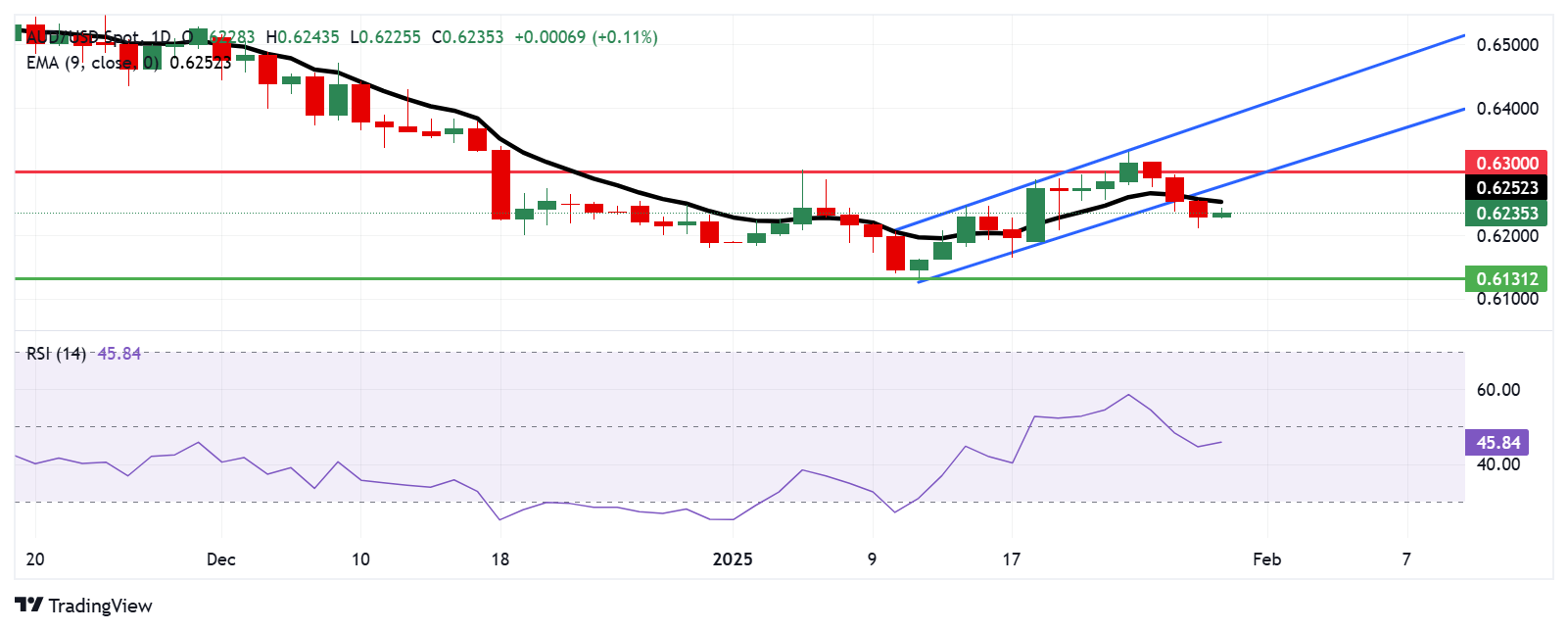
The AUD/USD pair hovers around 0.6230 on Thursday, trading just below the ascending channel on the daily chart, indicating a shift toward a bearish bias. The 14-day Relative Strength Index (RSI) remains below the 50 mark, further confirming the downside momentum.
A decisive break below the key support level at the lower boundary of the ascending channel has intensified bearish pressure, which could drive the pair toward 0.6131—the lowest level since April 2020—recorded on January 13.
On the upside, immediate resistance is seen at the nine-day Exponential Moving Average (EMA) at 0.6252, followed by the channel’s lower boundary at 0.6280. A sustained move above this level and a re-entry into the ascending channel could shift the outlook back to bullish, with the pair eyeing the upper boundary near 0.6380.
AUD/USD: Daily Chart
Australian Dollar PRICE Today
The table below shows the percentage change of Australian Dollar (AUD) against listed major currencies today. Australian Dollar was the weakest against the Japanese Yen.
| USD | EUR | GBP | JPY | CAD | AUD | NZD | CHF | |
|---|---|---|---|---|---|---|---|---|
| USD | -0.10% | -0.07% | -0.56% | -0.02% | 0.14% | 0.13% | -0.09% | |
| EUR | 0.10% | 0.03% | -0.43% | 0.08% | 0.23% | 0.23% | 0.01% | |
| GBP | 0.07% | -0.03% | -0.48% | 0.05% | 0.20% | 0.19% | -0.04% | |
| JPY | 0.56% | 0.43% | 0.48% | 0.53% | 0.68% | 0.63% | 0.43% | |
| CAD | 0.02% | -0.08% | -0.05% | -0.53% | 0.16% | 0.14% | -0.12% | |
| AUD | -0.14% | -0.23% | -0.20% | -0.68% | -0.16% | -0.01% | -0.26% | |
| NZD | -0.13% | -0.23% | -0.19% | -0.63% | -0.14% | 0.01% | -0.24% | |
| CHF | 0.09% | -0.01% | 0.04% | -0.43% | 0.12% | 0.26% | 0.24% |
The heat map shows percentage changes of major currencies against each other. The base currency is picked from the left column, while the quote currency is picked from the top row. For example, if you pick the Australian Dollar from the left column and move along the horizontal line to the US Dollar, the percentage change displayed in the box will represent AUD (base)/USD (quote).
Australian Dollar FAQs
One of the most significant factors for the Australian Dollar (AUD) is the level of interest rates set by the Reserve Bank of Australia (RBA). Because Australia is a resource-rich country another key driver is the price of its biggest export, Iron Ore. The health of the Chinese economy, its largest trading partner, is a factor, as well as inflation in Australia, its growth rate and Trade Balance. Market sentiment – whether investors are taking on more risky assets (risk-on) or seeking safe-havens (risk-off) – is also a factor, with risk-on positive for AUD.
The Reserve Bank of Australia (RBA) influences the Australian Dollar (AUD) by setting the level of interest rates that Australian banks can lend to each other. This influences the level of interest rates in the economy as a whole. The main goal of the RBA is to maintain a stable inflation rate of 2-3% by adjusting interest rates up or down. Relatively high interest rates compared to other major central banks support the AUD, and the opposite for relatively low. The RBA can also use quantitative easing and tightening to influence credit conditions, with the former AUD-negative and the latter AUD-positive.
China is Australia’s largest trading partner so the health of the Chinese economy is a major influence on the value of the Australian Dollar (AUD). When the Chinese economy is doing well it purchases more raw materials, goods and services from Australia, lifting demand for the AUD, and pushing up its value. The opposite is the case when the Chinese economy is not growing as fast as expected. Positive or negative surprises in Chinese growth data, therefore, often have a direct impact on the Australian Dollar and its pairs.
Iron Ore is Australia’s largest export, accounting for $118 billion a year according to data from 2021, with China as its primary destination. The price of Iron Ore, therefore, can be a driver of the Australian Dollar. Generally, if the price of Iron Ore rises, AUD also goes up, as aggregate demand for the currency increases. The opposite is the case if the price of Iron Ore falls. Higher Iron Ore prices also tend to result in a greater likelihood of a positive Trade Balance for Australia, which is also positive of the AUD.
The Trade Balance, which is the difference between what a country earns from its exports versus what it pays for its imports, is another factor that can influence the value of the Australian Dollar. If Australia produces highly sought after exports, then its currency will gain in value purely from the surplus demand created from foreign buyers seeking to purchase its exports versus what it spends to purchase imports. Therefore, a positive net Trade Balance strengthens the AUD, with the opposite effect if the Trade Balance is negative.
Author

Akhtar Faruqui
FXStreet
Akhtar Faruqui is a Forex Analyst based in New Delhi, India. With a keen eye for market trends and a passion for dissecting complex financial dynamics, he is dedicated to delivering accurate and insightful Forex news and analysis.