Australian Dollar rises as PBoC plans to expand consumption, US PCE awaited
- Australian Dollar may further appreciate as the US Dollar could struggle due to dovish Fed speak.
- Australia’s Private Sector Credit rose 0.7% MoM in July, marking the fastest growth since April.
- Fed Governor Christopher Waller supports an interest-rate cut in the September meeting.

The Australian Dollar (AUD) moves little against the US Dollar (USD) on Friday, following three days of gains. However, the AUD/USD may further appreciate as the US Dollar (USD) could struggle amid renewed dovish sentiment surrounding the Federal Reserve (Fed) policy outlook.
Australia’s Private Sector Credit rose 0.7% month-on-month in July, following two straight 0.6% increases and marking the fastest growth since April. On an annual basis, private credit expanded 7.2%, up from 6.9% in the previous two months, the strongest pace since February 2023.
The AUD also received support from stronger-than-expected inflation data, which has lowered the likelihood of a Reserve Bank of Australia (RBA) rate cut. Australia’s Monthly Consumer Price Index rose 2.8% year-over-year in July, beating both the previous 1.9% increase and the 2.3% forecast.
The National Development and Reform Commission of the People's Republic of China (NDRC) said on Friday that they are aware that household consumption capability and confidence need to be improved. China’s State Planner added that they will expand consumption and optimize investment structure.
Australian Dollar steadies as US Dollar edges higher ahead of PCE inflation data
- The US Dollar Index (DXY), which measures the value of the US Dollar against six major currencies, is remaining steady and trading around 97.90 at the time of writing. The Greenback received support as the United States (US) economy grew in the second quarter. US Gross Domestic Product (GDP) Annualized climbed 3.3% in Q2, a faster pace than the initially estimated 3.1% increase and 3.0% prior.
- Traders await the July Personal Consumption Expenditures (PCE) Price Index due on Friday, the last key inflation release before the Federal Reserve’s September meeting. Headline PCE is forecast to rise 2.6% year-over-year in July, while core PCE is expected to increase 2.9% over the same period.
- Fed Governor Christopher Waller said on Thursday that he would support an interest-rate cut in the September meeting and further reductions over the next three to six months to prevent the labor market from collapsing, per Reuters.
- US President Donald Trump announced on Tuesday that he was removing Fed Governor Lisa Cook from her position on the Fed's board of directors. The dismissal of Fed Governor Cook could increase the likelihood of heavy interest rate cuts, given Trump’s ongoing pressure on the central bank to reduce borrowing costs.
- President Trump threatened "subsequent additional tariffs" and export restrictions on advanced technology and semiconductors in retaliation for digital services taxes that hit American technology companies, per Bloomberg.
- Fed Chair Jerome Powell said at the Jackson Hole symposium on Friday that risks to the job market were rising, but also noted inflation remained a threat and that a decision wasn't set in stone. Powell also stated that the Fed still believes it may not need to tighten policy solely based on uncertain estimates that employment may be beyond its maximum sustainable level.
- China’s chipmakers are seeking to triple the country’s total output of artificial intelligence processors next year, the Financial Times reported on Thursday. Traders are already cautious following US President Donald Trump’s warning of imposing a 200% tariff on Chinese goods if Beijing refuses to supply magnets to the United States (US), per Reuters. It is worth noting that any change in the Chinese economy could influence AUD as China and Australia are close trading partners.
- Australia’s Private Capital Expenditure rose 0.2% in the second quarter, from the previous decline of 0.1% but fell short of the expected 0.7% increase.
- The Minutes from the Reserve Bank of Australia’s August policy meeting indicated that board members expect further reductions in the cash rate will likely be required over the coming year. The Minutes also highlighted that the timing and pace of any cuts would depend on incoming economic data and the outlook for global risks.
Australian Dollar targets 0.6550 barrier near monthly highs
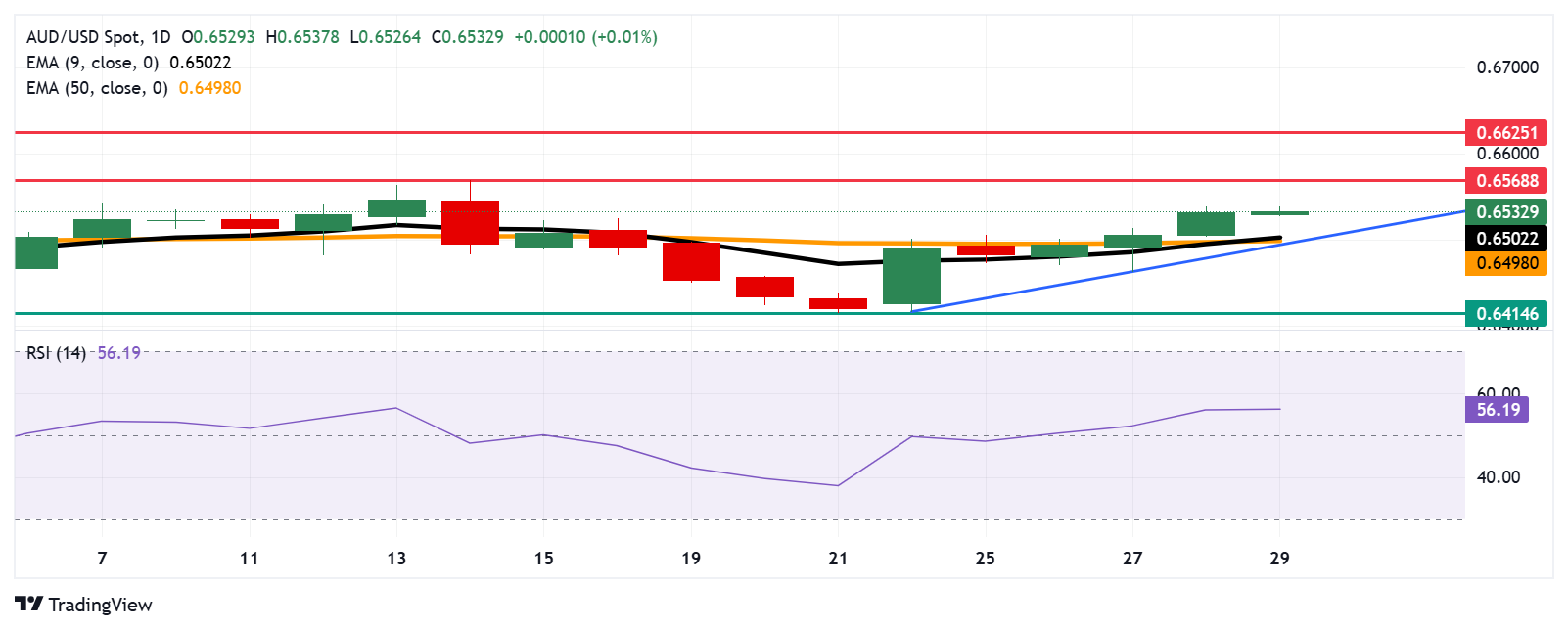
AUD/USD is trading around 0.6540 on Friday. The technical analysis of the daily chart indicates that the pair is positioned slightly above the ascending trendline, suggesting a prevailing bullish bias. Additionally, the pair is trading above the nine-day Exponential Moving Average (EMA), indicating short-term price momentum is stronger.
On the upside, the AUD/USD pair could target the monthly high at 0.6568, reached on August 14, followed by the nine-month high of 0.6625, which was recorded on July 24.
The AUD/USD pair may find initial support at the nine-day EMA of 0.6502 and the 50-day EMA at 0.6498, followed by the ascending trendline around 0.6490. A break below this crucial support zone would cause the emergence of the bearish bias and prompt the pair to test the two-month low of 0.6414, recorded on August 21.
(The story was corrected on August 29 at 2:10 GMT in the second paragraph of technical analysis, to refer to the AUD/USD pair, not the AUD/JPY pair.)
AUD/USD: Daily Chart
Australian Dollar Price Today
The table below shows the percentage change of Australian Dollar (AUD) against listed major currencies today. Australian Dollar was the strongest against the Swiss Franc.
| USD | EUR | GBP | JPY | CAD | AUD | NZD | CHF | |
|---|---|---|---|---|---|---|---|---|
| USD | 0.16% | 0.07% | 0.04% | 0.03% | -0.16% | -0.17% | 0.16% | |
| EUR | -0.16% | -0.08% | -0.14% | -0.12% | -0.25% | -0.31% | -0.01% | |
| GBP | -0.07% | 0.08% | -0.08% | -0.04% | -0.20% | -0.18% | 0.07% | |
| JPY | -0.04% | 0.14% | 0.08% | 0.05% | -0.22% | -0.19% | 0.19% | |
| CAD | -0.03% | 0.12% | 0.04% | -0.05% | -0.20% | -0.17% | 0.10% | |
| AUD | 0.16% | 0.25% | 0.20% | 0.22% | 0.20% | -0.05% | 0.27% | |
| NZD | 0.17% | 0.31% | 0.18% | 0.19% | 0.17% | 0.05% | 0.31% | |
| CHF | -0.16% | 0.01% | -0.07% | -0.19% | -0.10% | -0.27% | -0.31% |
The heat map shows percentage changes of major currencies against each other. The base currency is picked from the left column, while the quote currency is picked from the top row. For example, if you pick the Australian Dollar from the left column and move along the horizontal line to the US Dollar, the percentage change displayed in the box will represent AUD (base)/USD (quote).
Economic Indicator
Personal Consumption Expenditures - Price Index (YoY)
The Personal Consumption Expenditures (PCE), released by the US Bureau of Economic Analysis on a monthly basis, measures the changes in the prices of goods and services purchased by consumers in the United States (US). The YoY reading compares prices in the reference month to a year earlier. Price changes may cause consumers to switch from buying one good to another and the PCE Deflator can account for such substitutions. This makes it the preferred measure of inflation for the Federal Reserve. Generally, a high reading is bullish for the US Dollar (USD), while a low reading is bearish.
Read more.Next release: Fri Aug 29, 2025 12:30
Frequency: Monthly
Consensus: 2.6%
Previous: 2.6%
Source: US Bureau of Economic Analysis
Author

Akhtar Faruqui
FXStreet
Akhtar Faruqui is a Forex Analyst based in New Delhi, India. With a keen eye for market trends and a passion for dissecting complex financial dynamics, he is dedicated to delivering accurate and insightful Forex news and analysis.

















