Australian Dollar holds losses as the US Dollar remained firm ahead of PMI release
- The Australian Dollar declines as the US Dollar experiences a technical upward correction.
- Australia’s Judo Bank Manufacturing PMI increased to 50.6 in February, up from 50.2 in January.
- RBA's Bullock warned that an overly rapid or excessive monetary policy easing could hinder the disinflation process.
The Australian Dollar (AUD) edges lower against the US Dollar (USD) following the release of Judo Bank’s Purchasing Managers Index (PMI) on Friday. However, the AUD/USD pair saw gains after US President Donald Trump announced potential progress in trade negotiations with China, easing market concerns over tariffs. Traders will keep an eye on the preliminary reading of the US S&P Global Purchasing Managers Index (PMI) for February, which is due later on Friday.
Australia’s Judo Bank Manufacturing PMI rose to 50.6 in February, up from 50.2 in January. The Services PMI improved to 51.4 from 51.2, while the Composite PMI edged up to 51.2 from 51.1.
Reserve Bank of Australia (RBA) Governor Michele Bullock cautioned that easing monetary policy too quickly or excessively could stall disinflation, potentially keeping inflation above the target midpoint. Bullock emphasized the RBA’s commitment to data-driven decisions and careful risk assessment, suggesting that while rate cuts remain a possibility, a cautious approach is necessary.
Australian Dollar appreciated as US Dollar struggled following weak US jobless claims
- The US Dollar Index (DXY), which measures the USD against six major currencies, holds ground near 106.50 at the time of writing. However, the DXY faced challenges following weak US jobless claims data and mixed Federal Reserve (Fed) commentary.
- US Initial Jobless Claims for the week ending February 14 rose to 219,000, exceeding the expected 215,000. Meanwhile, Continuing Jobless Claims increased to 1.869 million, slightly below the forecast of 1.87 million.
- Federal Reserve Board Governor Adriana Kugler stated on Thursday that US inflation still has "some way to go" before reaching the central bank's 2% target, noting that the path remains uncertain, according to Reuters.
- St. Louis Fed President Alberto Musalem cautioned about potential stagflation risks and rising inflation expectations. Meanwhile, Atlanta Fed President Raphael Bostic kept the possibility of two rate cuts this year open, contingent on economic developments.
- President Trump indicated that a new trade deal with China is possible and expects Chinese President Xi Jinping to visit. He also mentioned discussions with China regarding TikTok and noted that his administration is considering a 25% tariff on lumber and forest products.
- The latest Federal Open Market Committee (FOMC) Meeting Minutes reaffirmed the decision to keep interest rates unchanged in January. Policymakers emphasized the need for more time to assess economic activity, labor market trends, and inflation before considering any rate adjustments. The committee also agreed that clear signs of declining inflation are necessary before implementing rate cuts.
- President Trump has confirmed that a 25% tariff on pharmaceutical and semiconductor imports will take effect in April. Additionally, he reaffirmed that auto tariffs will remain at 25%, further escalating global trade tensions.
- The Australian Bureau of Statistics (ABS) reported on Thursday that Australia’s seasonally adjusted Unemployment Rate rose to 4.1% in January from 4.0% in December, aligning with market expectations. Additionally, Employment Change came in at 44K for January, down from a revised 60K in December (previously 56.3K), but still exceeding the consensus forecast of 20K.
- Reserve Bank of Australia (RBA) Deputy Governor Andrew Hauser stated while speaking to Bloomberg News on Thursday that the central bank’s policy “is still restrictive.” Hauser noted that the latest jobs data showed little cause for concern.
- The Reserve Bank of Australia (RBA) lowered its Official Cash Rate (OCR) by 25 basis points to 4.10% on Tuesday—the first rate cut in four years. RBA Governor Michele Bullock acknowledged the impact of high interest rates but cautioned that it was too soon to declare victory over inflation. She also emphasized the strength of the labor market and clarified that future rate cuts are not guaranteed, despite market expectations.
Technical Analysis: Australian Dollar tests psychological barrier at 0.6400
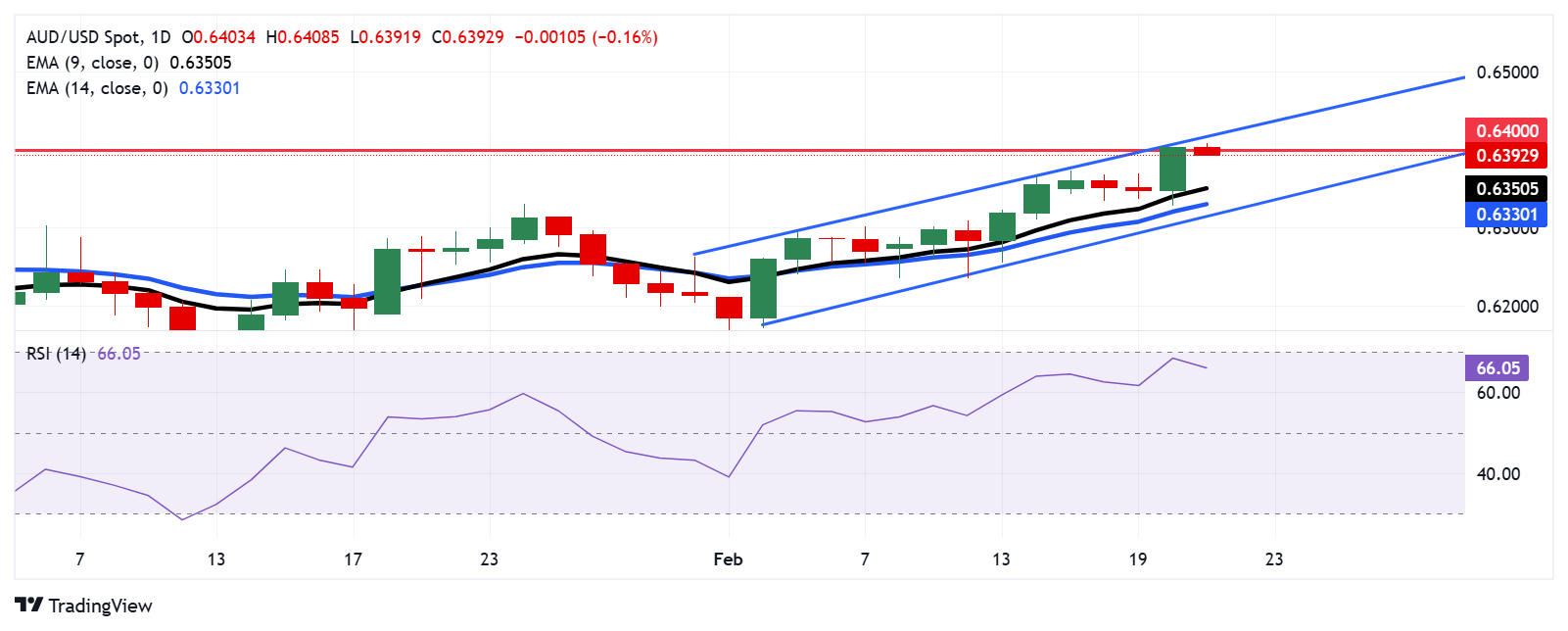
The AUD/USD pair hovers around 0.6400 on Friday, trading within an ascending channel that suggests a bullish market sentiment. The 14-day Relative Strength Index (RSI) remains above 50, reinforcing the positive outlook.
On the upside, the AUD/USD pair tests the key psychological resistance at 0.6400, followed by the ascending channel's upper boundary at 0.6420.
Immediate support could be at the nine-day Exponential Moving Average (EMA) of 0.6350, followed by the 14-day EMA at 0.6330. A stronger support zone lies near the channel's lower boundary at 0.6320.
AUD/USD: Daily Chart
Australian Dollar PRICE Today
The table below shows the percentage change of Australian Dollar (AUD) against listed major currencies today. Australian Dollar was the weakest against the US Dollar.
| USD | EUR | GBP | JPY | CAD | AUD | NZD | CHF | |
|---|---|---|---|---|---|---|---|---|
| USD | 0.14% | 0.08% | 0.60% | 0.07% | 0.28% | 0.14% | 0.17% | |
| EUR | -0.14% | -0.06% | 0.46% | -0.07% | 0.14% | 0.01% | 0.04% | |
| GBP | -0.08% | 0.06% | 0.51% | -0.01% | 0.19% | 0.06% | 0.09% | |
| JPY | -0.60% | -0.46% | -0.51% | -0.49% | -0.30% | -0.44% | -0.41% | |
| CAD | -0.07% | 0.07% | 0.01% | 0.49% | 0.20% | 0.08% | 0.10% | |
| AUD | -0.28% | -0.14% | -0.19% | 0.30% | -0.20% | -0.13% | -0.10% | |
| NZD | -0.14% | -0.01% | -0.06% | 0.44% | -0.08% | 0.13% | 0.02% | |
| CHF | -0.17% | -0.04% | -0.09% | 0.41% | -0.10% | 0.10% | -0.02% |
The heat map shows percentage changes of major currencies against each other. The base currency is picked from the left column, while the quote currency is picked from the top row. For example, if you pick the Australian Dollar from the left column and move along the horizontal line to the US Dollar, the percentage change displayed in the box will represent AUD (base)/USD (quote).
Economic Indicator
S&P Global Manufacturing PMI
The S&P Global Manufacturing Purchasing Managers Index (PMI), released on a monthly basis, is a leading indicator gauging business activity in the US manufacturing sector. The data is derived from surveys of senior executives at private-sector companies from the manufacturing sector. Survey responses reflect the change, if any, in the current month compared to the previous month and can anticipate changing trends in official data series such as Gross Domestic Product (GDP), industrial production, employment and inflation. A reading above 50 indicates that the manufacturing economy is generally expanding, a bullish sign for the US Dollar (USD). Meanwhile, a reading below 50 signals that activity in the manufacturing sector is generally declining, which is seen as bearish for USD.
Read more.Next release: Fri Feb 21, 2025 14:45 (Prel)
Frequency: Monthly
Consensus: 51.5
Previous: 51.2
Source: S&P Global
Author

Akhtar Faruqui
FXStreet
Akhtar Faruqui is a Forex Analyst based in New Delhi, India. With a keen eye for market trends and a passion for dissecting complex financial dynamics, he is dedicated to delivering accurate and insightful Forex news and analysis.

















