Australian Dollar struggles as US Dollar advances amid increased risk aversion
- The Australian Dollar experiences volatility as the US Dollar appreciates amid increased risk aversion.
- The Aussie Dollar may appreciate as the RBA is widely expected to continue its hawkish monetary policy.
- The US Dollar receives support from rising odds of a nominal rate cut by the Fed in November.

The Australian Dollar (AUD) struggles to secure its previous session's gains on Wednesday. However, the AUD/USD pair faced pressure as the US Dollar (USD) strengthened with rising Treasury yields. Market risk aversion has increased due to the growing likelihood of Donald Trump winning the presidency, adding to the selling pressure on US Treasury bonds.
The downside for the AUD could be restrained due to hawkish sentiment around the Reserve Bank of Australia (RBA), bolstered by the positive employment data. Further support for the Aussie Dollar came from China's recent rate cuts, as China remains Australia's largest trading partner.
The US Dollar gains ground as recent signs of economic resilience and concerns about a potential resurgence of inflation have diminished the chances of a significant rate cut by the Federal Reserve in November.
According to the CME FedWatch Tool, there is a 91% probability of a 25-basis-point rate cut, with no expectation of a larger 50-basis-point cut.
Daily Digest Market Movers: Australian Dollar loses ground due to increased risk aversion
- 2-year and 10-year yields on US Treasury bonds stand at 4.04% and 4.21%, respectively, at the time of writing.
- On Monday, Federal Reserve Bank of Minneapolis President Neel Kashkari highlighted that the Fed is closely monitoring the US labor market for signs of rapid destabilization. Kashkari cautioned investors to anticipate a gradual pace of rate cuts over the coming quarters, suggesting that any monetary easing will likely be moderate rather than aggressive.
- San Francisco Fed President Mary Daly supported further easing, stating she sees no reason to stop lowering rates. In contrast, Kansas City Fed President Jeffrey Schmid adopted a more cautious approach, favoring restraint in large rate cuts and emphasizing that the labor market is undergoing normalization rather than showing signs of deterioration.
- On Monday, RBA Deputy Governor Andrew Hauser addressed the CBA 2024 Global Markets Conference in Sydney, expressing slight surprise at the strength of employment growth. Hauser noted that the labor participation rate is remarkably high and emphasized that while the RBA is data-dependent, it is not data-obsessed.
- The People's Bank of China (PBoC) reduced the 1-year Loan Prime Rate (LPR) to 3.10% from 3.35% and the 5-year LPR to 3.60% from 3.85%, in line with expectations. Lower borrowing costs are anticipated to stimulate China's domestic economic activity, potentially increasing demand for Australian exports.
- National Australia Bank revised its projection for the Reserve Bank of Australia (RBA) in a note last week. "We have brought forward our expectations for the timing of rate cuts, now anticipating the first cut in February 2025, instead of May," the bank stated. They continue to foresee gradual cuts, with rates expected to decrease to 3.10% by early 2026.
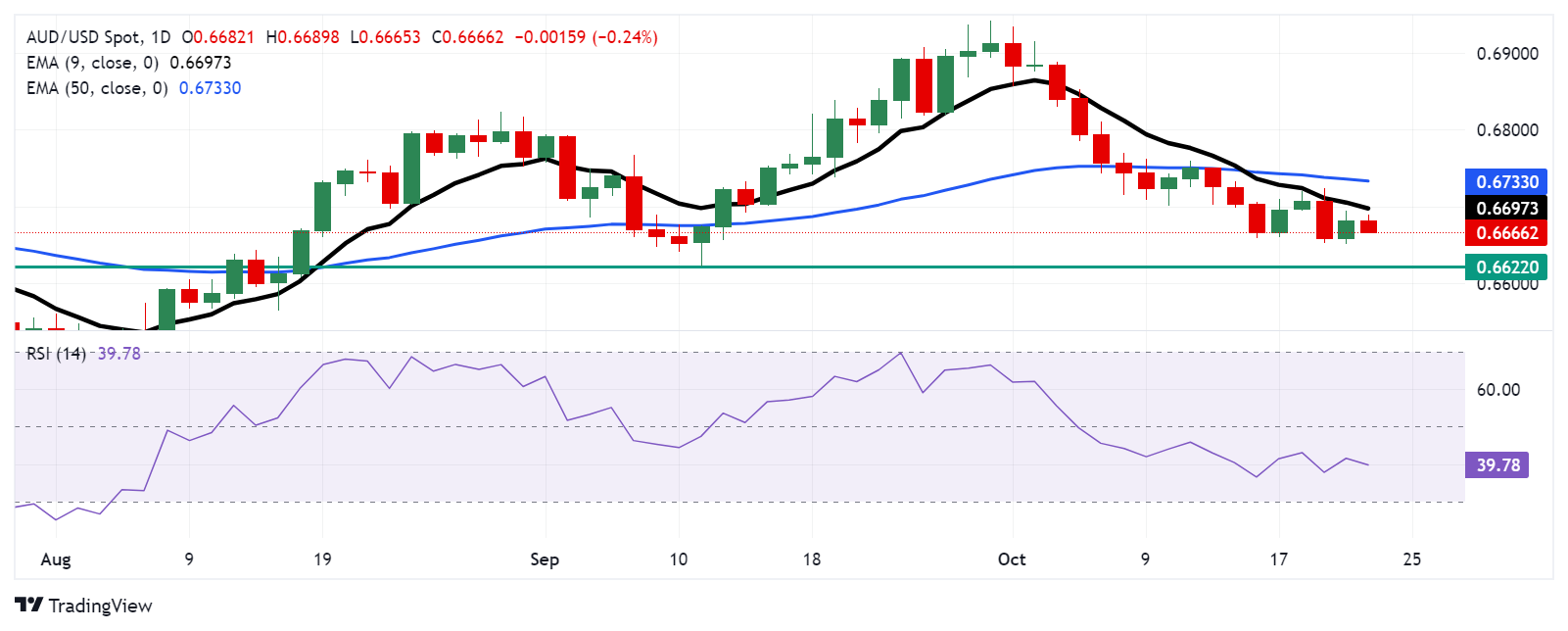
Technical Analysis: Australian Dollar falls toward 0.6650, six-week lows
The AUD/USD pair trades around 0.6670 on Wednesday, with technical analysis of the daily chart pointing to a short-term bearish outlook as the pair remains below the nine-day Exponential Moving Average (EMA). Additionally, the 14-day Relative Strength Index (RSI) is below 50, further supporting the bearish sentiment.
On the downside, the AUD/USD pair could test its six-week low of 0.6622, last seen on September 11. The next key support is at the psychological level of 0.6600.
Resistance is expected at the nine-day EMA at 0.6698, followed by the 50-day EMA at 0.6733. A break above these levels could pave the way for a move toward the psychological resistance of 0.6800.
AUD/USD: Daily Chart
Australian Dollar PRICE Today
The table below shows the percentage change of Australian Dollar (AUD) against listed major currencies today. Australian Dollar was the weakest against the British Pound.
| USD | EUR | GBP | JPY | CAD | AUD | NZD | CHF | |
|---|---|---|---|---|---|---|---|---|
| USD | -0.01% | -0.03% | 0.65% | 0.02% | 0.08% | 0.10% | 0.13% | |
| EUR | 0.01% | -0.00% | 0.67% | 0.06% | 0.12% | 0.09% | 0.15% | |
| GBP | 0.03% | 0.00% | 0.67% | 0.04% | 0.13% | 0.10% | 0.20% | |
| JPY | -0.65% | -0.67% | -0.67% | -0.63% | -0.58% | -0.59% | -0.48% | |
| CAD | -0.02% | -0.06% | -0.04% | 0.63% | 0.06% | 0.07% | 0.16% | |
| AUD | -0.08% | -0.12% | -0.13% | 0.58% | -0.06% | 0.00% | 0.09% | |
| NZD | -0.10% | -0.09% | -0.10% | 0.59% | -0.07% | -0.01% | 0.09% | |
| CHF | -0.13% | -0.15% | -0.20% | 0.48% | -0.16% | -0.09% | -0.09% |
The heat map shows percentage changes of major currencies against each other. The base currency is picked from the left column, while the quote currency is picked from the top row. For example, if you pick the Australian Dollar from the left column and move along the horizontal line to the US Dollar, the percentage change displayed in the box will represent AUD (base)/USD (quote).
Australian Dollar FAQs
One of the most significant factors for the Australian Dollar (AUD) is the level of interest rates set by the Reserve Bank of Australia (RBA). Because Australia is a resource-rich country another key driver is the price of its biggest export, Iron Ore. The health of the Chinese economy, its largest trading partner, is a factor, as well as inflation in Australia, its growth rate and Trade Balance. Market sentiment – whether investors are taking on more risky assets (risk-on) or seeking safe-havens (risk-off) – is also a factor, with risk-on positive for AUD.
The Reserve Bank of Australia (RBA) influences the Australian Dollar (AUD) by setting the level of interest rates that Australian banks can lend to each other. This influences the level of interest rates in the economy as a whole. The main goal of the RBA is to maintain a stable inflation rate of 2-3% by adjusting interest rates up or down. Relatively high interest rates compared to other major central banks support the AUD, and the opposite for relatively low. The RBA can also use quantitative easing and tightening to influence credit conditions, with the former AUD-negative and the latter AUD-positive.
China is Australia’s largest trading partner so the health of the Chinese economy is a major influence on the value of the Australian Dollar (AUD). When the Chinese economy is doing well it purchases more raw materials, goods and services from Australia, lifting demand for the AUD, and pushing up its value. The opposite is the case when the Chinese economy is not growing as fast as expected. Positive or negative surprises in Chinese growth data, therefore, often have a direct impact on the Australian Dollar and its pairs.
Iron Ore is Australia’s largest export, accounting for $118 billion a year according to data from 2021, with China as its primary destination. The price of Iron Ore, therefore, can be a driver of the Australian Dollar. Generally, if the price of Iron Ore rises, AUD also goes up, as aggregate demand for the currency increases. The opposite is the case if the price of Iron Ore falls. Higher Iron Ore prices also tend to result in a greater likelihood of a positive Trade Balance for Australia, which is also positive of the AUD.
The Trade Balance, which is the difference between what a country earns from its exports versus what it pays for its imports, is another factor that can influence the value of the Australian Dollar. If Australia produces highly sought after exports, then its currency will gain in value purely from the surplus demand created from foreign buyers seeking to purchase its exports versus what it spends to purchase imports. Therefore, a positive net Trade Balance strengthens the AUD, with the opposite effect if the Trade Balance is negative.
Author

Akhtar Faruqui
FXStreet
Akhtar Faruqui is a Forex Analyst based in New Delhi, India. With a keen eye for market trends and a passion for dissecting complex financial dynamics, he is dedicated to delivering accurate and insightful Forex news and analysis.
















