Australian Dollar depreciates due to the dovish RBA, US Dollar remains steady
- The Australian Dollar has depreciated due to the dovish sentiment surrounding the RBA.
- Australia's Treasury announced that inflation could re-enter the RBA target range by the end of 2024.
- The US Dollar received support from the cautious comments from Fed officials regarding interest rate cuts.

The Australian Dollar (AUD) extended its losses on Monday, possibly due to the Reserve Bank of Australia (RBA)'s less hawkish stance after it decided to keep its interest rate unchanged at 4.35% on Tuesday. Markets were speculating that the RBA might adopt a more hawkish stance, fueled by last week's inflation data, which exceeded expectations.
Australia's Treasury announced on Sunday that they forecasted that inflation could re-enter the Reserve Bank of Australia's (RBA) target range by the end of 2024. In their December outlook, officials predicted that CPI inflation would decrease to 3.75% by mid-2024 and 2.75% by mid-2025, aligning it with the RBA's target range.
The US Dollar Index (DXY), which gauges the performance of the US Dollar (USD) against six major currencies, continues to gain ground as traders digest Friday’s key economic data and cautious comments from Federal Reserve (Fed) officials regarding interest rate cuts. However, the downward correction in the US Treasury yields could limit the advance of the Greenback.
In the United States (US), investors are geared to focus on pivotal economic indicators that could serve as significant market catalysts this week. Key highlights include the Producer Price Index (PPI) scheduled for release on Tuesday, followed by the Consumer Price Index (CPI) and Retail Sales reports on Wednesday.
Daily Digest Market Movers: Australian Dollar depreciates due to a dovish RBA
- National Australia Bank's Business Conditions fell to 7 in April, from the previous reading of 9. Meanwhile, National Australia Bank's Business Confidence stood at the reading of 1.
- According to The Guardian, Treasurer of Australia Jim Chalmers hinted at positive developments during a series of television interviews on Sunday morning. Chalmers suggested that the upcoming budget would reveal a quicker decline in inflation than what the RBA had anticipated. He emphasized that Tuesday's budget aims to lower inflation rather than exacerbate it, while also aiming to alleviate some of the burdens for individuals.
- China's Consumer Price Index (CPI) experienced a YoY rise of 0.3% in April, up from 0.1% in the preceding month. This uptick coincides with a gradual rebound in the country's demand, although the broader economic recovery remains fragile. Meanwhile, the Producer Price Index (PPI) sustained its downward trajectory, falling by 2.5%, marking the 19th consecutive month of deflation. Given the close trading ties between China and Australia, these figures could potentially influence the Australian market.
- According to Reuters, Neel Kashkari, President of the Minneapolis Federal Reserve (Fed), expressed caution regarding the level of restrictiveness in monetary policy. On Friday, Kashkari stated in an interview with CNBC that while the threshold for another rate hike is high, it cannot be entirely ruled out. Additionally, San Francisco Fed President Mary Daly emphasized the necessity of maintaining a prolonged restrictive policy to attain the Federal Reserve's inflation objectives.
- On Friday, the University of Michigan Consumer Sentiment Index, dropped to 67.4 in May from April's 77.2, marking a six-month low and falling short of market expectations of 76 reading. Meanwhile, the UoM 5-year Consumer Inflation Expectation rose to 3.1%, a six-month high, up from 3.0% prior.
- The Commonwealth Bank of Australia (CBA) has revised down its forecasts for the Australian Dollar at the end of 2024 is 0.69, down from 0.71 previously. CBA cites factors such as the interest rate gap and elevated US Treasury bond yields, which are bolstering the US Dollar. The Federal Reserve's cautious stance on high inflation and its reluctance to implement rate cuts further support the US Dollar, as reported on forexlive.com.
Technical Analysis: Australian Dollar hovers around the psychological level of 0.6600
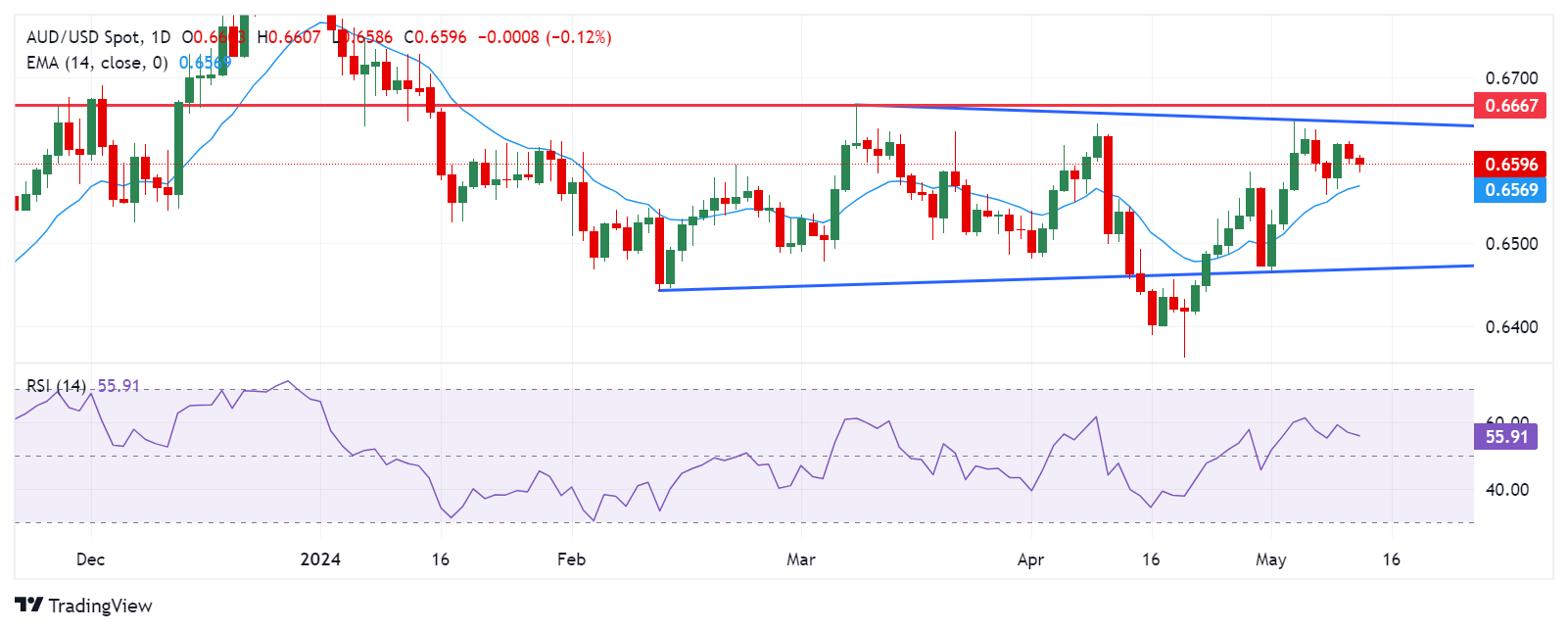
The Australian Dollar trades around 0.6600 on Monday. The AUD/USD pair maintains a sideways movement within a symmetrical triangle pattern, with the 14-day Relative Strength Index (RSI) suggesting a bullish inclination as it remains above the 50 level.
The AUD/USD pair could test the upper boundary near the swing area at 0.6650. A breakthrough above this level might prompt a retest of March's high at 0.6667, potentially extending gains toward the psychological barrier of 0.6700.
In terms of downside, immediate support is anticipated around the 14-day Exponential Moving Average (EMA) at 0.6569. Should the pair breach below this EMA, it could encounter additional selling pressure, potentially targeting the area around the lower boundary of the symmetrical triangle, approximately at 0.6465.
AUD/USD: Daily Chart
Australian Dollar price today
The table below shows the percentage change of the Australian Dollar (AUD) against listed major currencies today. The Australian Dollar was the weakest against the Euro.
| USD | EUR | GBP | CAD | AUD | JPY | NZD | CHF | |
| USD | -0.07% | 0.00% | -0.01% | -0.04% | 0.00% | 0.15% | -0.02% | |
| EUR | 0.07% | 0.06% | 0.07% | 0.02% | 0.09% | 0.22% | 0.06% | |
| GBP | 0.00% | -0.06% | 0.01% | -0.04% | 0.03% | 0.14% | -0.01% | |
| CAD | 0.01% | -0.06% | 0.00% | -0.04% | 0.01% | 0.16% | -0.01% | |
| AUD | 0.04% | -0.02% | 0.04% | 0.05% | 0.07% | 0.20% | 0.04% | |
| JPY | -0.01% | -0.10% | -0.04% | -0.01% | -0.04% | 0.08% | -0.03% | |
| NZD | -0.15% | -0.22% | -0.16% | -0.15% | -0.20% | -0.13% | -0.16% | |
| CHF | 0.01% | -0.06% | 0.00% | 0.01% | -0.04% | 0.03% | 0.16% |
The heat map shows percentage changes of major currencies against each other. The base currency is picked from the left column, while the quote currency is picked from the top row. For example, if you pick the Euro from the left column and move along the horizontal line to the Japanese Yen, the percentage change displayed in the box will represent EUR (base)/JPY (quote).
Economic Indicator
Author

Akhtar Faruqui
FXStreet
Akhtar Faruqui is a Forex Analyst based in New Delhi, India. With a keen eye for market trends and a passion for dissecting complex financial dynamics, he is dedicated to delivering accurate and insightful Forex news and analysis.

















