Australian Dollar holds gains as US Dollar remains steady amid risk-on mood
- The Australian Dollar strengthens as US–China negotiations gain traction ahead of the August 12 deadline.
- The six-month annualised growth rate in the Westpac Leading Index slowed to 0.03% in June, down from 0.11% in May.
- President Trump announced a trade agreement with Japan, featuring a 15% tariff on Japanese exports to the US.

The Australian Dollar (AUD) gains ground against the US Dollar (USD) on Wednesday, extending its winning streak for the fourth successive session. The AUD/USD pair appreciates amid improving market sentiment, driven by the US President Donald Trump’s announcement of a major tariff deal with Japan, which includes a 15% tariff on Japanese exports. Additionally, talks between the United States (US) and China are gaining momentum ahead of the August 12 deadline.
Westpac reports that its Leading Index continues to reflect weakening momentum. The six-month annualised growth rate in the Westpac-Melbourne Institute Leading Index eased to 0.03% in June, down from 0.11% in May. The slowdown is primarily driven by softer commodity prices, waning sentiment, and reduced hours worked.
The latest Reserve Bank of Australia’s (RBA) Meeting Minutes indicated that the board agreed further rate cuts warranted over time, with attention centered on timing and extent of easing. The majority believed it was best to await confirmation of an inflation slowdown before easing. Most members felt cutting rates three times in four meetings would not be "cautious and gradual.”
Australian Dollar advances as US Dollar steadies amid improved market sentiment
- The US Dollar Index (DXY), which measures the value of the US Dollar against six major currencies, is extending its losses and trading around 97.50 at the time of writing. Investors will likely observe the US S&P Global Purchasing Managers Index (PMI) data for July, which is scheduled to be released on Thursday.
- President Trump announced a trade deal with Japan that includes a 15% tariff on Japanese exports to the US. As part of the agreement, Japan will invest $550 billion in the US and open its markets to key American products.
- A White House official said that US President Donald Trump is likely to fire Fed Chairman Jerome Powell soon. However, Trump denied it in a Truth Social post on Sunday, calling it “typically untruthful.”
- Republican Congresswoman Anna Paulina Luna has formally accused the Fed Chair Powell of committing perjury on two separate occasions, both stemming from discussions about the Fed's long-scheduled renovations to its head offices in Washington, DC.
- The University of Michigan’s (UoM) preliminary Consumer Sentiment Index for July climbed to 61.8 from 60.7 in June, beating expectations of 61.5. Both the Current Conditions and Expectations components improved, reflecting cautious optimism among US households.
- FOMC Governor Adriana Kugler said that the US central bank should not lower interest rates "for some time" since the effects of Trump administration tariffs are starting to show up in consumer prices. Kugler added that restrictive monetary policy is essential to keep inflationary psychology in line.
- San Francisco Fed President Mary Daly said last week that expecting two rate cuts this year is a "reasonable" outlook, while warning against waiting too long. Daly added that rates would eventually settle at 3% or higher, which is higher than the pre-pandemic neutral rate.
- Fed Governor Christopher Waller said that he believes that the US central bank should reduce its interest rate target at the July meeting, citing mounting economic risks. Waller added that delaying cuts runs the risk of needing more aggressive action later.
- US Commerce Secretary Howard Lutnick stated unequivocally in a televised interview, “That’s a hard deadline, so on August 1, the new tariff rates will come in. Nothing stops countries from talking to us after August 1, but they’re going to start paying the tariffs on August 1.”
- The People’s Bank of China (PBoC) decided on Monday to leave the one- and five-year Loan Prime Rates (LPRs) unchanged at 3.00% and 3.50%, respectively. It is important to note that any change in the Chinese economy could impact the Australian Dollar as China and Australia are close trade partners.
- China's Commerce Minister Wang Wentao said on Friday that the economic and trade relations with the United States have gone through storms, but remain important to each other. Wentao also stated that Mutual benefit is the essence of US-China commercial ties. The Geneva agreement and the London framework effectively stabilized commercial ties and cooled tensions, he added.
Australian Dollar rises above 0.6550 after surpassing nine-day EMA
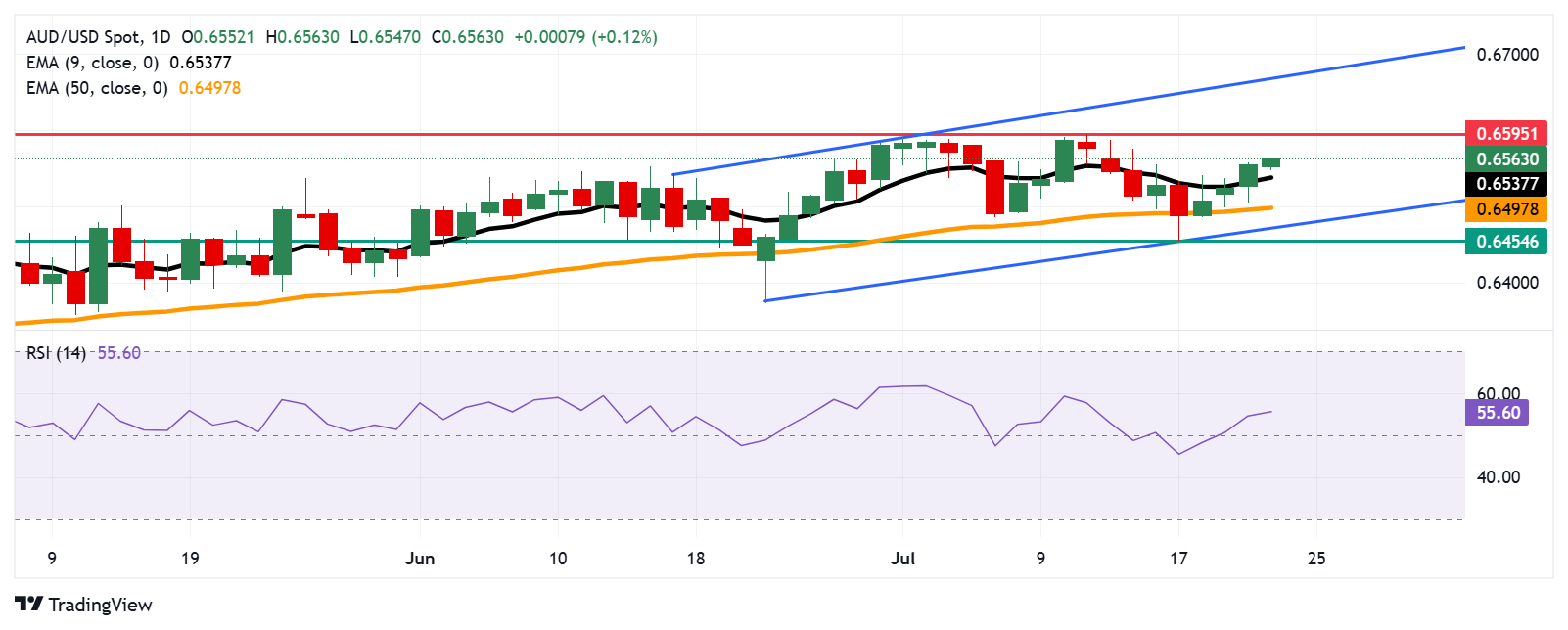
The AUD/USD pair is trading around 0.6560 on Wednesday. The daily chart’s technical analysis suggested a prevailing bullish bias as the pair remains within the ascending channel pattern. The 14-day Relative Strength Index (RSI) is positioned above the 50 mark, suggesting a bullish bias is active. Additionally, the pair has also moved above the nine-day Exponential Moving Average (EMA), indicating that short-term price momentum is strengthening.
On the upside, the AUD/USD pair may target the eight-month high of 0.6595, which was reached on July 11. A break above this level could reinforce the bullish bias and prompt the pair to explore the region around the ascending channel’s upper boundary around 0.6670.
The primary support appears at nine-day EMA at 0.6537, followed by the 50-day EMA of 0.6497. A break below this level would dampen the short- and medium-term price momentum and put downward pressure on the AUD/USD pair to test the ascending channel’s lower boundary around 0.6470, aligned with the three-week low at 0.6454, which was recorded on July 17.
AUD/USD: Daily Chart
Australian Dollar PRICE Today
The table below shows the percentage change of Australian Dollar (AUD) against listed major currencies today. Australian Dollar was the strongest against the Japanese Yen.
| USD | EUR | GBP | JPY | CAD | AUD | NZD | CHF | |
|---|---|---|---|---|---|---|---|---|
| USD | 0.16% | 0.03% | 0.25% | -0.04% | -0.22% | -0.44% | 0.12% | |
| EUR | -0.16% | -0.12% | 0.09% | -0.19% | -0.40% | -0.59% | -0.03% | |
| GBP | -0.03% | 0.12% | 0.24% | -0.07% | -0.28% | -0.47% | 0.14% | |
| JPY | -0.25% | -0.09% | -0.24% | -0.27% | -0.44% | -0.57% | -0.10% | |
| CAD | 0.04% | 0.19% | 0.07% | 0.27% | -0.17% | -0.19% | 0.19% | |
| AUD | 0.22% | 0.40% | 0.28% | 0.44% | 0.17% | -0.19% | 0.41% | |
| NZD | 0.44% | 0.59% | 0.47% | 0.57% | 0.19% | 0.19% | 0.61% | |
| CHF | -0.12% | 0.03% | -0.14% | 0.10% | -0.19% | -0.41% | -0.61% |
The heat map shows percentage changes of major currencies against each other. The base currency is picked from the left column, while the quote currency is picked from the top row. For example, if you pick the Australian Dollar from the left column and move along the horizontal line to the US Dollar, the percentage change displayed in the box will represent AUD (base)/USD (quote).
RBA FAQs
The Reserve Bank of Australia (RBA) sets interest rates and manages monetary policy for Australia. Decisions are made by a board of governors at 11 meetings a year and ad hoc emergency meetings as required. The RBA’s primary mandate is to maintain price stability, which means an inflation rate of 2-3%, but also “..to contribute to the stability of the currency, full employment, and the economic prosperity and welfare of the Australian people.” Its main tool for achieving this is by raising or lowering interest rates. Relatively high interest rates will strengthen the Australian Dollar (AUD) and vice versa. Other RBA tools include quantitative easing and tightening.
While inflation had always traditionally been thought of as a negative factor for currencies since it lowers the value of money in general, the opposite has actually been the case in modern times with the relaxation of cross-border capital controls. Moderately higher inflation now tends to lead central banks to put up their interest rates, which in turn has the effect of attracting more capital inflows from global investors seeking a lucrative place to keep their money. This increases demand for the local currency, which in the case of Australia is the Aussie Dollar.
Macroeconomic data gauges the health of an economy and can have an impact on the value of its currency. Investors prefer to invest their capital in economies that are safe and growing rather than precarious and shrinking. Greater capital inflows increase the aggregate demand and value of the domestic currency. Classic indicators, such as GDP, Manufacturing and Services PMIs, employment, and consumer sentiment surveys can influence AUD. A strong economy may encourage the Reserve Bank of Australia to put up interest rates, also supporting AUD.
Quantitative Easing (QE) is a tool used in extreme situations when lowering interest rates is not enough to restore the flow of credit in the economy. QE is the process by which the Reserve Bank of Australia (RBA) prints Australian Dollars (AUD) for the purpose of buying assets – usually government or corporate bonds – from financial institutions, thereby providing them with much-needed liquidity. QE usually results in a weaker AUD.
Quantitative tightening (QT) is the reverse of QE. It is undertaken after QE when an economic recovery is underway and inflation starts rising. Whilst in QE the Reserve Bank of Australia (RBA) purchases government and corporate bonds from financial institutions to provide them with liquidity, in QT the RBA stops buying more assets, and stops reinvesting the principal maturing on the bonds it already holds. It would be positive (or bullish) for the Australian Dollar.
Author

Akhtar Faruqui
FXStreet
Akhtar Faruqui is a Forex Analyst based in New Delhi, India. With a keen eye for market trends and a passion for dissecting complex financial dynamics, he is dedicated to delivering accurate and insightful Forex news and analysis.

















