Australian Dollar advances as US Dollar remains tepid ahead of US Consumer Sentiment Index
- The Australian Dollar gains ground due to hawkish sentiment surrounding the RBA.
- RBA Governor Michele Bullock does not anticipate rate cuts in the near term.
- The US Dollar depreciates ahead of the US Michigan Consumer Sentiment Index release on Friday


The Australian Dollar (AUD) extends its gains for the second consecutive day against the US Dollar (USD) on Friday. The hawkish remarks from the Reserve Bank of Australia (RBA) Governor Michele Bullock fuel the upside of the Aussie Dollar and underpin the AUD/USD pair.
RBA Governor Bullock stated on Friday that the Australian central bank remains focused on the potential upside risks to inflation and does not anticipate rate cuts in the near term. The board believes it has struck the right balance between controlling inflation and maintaining stability in the current economic climate, per ABC News.
Read the full article: RBA's Bullock: Inflation remains too high
The US Dollar edges lower as traders fully price in a 25 basis point rate reduction by the US Federal Reserve for September. However, a 50 basis point cut remains a possibility, with the CME FedWatch tool indicating a 26% chance of such a move. Traders will also be observing the preliminary US Michigan Consumer Sentiment Index for August, which is set to be released on Friday.
Daily Digest Market Movers: Australian Dollar edges higher due to hawkish RBA
- On Thursday, US Retail Sales rose by 1.0% month-over-month in July, a significant rebound from June's 0.2% decline, according to the US Census Bureau. This figure exceeded the forecasted increase of 0.3%. Additionally, Initial Jobless Claims for the week ending August 9 came in at 227,000, better than the anticipated 235,000 and a decrease from the previous week's 234,000.
- The People's Bank of China (PBoC) announced on Thursday that it will renew the medium-term lending facility funds maturing on August 15th later this month. The central bank also lent CNY 577.7 billion (USD 80.9 billion) through seven-day reverse bond repurchase agreements at 1.7% in an open market operation, maintaining the previous rate, according to Reuters. Any change in the Chinese economy could impact the Australian market as both countries are close trade partners.
- China's Retail Sales grew by 2.7% year-on-year in July, exceeding market forecasts of 2.6% and accelerating from June's 17-month low of 2.0%. Meanwhile, Industrial Production increased by 5.1% year-on-year, falling short of the 5.2% expected and easing from the 5.3% growth seen in the previous month. This marks the third consecutive month of moderation in industrial output.
- Australian Employment Change is reported at 58.2K for July, surpassing the expected 20.0K and the previous reading of 52.3K. However, the Unemployment Rate increased to 4.2%, exceeding the market expectation of remaining steady at 4.1%. Additionally, Consumer Inflation Expectations for August rose to 4.5%, up from the prior reading of 4.3%.
- Federal Reserve Bank of Chicago President Austan Goolsbee expressed growing concern on Wednesday about the labor market rather than inflation, noting recent improvements in price pressures alongside weak jobs data. Goolsbee added that the extent of rate cuts will be determined by the prevailing economic conditions, per Bloomberg.
- US headline Consumer Price Index (CPI) rose 2.9% year-over-year in July, slightly down from the 3% increase in June and below market expectations. The Core CPI, which excludes food and energy, climbed 3.2% year-over-year, a slight decrease from the 3.3% rise in June but aligned with market forecasts.
- On Tuesday, Atlanta Fed President Raphael Bostic stated that recent economic data has increased his confidence that the Fed can achieve its 2% inflation target. However, Bostic indicated that additional evidence is required before he would support a reduction in interest rates, according to Reuters.
Technical Analysis: Australian Dollar moves above 0.6600
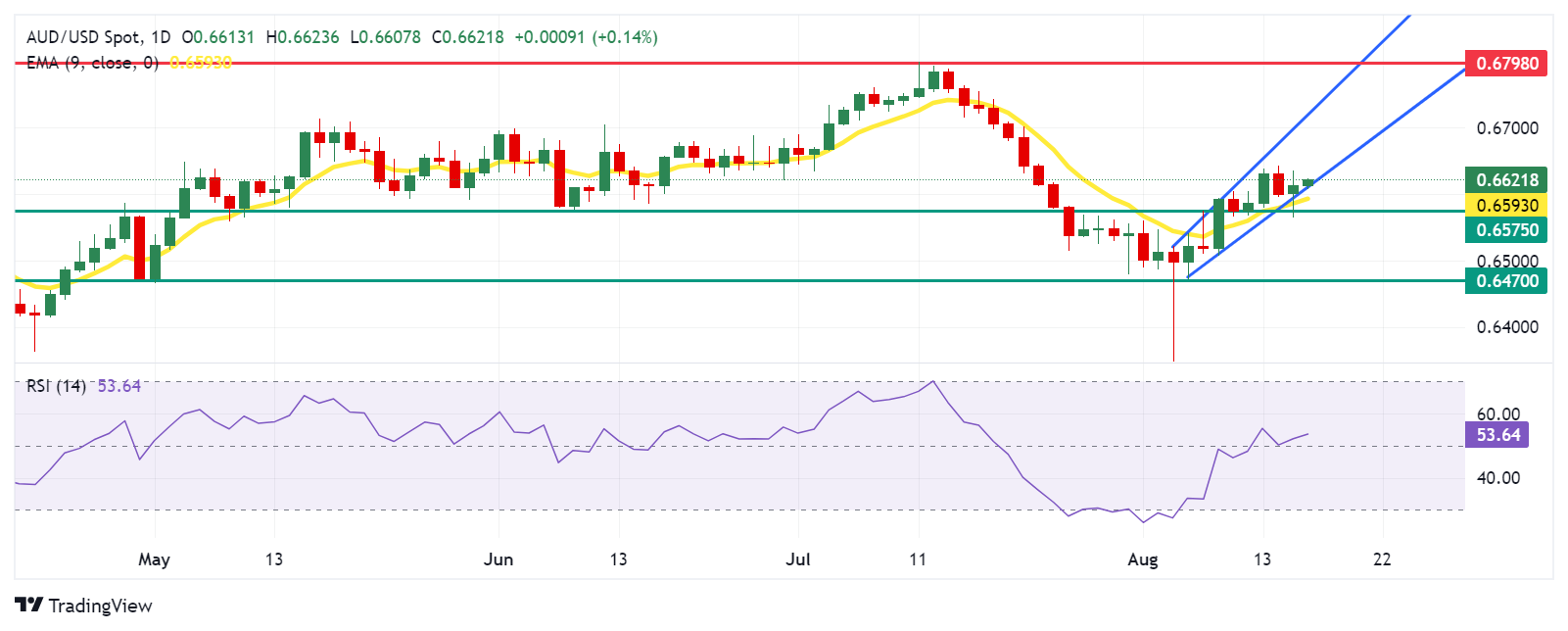
The Australian Dollar trades around 0.6620 on Friday. According to daily chart analysis, the AUD/USD pair is testing the lower boundary of an ascending channel. A break below this level could indicate a weakening of the bullish trend. Additionally, the 14-day Relative Strength Index (RSI) is slightly above the 50 mark, supporting the current bullish momentum.
In terms of support, the lower boundary of the ascending channel, around 0.6610, is the immediate support level for the AUD/USD pair. A break below this could lead the pair to test the nine-day Exponential Moving Average (EMA) at 0.6593, followed by the throwback level at 0.6575. Should the pair fall below this support zone, it could signal a bearish outlook, potentially pushing it toward the throwback level at 0.6470.
On the upside, the AUD/USD pair might target the area near the upper boundary of the ascending channel at the 0.6720 level. A breakout above this could propel the pair toward its six-month high of 0.6798, recorded on July 11.
AUD/USD: Daily Chart
Australian Dollar PRICE Today
The table below shows the percentage change of Australian Dollar (AUD) against listed major currencies today. Australian Dollar was the strongest against the US Dollar.
| USD | EUR | GBP | JPY | CAD | AUD | NZD | CHF | |
|---|---|---|---|---|---|---|---|---|
| USD | -0.09% | -0.14% | -0.24% | -0.04% | -0.21% | -0.38% | -0.16% | |
| EUR | 0.09% | -0.05% | -0.16% | 0.03% | -0.15% | -0.41% | -0.04% | |
| GBP | 0.14% | 0.05% | -0.12% | 0.09% | -0.09% | -0.35% | -0.01% | |
| JPY | 0.24% | 0.16% | 0.12% | 0.25% | 0.03% | -0.25% | 0.08% | |
| CAD | 0.04% | -0.03% | -0.09% | -0.25% | -0.19% | -0.47% | -0.11% | |
| AUD | 0.21% | 0.15% | 0.09% | -0.03% | 0.19% | -0.27% | 0.07% | |
| NZD | 0.38% | 0.41% | 0.35% | 0.25% | 0.47% | 0.27% | 0.36% | |
| CHF | 0.16% | 0.04% | 0.00% | -0.08% | 0.11% | -0.07% | -0.36% |
The heat map shows percentage changes of major currencies against each other. The base currency is picked from the left column, while the quote currency is picked from the top row. For example, if you pick the Australian Dollar from the left column and move along the horizontal line to the US Dollar, the percentage change displayed in the box will represent AUD (base)/USD (quote).
Economic Indicator
Michigan Consumer Sentiment Index
The Michigan Consumer Sentiment Index, released on a monthly basis by the University of Michigan, is a survey gauging sentiment among consumers in the United States. The questions cover three broad areas: personal finances, business conditions and buying conditions. The data shows a picture of whether or not consumers are willing to spend money, a key factor as consumer spending is a major driver of the US economy. The University of Michigan survey has proven to be an accurate indicator of the future course of the US economy. The survey publishes a preliminary, mid-month reading and a final print at the end of the month. Generally, a high reading is bullish for the US Dollar (USD), while a low reading is bearish.
Read more.Next release: Fri Aug 16, 2024 14:00 (Prel)
Frequency: Monthly
Consensus: 66.9
Previous: 66.4
Source: University of Michigan
Consumer exuberance can translate into greater spending and faster economic growth, implying a stronger labor market and a potential pick-up in inflation, helping turn the Fed hawkish. This survey’s popularity among analysts (mentioned more frequently than CB Consumer Confidence) is justified because the data here includes interviews conducted up to a day or two before the official release, making it a timely measure of consumer mood, but foremost because it gauges consumer attitudes on financial and income situations. Actual figures beating consensus tend to be USD bullish.
Author
Akhtar Faruqui
FXStreet
Akhtar Faruqui is a Forex Analyst based in New Delhi, India. With a keen eye for market trends and a passion for dissecting complex financial dynamics, he is dedicated to delivering accurate and insightful Forex news and analysis.

















