Australian Dollar strengthens as US Dollar weakens due to expectations of Fed rate cuts
- The Australian Dollar advanced as the Chinese government announced its annual policy statement for 2025 on Sunday.
- The AUD struggled as Trump instructed the Committee on Foreign Investment to limit Chinese investments in the US.
- The US Dollar struggles following the downbeat US economic data released last week.

The Australian Dollar (AUD) retraces its recent losses from the previous session on Monday following the Chinese government’s release of its annual policy statement for 2025 on Sunday. The statement details strategies to advance rural reforms and promote comprehensive rural revitalization. Optimism around China’s stimulus plans could strengthen the AUD, given China’s role as a key trading partner for Australia.
China’s state-supported developers are aggressively increasing land purchases at premium prices, driven by the government’s relaxation of home price restrictions aimed at revitalizing the troubled property market. In 2025 so far, 37% of land sales have closed at prices 20% or more above the asking price — a sharp rise from 14% in 2024 and just 4.6% in 2023, according to the China Index Academy.
The AUD/USD pair faced challenges as President Donald Trump signed a memorandum on Friday instructing the Committee on Foreign Investment in the United States (US) to limit Chinese investments in strategic sectors. Reuters cited a White House official saying that the national security memorandum seeks to encourage foreign investment while safeguarding US national security interests from potential threats posed by foreign adversaries like China.
The Reserve Bank of Australia (RBA) lowered its Official Cash Rate (OCR) by 25 basis points to 4.10% last week—the first rate cut in four years. Reserve Bank of Australia (RBA) Governor Michele Bullock acknowledged the impact of high interest rates but cautioned that it was too soon to declare victory over inflation. She also emphasized the labor market's strength and clarified that future rate cuts are not guaranteed, despite market expectations.
Australian Dollar strengthens as the US Dollar falters amid disappointing economic data
- The US Dollar Index (DXY), which measures the USD against six major currencies, depreciates below 106.50 at the time of writing. The DXY faced challenges following the downbeat US economic data including Jobless Claims and S&P Global Purchasing Managers' Index (PMI) released last week.
- The US Composite PMI fell to 50.4 in February, down from 52.7 in the previous month. In contrast, the Manufacturing PMI rose to 51.6 in February from 51.2 in January, surpassing the forecast of 51.5. Meanwhile, the Services PMI declined to 49.7 in February from 52.9 in January, falling short of the expected 53.0.
- US Initial Jobless Claims for the week ending February 14 rose to 219,000, exceeding the expected 215,000. Meanwhile, Continuing Jobless Claims increased to 1.869 million, slightly below the forecast of 1.87 million.
- Federal Reserve Board Governor Adriana Kugler stated on Thursday that US inflation still has "some way to go" before reaching the central bank's 2% target, noting that the path remains uncertain, according to Reuters.
- St. Louis Fed President Alberto Musalem cautioned about potential stagflation risks and rising inflation expectations. Meanwhile, Atlanta Fed President Raphael Bostic kept the possibility of two rate cuts this year open, contingent on economic developments.
- President Trump indicated that a new trade deal with China is possible and expects Chinese President Xi Jinping to visit. He also mentioned discussions with China regarding TikTok and noted that his administration is considering a 25% tariff on lumber and forest products.
- The latest Federal Open Market Committee (FOMC) Meeting Minutes reaffirmed the decision to keep interest rates unchanged in January. Policymakers emphasized the need for more time to assess economic activity, labor market trends, and inflation before considering any rate adjustments. The committee also agreed that clear signs of declining inflation are necessary before implementing rate cuts.
- President Trump has confirmed that a 25% tariff on pharmaceutical and semiconductor imports will take effect in April. Additionally, he reaffirmed that auto tariffs will remain at 25%, further escalating global trade tensions.
- Australia’s Judo Bank Manufacturing PMI rose to 50.6 in February, up from 50.2 in January. The Services PMI improved to 51.4 from 51.2, while the Composite PMI edged up to 51.2 from 51.1.
- The Australian Bureau of Statistics (ABS) reported on Thursday that Australia’s seasonally adjusted Unemployment Rate rose to 4.1% in January from 4.0% in December, aligning with market expectations. Additionally, Employment Change came in at 44K for January, down from a revised 60K in December (previously 56.3K), but still exceeding the consensus forecast of 20K.
- Reserve Bank of Australia (RBA) Deputy Governor Andrew Hauser stated while speaking to Bloomberg News last week that the central bank’s policy “is still restrictive.” Hauser noted that the latest jobs data showed little cause for concern.
Australian Dollar could test 0.6350 support near nine-day EMA
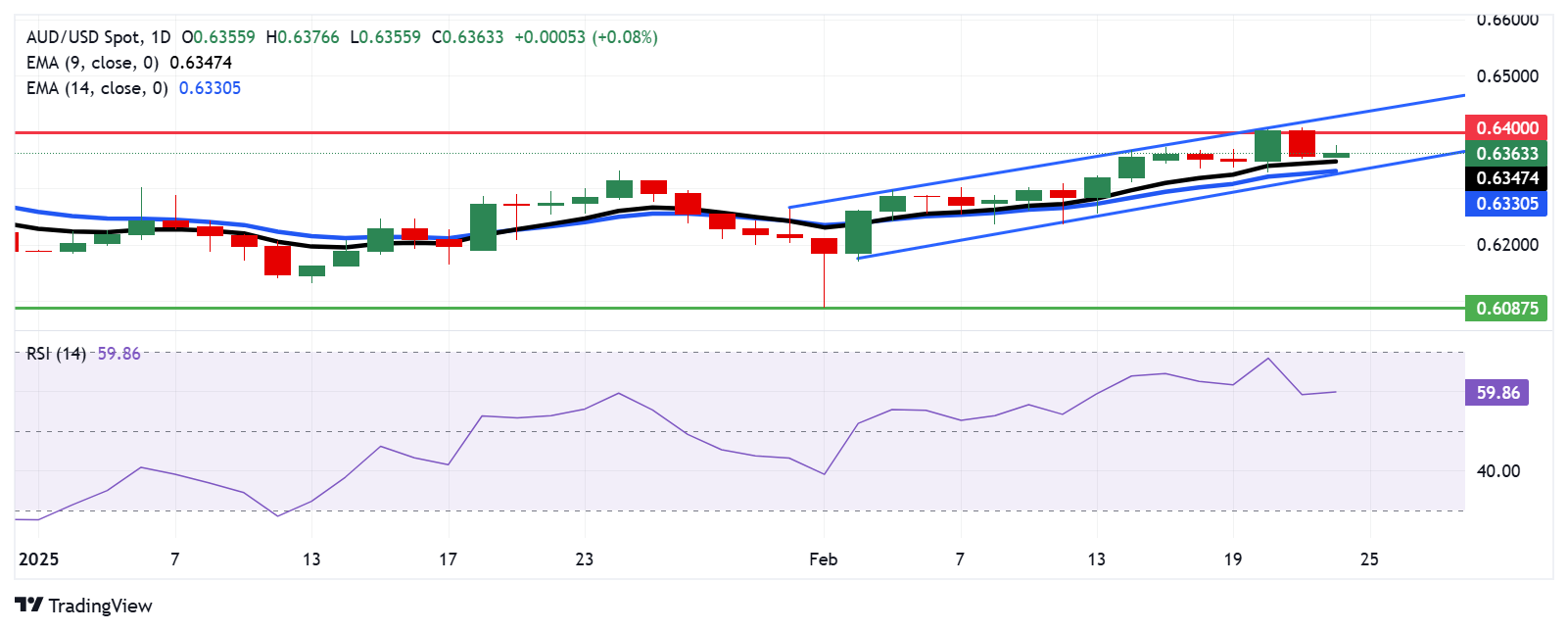
AUD/USD trades near 0.6370 on Monday, moving within an ascending channel that reflects bullish market sentiment. The 14-day Relative Strength Index (RSI) stays above 50, supporting the positive outlook.
On the upside, the AUD/USD pair could challenge the key psychological resistance at 0.6400, with the next hurdle at the ascending channel’s upper boundary around 0.6430.
The AUD/USD pair could find immediate support at the nine-day Exponential Moving Average (EMA) of 0.6347, followed by the 14-day EMA at 0.6330. A stronger support zone aligns with the channel’s lower boundary near 0.6320.
AUD/USD: Daily Chart
Australian Dollar PRICE Today
The table below shows the percentage change of Australian Dollar (AUD) against listed major currencies today. Australian Dollar was the strongest against the Japanese Yen.
| USD | EUR | GBP | JPY | CAD | AUD | NZD | CHF | |
|---|---|---|---|---|---|---|---|---|
| USD | -0.50% | -0.34% | 0.12% | -0.22% | -0.38% | -0.30% | -0.21% | |
| EUR | 0.50% | 0.07% | 0.44% | 0.09% | 0.10% | 0.01% | 0.11% | |
| GBP | 0.34% | -0.07% | 0.44% | 0.02% | 0.04% | -0.05% | 0.05% | |
| JPY | -0.12% | -0.44% | -0.44% | -0.34% | -0.42% | -0.35% | -0.24% | |
| CAD | 0.22% | -0.09% | -0.02% | 0.34% | -0.21% | -0.08% | 0.02% | |
| AUD | 0.38% | -0.10% | -0.04% | 0.42% | 0.21% | -0.09% | 0.00% | |
| NZD | 0.30% | -0.01% | 0.05% | 0.35% | 0.08% | 0.09% | 0.10% | |
| CHF | 0.21% | -0.11% | -0.05% | 0.24% | -0.02% | -0.00% | -0.10% |
The heat map shows percentage changes of major currencies against each other. The base currency is picked from the left column, while the quote currency is picked from the top row. For example, if you pick the Australian Dollar from the left column and move along the horizontal line to the US Dollar, the percentage change displayed in the box will represent AUD (base)/USD (quote).
Interest rates FAQs
Interest rates are charged by financial institutions on loans to borrowers and are paid as interest to savers and depositors. They are influenced by base lending rates, which are set by central banks in response to changes in the economy. Central banks normally have a mandate to ensure price stability, which in most cases means targeting a core inflation rate of around 2%. If inflation falls below target the central bank may cut base lending rates, with a view to stimulating lending and boosting the economy. If inflation rises substantially above 2% it normally results in the central bank raising base lending rates in an attempt to lower inflation.
Higher interest rates generally help strengthen a country’s currency as they make it a more attractive place for global investors to park their money.
Higher interest rates overall weigh on the price of Gold because they increase the opportunity cost of holding Gold instead of investing in an interest-bearing asset or placing cash in the bank. If interest rates are high that usually pushes up the price of the US Dollar (USD), and since Gold is priced in Dollars, this has the effect of lowering the price of Gold.
The Fed funds rate is the overnight rate at which US banks lend to each other. It is the oft-quoted headline rate set by the Federal Reserve at its FOMC meetings. It is set as a range, for example 4.75%-5.00%, though the upper limit (in that case 5.00%) is the quoted figure. Market expectations for future Fed funds rate are tracked by the CME FedWatch tool, which shapes how many financial markets behave in anticipation of future Federal Reserve monetary policy decisions.
Author

Akhtar Faruqui
FXStreet
Akhtar Faruqui is a Forex Analyst based in New Delhi, India. With a keen eye for market trends and a passion for dissecting complex financial dynamics, he is dedicated to delivering accurate and insightful Forex news and analysis.