Australian Dollar rises despite rising odds of further RBA rate cuts, focus on Fedspeak
- The Australian Dollar strengthens as the US Dollar weakens amid concerns over the economic outlook and declining business sentiment.
- Federal Reserve officials highlighted a drop in both business and consumer confidence, partly blaming shifts in US trade policy.
- RBA’s Bullock described the rate cut as a proactive step aimed at bolstering confidence and aligning with the current economic landscape.

The Australian Dollar (AUD) depreciated against the US Dollar (USD) on Wednesday, recovering after registering more than 0.50% losses in the previous session. The AUD/USD pair appreciates as the US Dollar extends its decline, pressured by cautious remarks from Federal Reserve (Fed) officials regarding the economic outlook and business sentiment.
Cleveland Fed President Beth Hammack and San Francisco Fed President Mary C. Daly both voiced rising concerns about the US economy during a panel event organized by the Federal Reserve Bank of Atlanta. Despite the fact that important economic indicators are still strong, both officials noted a decline in consumer and corporate confidence and partially blamed the change in opinion on US trade policies.
On Wednesday, China’s Commerce Ministry stated that US measures on China’s advanced chips are ‘typical of unilateral bullying and protectionism.’ Chinese authorities are looking further into whether the United States is serious about correcting its erroneous practices.
On Tuesday, the Reserve Bank of Australia (RBA) reduced its Official Cash Rate (OCR) by 25 basis points, from 4.1% to 3.85%. Moreover, RBA Governor Michele Bullock expressed confidence in the central bank's rate cut decision. She emphasized the significance of curbing inflation and expressed that a rate cut was a proactive, confidence-boosting move that was suitable given the state of the economy. She also mentioned that the Board is prepared to take additional action if necessary, raising the prospect of future changes.
The AUD was also affected by Australia's political unrest. Following the National Party's withdrawal from its collaboration with the Liberal Party, the opposition coalition disbanded. The ruling Labor Party, meanwhile, took advantage of the unrest and retook power with a more robust and expansive agenda.
Australian Dollar appreciates as US Dollar weakens on economic concerns
- The US Dollar Index (DXY), which tracks the US Dollar (USD) against a basket of six major currencies, is losing ground for the third successive session and trading lower at around 99.90 at the time of writing.
- On Tuesday, Atlanta Fed President Raphael Bostic expanded on remarks he made the previous day. Bostic warned that the inconsistent and shifting tariff policies introduced during the Trump administration risk disrupting US trade logistics, which are heavily dependent on large-scale imports to satisfy domestic demand.
- The US Dollar struggles after Moody’s downgraded the US credit rating from Aaa to Aa1. This move aligns with similar downgrades by Fitch Ratings in 2023 and Standard & Poor’s in 2011. Moody’s now projects US federal debt to climb to around 134% of GDP by 2035, up from 98% in 2023, with the budget deficit expected to widen to nearly 9% of GDP. This deterioration is attributed to rising debt-servicing costs, expanding entitlement programs, and falling tax revenues.
- Economic data released last week pointed to easing inflation, as both the Consumer Price Index (CPI) and Producer Price Index (PPI) signaled a deceleration in price pressures. This has heightened expectations that the Federal Reserve may implement additional rate cuts in 2025, contributing to further weakness in the US Dollar. Additionally, disappointing US Retail Sales figures have deepened concerns over an extended period of sluggish economic growth.
- The PBoC announced a reduction in its Loan Prime Rates (LPRs) on Tuesday. The one-year LPR was lowered from 3.10% to 3.00%, while the five-year LPR was reduced from 3.60% to 3.50%.
- The National Bureau of Statistics (NBS) reported on Monday that China’s Retail Sales rose by 5.1% year-over-year (YoY) in April, falling short of the 5.5% forecast and down from 5.9% in March. Industrial Production grew by 6.1% YoY during the same period, beating the expected 5.5% but slowing from the previous 7.7% growth.
- The risk-sensitive Australian Dollar gained support from renewed optimism surrounding a 90-day US-China trade truce and hopes for further trade deals with other countries. Meanwhile, US Treasury Secretary Scott Bessent told CNN on Sunday that President Donald Trump intends to implement tariffs at previously threatened levels on trading partners that do not engage in negotiations “in good faith.”
- According to the Australian Bureau of Statistics (ABS), employment surged by 89,000 in April, significantly higher than the 36,400 increase in March and far above the forecasted 20,000. Meanwhile, the Unemployment Rate remained unchanged at 4.1%.
Australian Dollar remains below 0.6450, support appears at nine-day EMA
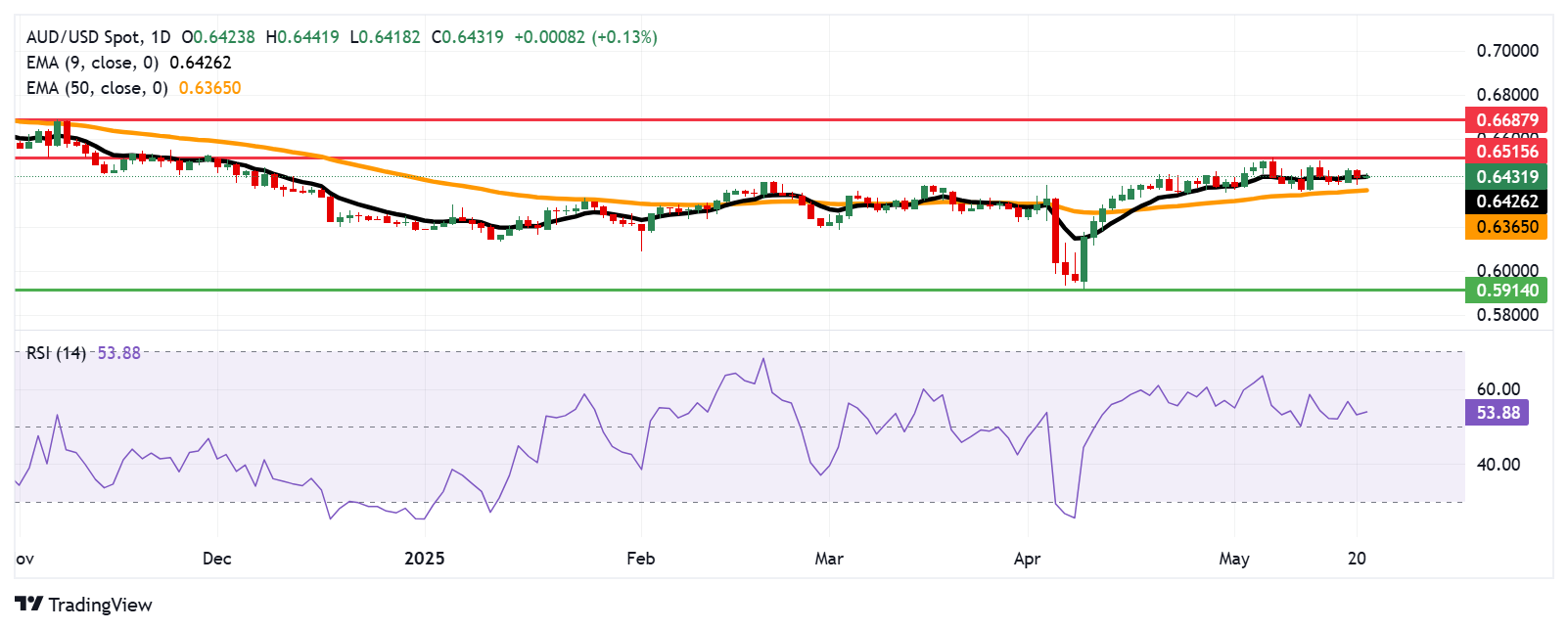
The AUD/USD pair is trading around 0.6450 on Wednesday, with daily technical indicators reflecting a bullish tone. The pair continues to trade above the nine-day Exponential Moving Average (EMA), while the 14-day Relative Strength Index (RSI) remains above the neutral 50 level—both signals supporting sustained upward momentum.
On the upside, immediate resistance is seen at the six-month high of 0.6515, recorded on December 2, 2024. A decisive break above this barrier could pave the way for a test of the seven-month high at 0.6687, which was reached in November 2024.
Initial support lies at the nine-day EMA of 0.6426, followed by the 50-day EMA near 0.6365. A firm move below these levels would undermine the short- to medium-term bullish outlook, possibly opening the path toward the March 2020 low of 0.5914.
AUD/USD: Daily Chart
Australian Dollar PRICE Today
The table below shows the percentage change of Australian Dollar (AUD) against listed major currencies today. Australian Dollar was the strongest against the US Dollar.
| USD | EUR | GBP | JPY | CAD | AUD | NZD | CHF | |
|---|---|---|---|---|---|---|---|---|
| USD | -0.56% | -0.52% | -0.67% | -0.24% | -0.49% | -0.45% | -0.82% | |
| EUR | 0.56% | 0.03% | -0.13% | 0.33% | 0.09% | 0.10% | -0.27% | |
| GBP | 0.52% | -0.03% | -0.17% | 0.28% | 0.07% | 0.08% | -0.32% | |
| JPY | 0.67% | 0.13% | 0.17% | 0.42% | 0.19% | 0.21% | -0.15% | |
| CAD | 0.24% | -0.33% | -0.28% | -0.42% | -0.24% | -0.20% | -0.60% | |
| AUD | 0.49% | -0.09% | -0.07% | -0.19% | 0.24% | 0.02% | -0.34% | |
| NZD | 0.45% | -0.10% | -0.08% | -0.21% | 0.20% | -0.02% | -0.38% | |
| CHF | 0.82% | 0.27% | 0.32% | 0.15% | 0.60% | 0.34% | 0.38% |
The heat map shows percentage changes of major currencies against each other. The base currency is picked from the left column, while the quote currency is picked from the top row. For example, if you pick the Australian Dollar from the left column and move along the horizontal line to the US Dollar, the percentage change displayed in the box will represent AUD (base)/USD (quote).
Australian Dollar FAQs
One of the most significant factors for the Australian Dollar (AUD) is the level of interest rates set by the Reserve Bank of Australia (RBA). Because Australia is a resource-rich country another key driver is the price of its biggest export, Iron Ore. The health of the Chinese economy, its largest trading partner, is a factor, as well as inflation in Australia, its growth rate and Trade Balance. Market sentiment – whether investors are taking on more risky assets (risk-on) or seeking safe-havens (risk-off) – is also a factor, with risk-on positive for AUD.
The Reserve Bank of Australia (RBA) influences the Australian Dollar (AUD) by setting the level of interest rates that Australian banks can lend to each other. This influences the level of interest rates in the economy as a whole. The main goal of the RBA is to maintain a stable inflation rate of 2-3% by adjusting interest rates up or down. Relatively high interest rates compared to other major central banks support the AUD, and the opposite for relatively low. The RBA can also use quantitative easing and tightening to influence credit conditions, with the former AUD-negative and the latter AUD-positive.
China is Australia’s largest trading partner so the health of the Chinese economy is a major influence on the value of the Australian Dollar (AUD). When the Chinese economy is doing well it purchases more raw materials, goods and services from Australia, lifting demand for the AUD, and pushing up its value. The opposite is the case when the Chinese economy is not growing as fast as expected. Positive or negative surprises in Chinese growth data, therefore, often have a direct impact on the Australian Dollar and its pairs.
Iron Ore is Australia’s largest export, accounting for $118 billion a year according to data from 2021, with China as its primary destination. The price of Iron Ore, therefore, can be a driver of the Australian Dollar. Generally, if the price of Iron Ore rises, AUD also goes up, as aggregate demand for the currency increases. The opposite is the case if the price of Iron Ore falls. Higher Iron Ore prices also tend to result in a greater likelihood of a positive Trade Balance for Australia, which is also positive of the AUD.
The Trade Balance, which is the difference between what a country earns from its exports versus what it pays for its imports, is another factor that can influence the value of the Australian Dollar. If Australia produces highly sought after exports, then its currency will gain in value purely from the surplus demand created from foreign buyers seeking to purchase its exports versus what it spends to purchase imports. Therefore, a positive net Trade Balance strengthens the AUD, with the opposite effect if the Trade Balance is negative.
depreciated
Author

Akhtar Faruqui
FXStreet
Akhtar Faruqui is a Forex Analyst based in New Delhi, India. With a keen eye for market trends and a passion for dissecting complex financial dynamics, he is dedicated to delivering accurate and insightful Forex news and analysis.

















