AUDUSD: Recessionary fears in Australia and a hawkish Federal Reserve, to keep AUDUSD pressured
- The American Dollar remains in the driver’s seat, bolstered by the Federal Reserve Chair Jerome Powell.
- Positive US economic data underpinned the US Dollar, though justified the need for further tightening
- The Trade of Balance in Australia capped the AUD losses, though PMIs at recessionary territory weighed on the AUDUSD.
- AUDUSD Price Analysis: A fall below 0.6300 could exacerbate a fall towards 0.6209 ahead of testing the YTD low at 0.6169.

The Aussie Dollar is registering minimal gains as the Asian session kicks in, following a risk-off trading session as market participants assessed the Federal Reserve’s adjustments to its policy rate, saying that Jerome Powell and his colleagues would slow the size of rates increases but will revise up the Federal funds rate (FFR) projections for 2023. Additionally, the United States calendar revealed goodish economic data that weighed on the Australian Dollar. Hence the AUDUSD is trading at 0.6288 at the time of writing.
A dampened sentiment spurred by the Federal Reserve weighed on the AUD, bolstered the USD
Sentiment remains negative, as Wall Street’s ended with losses, while US equity futures prolong the ongoing week’s agony for the stock market. The Federal Reserve’s 75 bps rate hike and Fed Chair Jerome Powell’s hawkish press conference triggered risk aversion, a headwind for the AUD. Data from the US, like the ISM Non-Manufacturing PMI Index for October, confirmed a deceleration of the economy but persisted at expansionary territory at 54.4 vs. 55.5 estimates and 56.7, the previous month’s reading. At the same time, Factory Orders for September remained unchanged at 0.3% MoM, while the Jobless Claims for the week ending on October 28, rose by 217K, lower than the 220K estimated.
Given that economic data was positive for the United States economy, it’s not what the Federal Reserve is expecting, as it’s struggling to curb inflation at around 8% YoY levels, suggesting that the central bank would continue its tightening cycle until demand slows as expected.
The Balance of Trade in Australia registered a surplus, though weak PMIs and poor China data, headwinds for the AUD
Elsewhere, the economic calendar in Australia featured October’s S&P Global Services and Composite PMIs, which came lower than the previous reading, signaling that Australia´s economy is slowing faster than estimates. Also, the Balance of Trade printed a surplus of A$12.44 billion against A$8.85 billion foreseen, putting a lid on the AUDUSD fall on Thursday.
Additional factors, like China’s Caixin Services and Composite PMI, summed to a risk-off impulse, decreasing demand for the Aussie Dollar, as investors seeking safety turned to the US Dollar. The figures came at 48.4 and 48.3, respectively, illustrating that Covid-19 restrictions derailed the Chinese economy, weighing in its largest trading partner, Australia.
On Friday, the Australian economic calendar will feature Retail Sales and the RBA Statement of Monetary Policy (SoMP). On the US front, the US Nonfarm Payrolls report for October is awaited, alongside the Unemployment Rate.
AUDUSD Price Analysis: Technical outlook
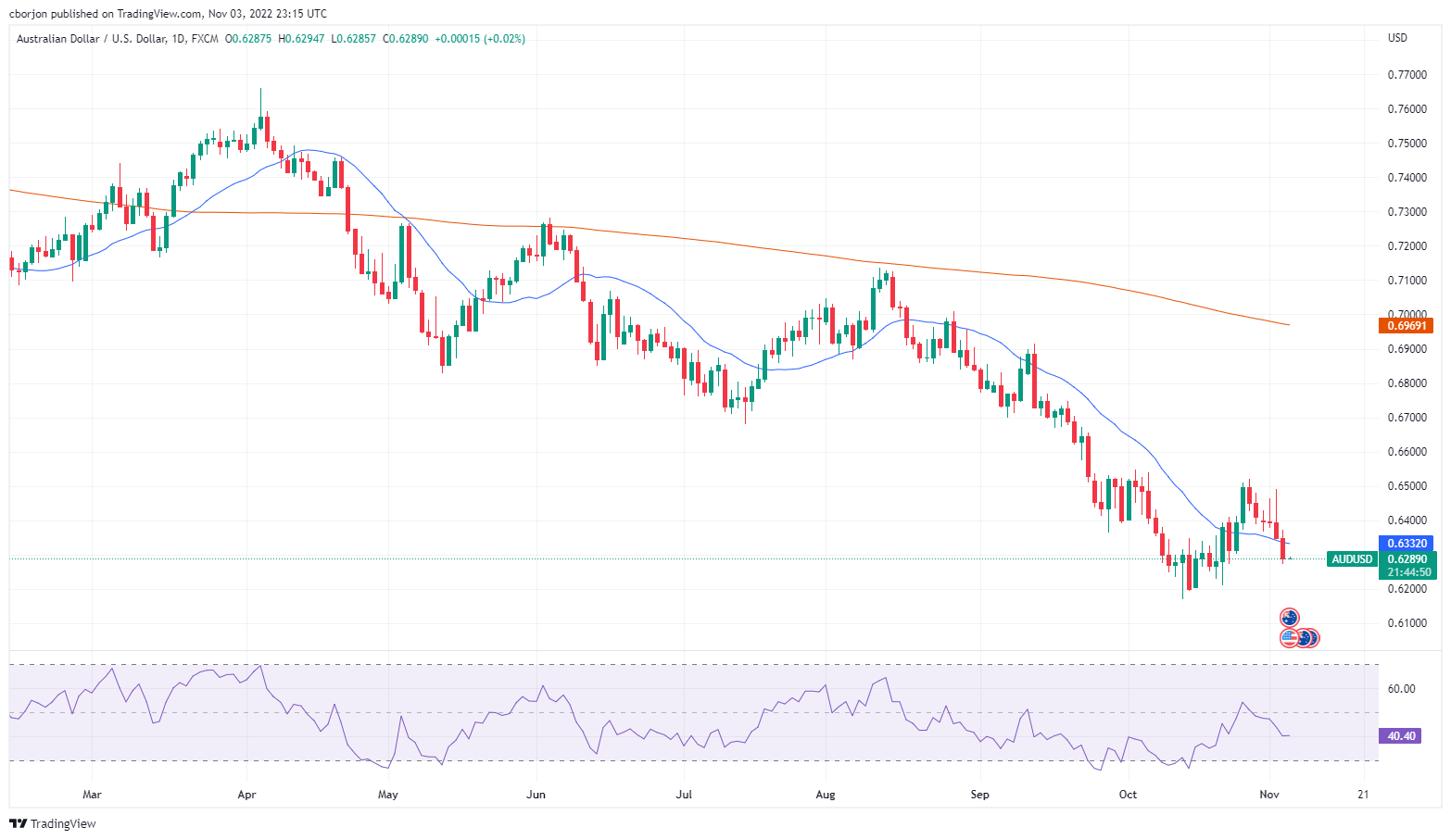
After the Federal Reserve hiked rates on Wednesday, the AUDUSD remains downward biased, per the daily chart. The Fed day left a huge 140-pip candle, shy of testing the 50-day EMA, which pierced the 20-day EMA. But it retreated later in remarks by Federal Reserve Chair Jerome Powell, as the AUDUSD slid below the 20-day EMA as sellers gathered momentum.
That said, the AUDUSD is extending its losses and is eyeing the October 21 swing low at 0.6209, which, once cleared, could pave the way toward the YTD low at 0.6169. Nevertheless, if the AUDUSD reclaims 0.6300, it could climb towards the November 3 high at 0.6371, posing a real threat of challenging the psychological 0.6400.
Author

Christian Borjon Valencia
FXStreet
Markets analyst, news editor, and trading instructor with over 14 years of experience across FX, commodities, US equity indices, and global macro markets.